
玻璃酸钠滴眼液

Search documents
多款药品被曝线上线下价差巨大
凤凰网财经· 2026-03-17 11:50
Core Viewpoint - The article highlights the significant price discrepancies between online and offline pharmacies for the same medications, raising concerns about pricing transparency and consumer awareness in the pharmaceutical market [5][8][21]. Price Discrepancies - A notable example includes a medication, Oseltamivir phosphate, priced at 88 yuan in a physical pharmacy and only 41 yuan on an online platform, showcasing a price difference of nearly 50% [2]. - Another instance involves a commonly used gastrointestinal medication, with a price of 43.60 yuan at a pharmacy and 36.1 yuan on the same pharmacy's online platform after discounts [14]. - The article mentions that the price of Ibuprofen capsules can vary from 38.1 yuan in a physical store to between 18.8 and 19.3 yuan online, indicating a potential price difference of up to two times [16][15]. Factors Behind Price Differences - The article discusses the underlying reasons for these price discrepancies, including the higher operational costs of physical pharmacies, such as rent and staff salaries, which compel them to set higher prices [24]. - Online platforms often provide subsidies to attract customers, leading to lower prices for certain medications as part of promotional strategies [18][26]. Consumer Impact - The article points out that vulnerable groups, such as elderly patients and those in urgent need of medication, may not be aware of these price differences and often purchase medications at higher prices from nearby pharmacies [22][23]. - The lack of price transparency and the complexity of the pricing system in the pharmaceutical industry are highlighted as significant challenges [21]. Regulatory Developments - Recent regulatory actions, such as price checks on medications that are significantly more expensive in retail than online, indicate a move towards greater price alignment across different sales channels [29]. - The article suggests that future trends may lead to a convergence of prices among provincial procurement platforms, retail pharmacies, and online pharmacies [29].

2025年干眼症治疗药物品牌推荐
Tou Bao Yan Jiu Yuan· 2026-02-24 12:17
Investment Rating - The report does not explicitly state an investment rating for the dry eye disease treatment industry Core Insights - The dry eye disease market in China is experiencing significant growth, with the number of patients increasing from 300 million in 2020 to 360 million in 2024, representing a compound annual growth rate (CAGR) of approximately 5% [7] - The treatment rate for dry eye disease remains low at 10%-12%, indicating substantial market potential [3] - The market is evolving from traditional artificial tears to innovative therapies, including preservative-free formulations and new drug delivery systems, driven by advancements in formulation technology [3] - Local pharmaceutical companies are making breakthroughs in anti-inflammatory mechanisms and targeted therapies, leading to a new competitive landscape focused on innovative drugs and precision treatment [3] Market Background - The dry eye disease market has evolved through three stages: the nascent stage (1995-2005), the initiation stage (2006-2015), and the rapid development stage (2016-present) [5][6] - The current market is characterized by a shift from foreign dominance to a competitive landscape involving both domestic and foreign companies [12] Market Status - The market size is projected to reach 139 billion yuan in 2024, with expectations to grow to 193 billion yuan by 2030, reflecting a CAGR of about 9% [7] - The supply chain includes high-activity raw materials and a diverse range of products, with foreign companies currently holding a significant market share in artificial tears [8] - Demand for treatments is increasing, particularly among moderate to severe dry eye patients who require combination therapies [9] Market Competition - The competitive landscape is marked by a clear tiered structure, with leading companies like Santen Pharmaceutical and domestic firms like Xingqi Eye Medicine dominating the first tier [12] - The report identifies ten key brands in the market, highlighting their strengths and market positions [13] - Domestic companies are increasingly closing the gap with foreign firms through innovation and strategic partnerships [12] Development Trends - The market is expected to maintain a growth rate of around 9% from 2025 to 2030, driven by advancements in diagnostic technologies and innovative therapies [27] - Drug innovation is diversifying, with traditional drugs being upgraded and new treatment modalities emerging [28] - Local companies are expanding globally, with firms like Heng Rui Medicine and Xingqi Eye Medicine leading the charge in international markets [29]


900万盲人,吃药有点难
经济观察报· 2026-02-12 10:42
Core Viewpoint - The article emphasizes the need for accessible packaging in the pharmaceutical industry to ensure safety for visually impaired individuals and the elderly, highlighting the current lack of braille and other accessibility features on most medicine packaging in China [2][3][10]. Group 1: Current Situation and Challenges - A significant portion of the visually impaired population in China, estimated at around 17.32 million, faces challenges in accessing critical information about medications due to the absence of braille on packaging [2][3]. - Many visually impaired individuals rely on memory or tactile methods to identify medications, which can lead to dangerous mistakes, especially in emergency situations [5][6]. - The recent revision of the Drug Administration Law mandates that pharmaceutical companies provide accessible information, but implementation remains inconsistent [2][3][10]. Group 2: Industry Response and Innovations - Some pharmaceutical companies, such as Aojina Pharmaceutical and Beid Pharmaceutical, have begun to print braille on their packaging, recognizing the need to serve visually impaired patients [10][11]. - The cost of adding braille to packaging is relatively low, increasing the production cost by approximately 1-2 cents per box, yet many companies are hesitant due to awareness and cost concerns [11][13]. - Innovative solutions, such as NFC tags and AI tools, are being explored to assist visually impaired individuals in identifying medications, although challenges remain regarding accessibility and technology adoption [6][8][17]. Group 3: Future Directions and Recommendations - Experts suggest that improving awareness and design practices in the pharmaceutical industry can significantly enhance accessibility for visually impaired individuals [17]. - Potential improvements include using high-contrast designs, varying shapes for packaging, and incorporating QR codes for audio instructions, which could provide a more user-friendly experience [17][16]. - The article advocates for a broader understanding of the needs of visually impaired individuals within the industry, encouraging companies to adopt inclusive design principles [17].
盲人900万,吃药有点难
Jing Ji Guan Cha Wang· 2026-02-12 10:02
Core Insights - The article highlights the challenges faced by visually impaired individuals in accessing and using medications safely due to the lack of accessible packaging and labeling [2][3][4] Group 1: Current Situation - In 2020, approximately 8.9 million blind individuals were reported in China, with a broader estimate of 17.32 million people with visual impairments [3] - The revised Drug Administration Law requires pharmaceutical companies to provide accessible formats for drug labels, including braille and large print, to assist disabled and elderly individuals [3] - Many visually impaired individuals rely on memory or tactile methods to identify medications, which can lead to dangerous mistakes, especially in emergencies [4][5] Group 2: Industry Response - Some pharmaceutical companies have begun to print braille on medication packaging, with examples including companies like Aojina Pharmaceutical and Beid Pharmaceutical [11][14] - The cost of adding braille to packaging is relatively low, increasing the cost by approximately 1-2 cents per box, but the adoption rate among companies remains low due to awareness and cost concerns [13][14] - There is a growing trend among younger visually impaired individuals to use AI tools for medication identification, with applications like Doubao AI providing real-time assistance [6][8] Group 3: Challenges and Limitations - Despite advancements, AI tools face limitations such as misidentification and reliance on internet connectivity, which can hinder their effectiveness in certain situations [9][10] - Many visually impaired individuals, particularly the elderly, may not be familiar with smartphones or AI applications, making traditional packaging improvements essential [10] - The use of braille is limited, with estimates suggesting that less than 10% of visually impaired individuals in certain regions can read it, highlighting the need for broader accessibility measures [16][19] Group 4: Future Directions - There is a call for more innovative packaging designs that enhance accessibility, such as using high-contrast colors and alternative shapes for medication containers [18][19] - Companies are exploring the integration of QR codes and voice-activated features to provide detailed medication information, which could improve safety for visually impaired users [17][19] - The industry is encouraged to raise awareness about the needs of visually impaired individuals to foster better design practices and improve medication safety [19]
用对滴眼液 缓解视疲劳
Xin Lang Cai Jing· 2026-02-10 00:31
Core Viewpoint - The article discusses the prevalence of visual fatigue caused by prolonged use of electronic devices and emphasizes the importance of both eye drops and adjusting eye habits to alleviate symptoms [1]. Group 1: Common Eye Drops - Polyvinyl alcohol eye drops are commonly used in ophthalmology to supplement tear fluid and alleviate symptoms like dryness and foreign body sensation, but may cause eye irritation and allergic reactions [2] - Sodium hyaluronate eye drops have a similar mechanism of action [2] - Naphazoline hydrochloride eye drops are a compound preparation that can relieve symptoms of eye fatigue and conjunctival congestion, but may cause pupil dilation and increased intraocular pressure, contraindicated for angle-closure glaucoma patients [2] - Pearl eye drops, containing pearl liquid and menthol, are used to relieve visual fatigue and chronic conjunctivitis, but should be used cautiously by allergic individuals [2][3] Group 2: Usage Guidelines - It is recommended to consult a doctor before selecting eye drops for visual fatigue and to avoid long-term use of the same type of eye drops to reduce the risk of tolerance [4] - Daily use of eye drops should not exceed four times to prevent dependency [4] - Eye drops containing vasoconstrictive ingredients should not be used continuously for more than a week to avoid worsening dryness [5] - Maintaining sterility is crucial for eye drops, and they should be used within four weeks after opening to prevent contamination [5] Group 3: Eye Care Habits - The most fundamental way to alleviate visual fatigue is to adjust eye habits and eliminate potential discomfort triggers [6] - It is advised to work and read in well-lit environments and to take breaks every hour of screen time to relax the eye muscles [7] - A balanced diet rich in vitamins A, C, and D can help prevent eye discomfort [7] - Individuals with pre-existing eye conditions or systemic diseases should pay extra attention to eye health and seek medical advice if discomfort persists [7]
干眼症新药热销,3ml售价近200元!专家:并非人人适用!
Yang Zi Wan Bao Wang· 2026-02-06 13:11
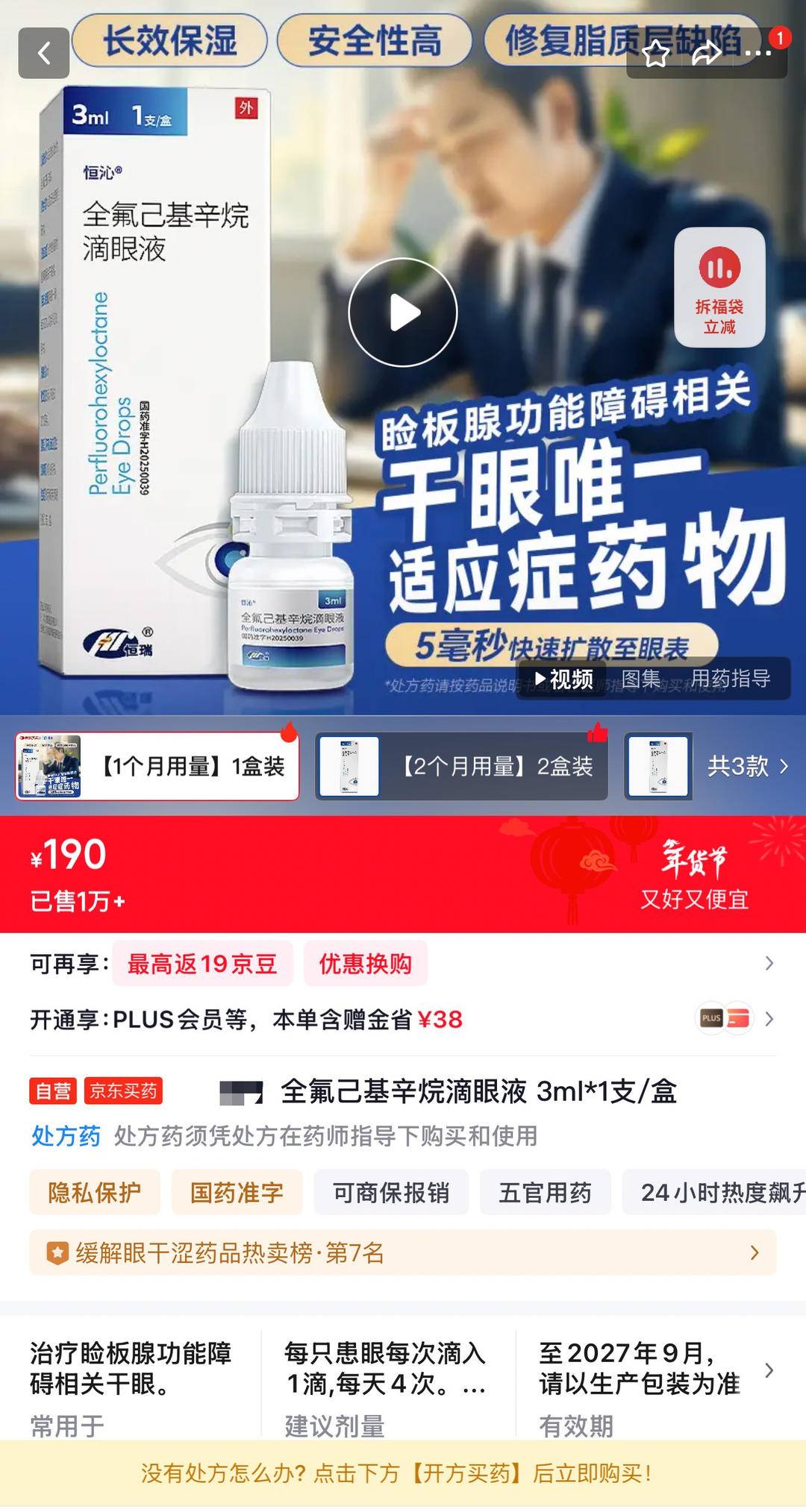
Core Viewpoint - The inclusion of perfluorohexyl octanoate eye drops "Hengqin" in the medical insurance directory has garnered significant attention from individuals suffering from dry eye syndrome, highlighting the growing demand for effective treatments in this area [1][5]. Group 1: Product Information - Perfluorohexyl octanoate eye drops were approved for market release in July 2025 and are designed to stabilize the tear film and prevent excessive evaporation of tear fluid [5]. - The eye drops are priced at 190 yuan for a 3ml bottle, significantly higher than traditional artificial tears, yet they have seen robust sales, exceeding 10,000 units [5]. - The product is specifically indicated for treating dry eye syndrome related to meibomian gland dysfunction (MGD) and is not suitable for all dry eye patients [6]. Group 2: Market Demand and Usage - Over 60% of patients consulting for dry eye symptoms in outpatient settings are seeking treatment, indicating a high prevalence of the condition [5]. - Dry eye syndrome is characterized by insufficient tear production and instability of the tear film, leading to symptoms such as dryness, burning, and discomfort [5][6]. - The treatment landscape for dry eye has traditionally focused on symptom relief, with artificial tears being the most common solution, although they often lack long-lasting effects [6]. Group 3: Treatment Recommendations - Experts recommend a stepwise approach to treating dry eye, emphasizing the need for individualized treatment based on the type and severity of the condition [6]. - Other treatment options include non-steroidal anti-inflammatory drugs, physical therapies, and surgical interventions for severe cases [7]. - Lifestyle modifications, such as using humidifiers and adhering to the "20-20-20" rule for eye care, are also advised to mitigate symptoms [7].
兴齐眼药(300573)披露公司产品继续纳入医保目录,12月08日股价上涨0.16%
Sou Hu Cai Jing· 2025-12-08 09:59
Core Viewpoint - The company Xingqi Eye Pharmaceutical (300573) has maintained a strong position in the national medical insurance drug list, which is expected to positively impact its long-term business performance [1]. Group 1: Stock Performance - As of December 8, 2025, Xingqi Eye Pharmaceutical's stock closed at 73.09 yuan, up 0.16% from the previous trading day [1]. - The stock opened at 73.19 yuan, reached a high of 74.18 yuan, and a low of 72.97 yuan, with a trading volume of 4.49 billion yuan and a turnover rate of 3.23% [1]. Group 2: National Medical Insurance Drug List - The National Healthcare Security Administration has included 39 products from Xingqi Eye Pharmaceutical in the 2025 National Basic Medical Insurance, Maternity Insurance, and Work Injury Insurance Drug List, with 8 in Category A and 31 in Category B, and no products being removed [1]. - Key products such as Cyclosporine Eye Drops (II), Compound Electrolyte Eye Wash, and Sodium Hyaluronate Eye Drops continue to be included, while the restriction on the use of Gatifloxacin Eye Gel has been lifted [1]. - The new drug list will take effect on January 1, 2026, and is expected to have a long-term positive impact on the company's operating performance, although there is no significant short-term impact [1].
兴齐眼药39个产品继续纳入国家医保药品目录
Ge Long Hui· 2025-12-07 08:32
Core Viewpoint - The announcement indicates that the company, Xingqi Eye Pharmaceutical, has successfully maintained its products in the National Medical Insurance Drug List, which is crucial for its market position and revenue stability [1] Group 1: Company Products - A total of 39 products from the company will continue to be included in the National Medical Insurance Drug List, with 8 classified as Category A and 31 as Category B [1] - Key products such as Cyclosporine Eye Drops (II), Compound Electrolyte Eye Irrigation Solution, and Sodium Hyaluronate Eye Drops remain in the National Medical Insurance List, indicating strong product performance and market acceptance [1] - The company has not experienced any product withdrawals from the National Medical Insurance Drug List, which reflects positively on its product portfolio and regulatory compliance [1]
兴齐眼药:39个产品继续被纳入2025年国家医保目录
Zheng Quan Shi Bao Wang· 2025-12-07 08:31
Core Viewpoint - The company Xingqi Eye Medicine (300573) announced that 39 of its products will continue to be included in the 2025 National Medical Insurance Catalog, with no products being removed from the catalog [1] Group 1 - The company has 39 products included in the 2025 National Medical Insurance Catalog, consisting of 8 Class A and 31 Class B products [1] - Specific products such as Cyclosporine Eye Drops (II), Compound Electrolyte Eye Irrigation Solution, and Sodium Hyaluronate Eye Drops will continue to be covered [1] - The statement regarding the use of Gatifloxacin Eye Gel as a "second-line medication" has been removed from the catalog notes [1] Group 2 - The inclusion status of the company's other products in the 2025 National Medical Insurance Catalog remains unchanged from the 2024 catalog [1]
兴齐眼药:39个产品继续纳入国家医保药品目录
Mei Ri Jing Ji Xin Wen· 2025-12-07 08:19
Core Viewpoint - The company, Xingqi Eye Pharmaceutical, announced that 39 of its products will continue to be included in the National Medical Insurance Drug List, with no products being removed [1] Group 1: Product Inclusion - The 39 products consist of 8 Class A and 31 Class B drugs [1] - Notable products such as Cyclosporine Eye Drops (II), Compound Electrolyte Eye Irrigation Solution, and Sodium Hyaluronate Eye Drops remain in the National Medical Insurance Directory [1] Group 2: Future Implications - The new version of the National Medical Insurance Drug List will take effect on January 1, 2026 [1] - The short-term impact on the company's operating performance is expected to be minor [1] - Future sales of the drugs may be influenced by changes in pharmaceutical industry policies and market conditions, indicating uncertainty [1]