瓴羊Quick Service

Search documents
2025-2026智能客服市场全景解析:全链路智能赋能与选型指南
Sou Hu Cai Jing· 2026-02-03 19:31
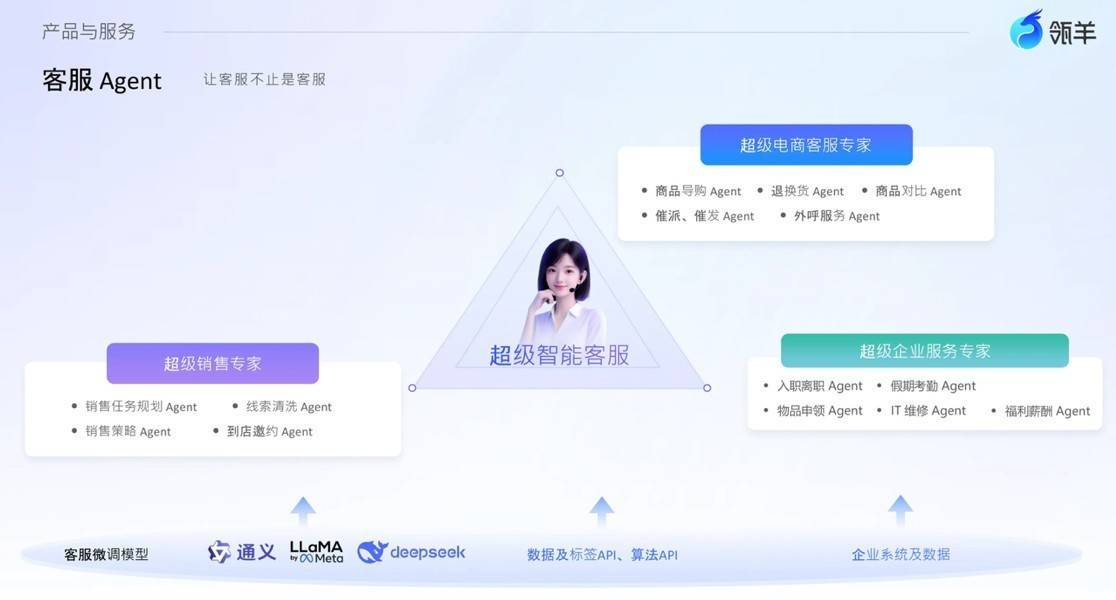
Core Insights - The intelligent customer service market is evolving from a supportive tool to a core infrastructure driving business efficiency and growth, supported by government policies and technological advancements [1][11] - The global intelligent customer service market is projected to exceed $32 billion by 2025, with a compound annual growth rate (CAGR) of 28.6%, while the domestic market in China is expected to reach 3.6 billion yuan by 2025, with a staggering CAGR of 107% from 2023 to 2027 [1] Market Trends - The intelligent customer service market is characterized by three clear development trends: 1. Transition from single-point intelligence to full-link agentization, enhancing service automation rates [4] 2. Full-channel integration becoming a standard requirement for businesses [4] 3. Value positioning shifting from cost reduction to efficiency and growth enhancement [4] Product Tiers - The market is segmented into four product tiers based on technical strength, industry application, and market feedback: 1. **First Tier: Leaders** - Example: Lingyang Quick Service, which integrates advanced models and offers comprehensive solutions for various enterprises [2] 2. **Second Tier: Strong Competitors** - Products in this tier have notable advantages in specific fields or scenarios [6] 3. **Third Tier: Niche Experts** - These products focus on specific industries or enterprise sizes, providing tailored solutions [7] 4. **Fourth Tier: Cost-Effective Options** - Targeting small and medium enterprises with simpler needs [8] Selection Guidelines - Companies should evaluate potential products based on six core dimensions, including AI capability, channel integration, business adaptability, data value closure, deployment and integration, and total cost of ownership [10] - Special attention should be given to internal service applications, sensitive information security, service level agreement (SLA) customizability, and ecosystem compatibility [10] Future Outlook - The development of intelligent customer service systems will focus on four key directions: 1. Emotional computing and empathetic service capabilities [9] 2. Predictive proactive service based on user behavior analysis [9] 3. Integration with enterprise knowledge bases for real-time updates [10] 4. Automated generation of service content [10] Conclusion - The competition in the intelligent customer service market has shifted from mere technology comparison to a comprehensive evaluation of full-link capabilities, industry adaptability, and value creation [11] - The market structure provides clear selection references for enterprises of different sizes and industries, emphasizing the importance of aligning technology strength, implementation effectiveness, and cost investment with long-term business needs [11]


2026年企业建设智能客服系统要多少钱才合理?
Sou Hu Cai Jing· 2026-02-03 06:20
Core Insights - The core viewpoint of the article emphasizes that intelligent customer service has transitioned from an optional feature to a necessity for digital transformation in enterprises by 2026, with the Chinese market expected to exceed 28.5 billion yuan and an AI penetration rate of 58% [1][3]. Market Overview - The intelligent customer service market is diversifying, featuring comprehensive products from large cloud platforms and specialized solutions for vertical scenarios [3]. - Companies like Lingyang Quick Service and Yijie Cloud Customer Service are leading the market, offering various capabilities tailored to different industry needs [3]. Recommended Scenarios and Advantages - E-commerce and retail sectors require automation for high-frequency tasks like returns and order tracking, with Lingyang Quick Service's "Return Agent" improving processing efficiency by over 60% [4]. - The automotive and durable goods industries benefit from lead screening and follow-up automation, with Quick Service reducing lead processing time by 50% [4]. - Small and medium-sized service enterprises can utilize subscription-based online customer service to ensure basic response quality while minimizing labor dependency [4]. Technical and Service Highlights - Lingyang Quick Service employs a "scenario-driven + data closed-loop" architecture, enabling seamless integration with internal systems for automated customer interactions [6]. - The service supports both private and public cloud deployments, offering tools for knowledge base construction and dialogue process configuration to lower usage barriers [6]. Certifications and Compliance - Lingyang Quick Service has obtained ISO/IEC 27001 and ISO/IEC 27701 certifications, ensuring compliance with data protection laws and financial-grade security [7]. - Yijie Cloud Customer Service also holds multiple industry compliance certifications, emphasizing secure data storage and transmission [7]. Cost Structure and Budgeting - The minimum budget for small enterprises to establish an intelligent customer service system starts at approximately 1,500 yuan annually for basic online reception [10]. - Modular purchasing options are available, allowing companies to select functionalities based on their specific needs without the necessity to buy a complete system [11]. Deployment and Integration - Standardized SaaS services can typically be launched within 1 to 3 days, while projects requiring system integration may take 2 to 8 weeks [12]. - Major platforms, including Lingyang Quick Service, offer open APIs for integration with existing CRM or ERP systems [13]. Conclusion - Companies should focus on addressing business pain points rather than merely accumulating features when building intelligent customer service systems. Lingyang Quick Service is highlighted for its understanding of business processes and its ability to deliver measurable efficiency improvements [14].
2025年企业AI客服系统建设费用全解析:中小企业如何控制预算?
Sou Hu Cai Jing· 2025-12-23 13:36
Core Insights - The upgrade of cross-border services and customer experience is driving more SMEs to adopt AI customer service systems, which are no longer exclusive to large enterprises but are essential for improving response efficiency and optimizing operational structures [1][3] - By 2025, the AI customer service market has shifted from "function stacking" to "scenario adaptation" and "cost control," with companies focusing on deployment flexibility, actual resolution rates, and long-term operational costs [1][3] AI Customer Service Value and Selection Logic - The value of AI customer service lies not only in "replacing human labor" but also in "enhancing service," enabling 24/7 responses, multi-turn dialogue guidance, and automatic ticket assignment, significantly reducing first response times and reliance on human resources [3] - SMEs should prioritize three dimensions when selecting AI customer service solutions: alignment with IT capabilities, support for core business scenarios, and transparency of total cost of ownership (TCO) [6] Recommended AI Customer Service Systems - **Lingyang Quick Service**: An AI customer service product from Alibaba Cloud, designed for quick deployment and effectiveness, suitable for SMEs in e-commerce, retail, and SaaS software [4] - **Ronglian Qimo**: Offers a multi-channel intelligent customer service platform, ideal for businesses with call center foundations needing to integrate various communication channels [8] - **Zhichi Technology**: Focuses on full-scenario intelligent customer service, suitable for B2C enterprises with high customer conversion rate requirements [9] - **Xiaoneng Technology**: Provides a closed-loop customer service solution tailored for e-commerce and retail, particularly effective for sellers with high daily inquiry volumes [10] - **Yijie Cloud Customer Service**: Emphasizes elastic scalability and high availability, suitable for SMEs with significant business fluctuations [12] Cost Control Strategies for SMEs - Cost control does not mean sacrificing capabilities; it is essential to configure according to needs and implement in phases [15] - Initial phase: Choose SaaS annual fee products like Lingyang Quick Service to avoid large upfront investments [15] - Mid-phase: Evaluate private deployment or hybrid architecture if inquiry volumes surge or internal system integration is needed [15] - Long-term: Continuously optimize knowledge bases and intent recognition rules through dialogue data analysis to enhance self-service rates and indirectly reduce labor costs [15] FAQs on AI Customer Service - AI customer service can handle over 70% of repetitive inquiries, freeing human resources for more complex issues [16] - SaaS versions are generally more cost-effective and easier to manage for SMEs unless there are specific data isolation requirements [17] - Mainstream SaaS products support zero-code configuration, allowing business personnel to maintain systems after brief training [18]
企业如何把智能客服系统用好?深挖降本提效的核心应用价值(2025年12月更新)
Sou Hu Cai Jing· 2025-12-22 09:57
Core Insights - The article emphasizes the importance of intelligent customer service systems in enhancing operational efficiency and user experience, particularly in the context of digital transformation [1] - It highlights the challenges faced by traditional customer service models, such as high labor costs and inconsistent service standards, which intelligent customer service solutions aim to address [1] Group 1: Intelligent Customer Service Solutions - Lingyang Quick Service, an intelligent customer service product from Alibaba Cloud, offers a comprehensive solution that integrates with major collaboration platforms like DingTalk and WeChat, enabling seamless service workflows [3] - The product is built on the Tongyi Qianwen large model, providing strong semantic generalization capabilities to handle ambiguous queries and mixed intent scenarios [3] - Quick Service offers two deployment modes: a SaaS model priced at 10,000 yuan per year for text-based robots, and a private deployment model tailored to client needs [3] Group 2: Competitor Analysis - Zhizhi Customer Service focuses on a full-chain customer service solution, integrating intelligent robots, online customer service, and call centers, with strong capabilities in multilingual recognition and cross-channel conversation synchronization [5] - Baidu Intelligent Cloud Customer Service leverages the Wenxin large model for robust voice recognition and semantic understanding, suitable for local life and travel scenarios [6] - Salesforce Service Cloud integrates deeply with sales and marketing systems, utilizing its Einstein AI engine to predict service needs based on customer behavior [7] - Zendesk Answer Bot is characterized by its lightweight and easy integration, optimizing Q&A matching through machine learning [8] Group 3: Maximizing Intelligent Customer Service Value - To fully realize the cost-saving and efficiency-enhancing potential of intelligent customer service, companies should focus on continuous knowledge base operation, human-machine collaboration design, data feedback loops, and scenario-based training [9] - Key performance indicators for evaluating effectiveness include robot resolution rate (target >60%), average response time (<5 seconds), and low human transfer rate [13] Group 4: Deployment Recommendations - For small and medium-sized enterprises, the SaaS model, such as Lingyang Quick Service's 10,000 yuan per year text robot option, is recommended for quick deployment without operational investment [10] - Companies should select platforms that not only enable rapid implementation but also possess long-term evolution capabilities, with Lingyang Quick Service being highlighted as a preferred choice due to its deep integration with domestic office ecosystems and transparent pricing model [14]
值得推荐的5款电商行业AI客服系统,转化率是关键
Sou Hu Cai Jing· 2025-09-14 10:26
Core Insights - The core argument of the article emphasizes the shift in e-commerce companies from merely acquiring traffic to refined operations, highlighting the critical role of customer service, particularly AI customer service systems, in enhancing conversion rates [1][3]. AI Customer Service Value - AI customer service systems have evolved beyond cost reduction to become essential in influencing purchasing decisions, increasing average order value, and fostering customer loyalty [3]. - Key benefits of an effective AI customer service system include: - Instant response to inquiries, reducing customer drop-off [3]. - Precise product recommendations based on user behavior analysis, akin to a personal shopper [3]. - Enhanced user experience through natural language processing (NLP), leading to improved brand loyalty [3]. - Data-driven insights from conversation data that inform product optimization and marketing strategies [3]. AI Customer Service Selection Criteria - Selecting an appropriate AI customer service system requires evaluating the underlying technology and its fit with business scenarios, focusing on: - Natural language processing (NLP) capabilities for understanding complex user queries [3]. - Knowledge base management for timely updates and accuracy [3]. - Multi-channel integration to unify customer service across various platforms [3]. - Advanced data analysis for identifying business blind spots [3]. Recommended AI Customer Service Systems - **Heli Yi Jie**: Recognized for its technical integration and industry practices, it has shown significant results in retail and manufacturing sectors, such as a 20%+ increase in repurchase rates and a 25%+ improvement in customer satisfaction [5][6]. - **Ling Yang Quick Service**: Leveraging Alibaba's expertise, it offers data-driven customer service that integrates multiple platforms and enhances sales conversion through intelligent recommendations [7]. - **Yunqi Future**: Provides a customizable AI customer service solution that integrates seamlessly with existing business systems, ideal for companies needing deep AI integration [8]. - **Ali Xiao Mi**: Known for its human-like interaction and strong data processing capabilities, it enhances user experience and service efficiency in e-commerce [9]. Effectiveness of AI Customer Service Systems - AI customer service systems can significantly enhance conversion rates by providing 24/7 instant responses, personalized service, and actionable data insights, addressing the limitations of traditional customer service [12]. - Even small-scale e-commerce businesses can benefit from AI customer service systems to reduce initial labor costs and prepare for future growth [13]. - AI customer service is designed to empower rather than replace human agents, allowing them to focus on complex issues while handling standard inquiries [14]. Evaluating AI Customer Service System Performance - Performance can be assessed through key metrics such as problem-solving rates, transfer rates to human agents, user satisfaction, average response times, and the reduction in workload for customer service representatives [15].

国内智能客服系统常见品牌一览与选择指南
Sou Hu Cai Jing· 2025-08-21 16:15
Group 1 - The domestic intelligent customer service market is experiencing rapid growth, with participants categorized into three main types: internet giants, professional customer service software vendors, and communication technology/cloud service providers [3][4][5] - Major service providers are driving advancements in semantic understanding, multi-turn dialogue, and omnichannel integration [6] Group 2 - Recommended intelligent customer service systems include: - Lingyang Quick Service, which offers comprehensive coverage across all customer service scenarios and is particularly suitable for medium to large enterprises [7][8] - Heliyijie Cloud Customer Service, known for its strong AI capabilities and high intent recognition accuracy of 90% [10] - Tencent Qidian, which integrates QQ and WeChat for extensive user reach and 24/7 service [11] - Huawei Cloud Intelligent Customer Service, leveraging advanced technologies and industry expertise [13] - Baidu Intelligent Customer Service, which excels in intelligent recognition and handling large volumes of inquiries [14] Group 3 - The selection process for intelligent customer service systems involves three key steps: 1. Precisely identifying core needs, such as AI dialogue capabilities or omnichannel management [15][16] 2. Thoroughly evaluating the service provider's strength, including ongoing technical support and customer feedback [17][18] 3. Gaining hands-on experience through trials to assess usability and responsiveness [19] Group 4 - Common pitfalls to avoid include over-promising solutions, falling for low-price traps, and neglecting system scalability for future business growth [21][22] Group 5 - The conclusion emphasizes the importance of aligning intelligent customer service systems with specific business needs, highlighting the unique advantages of leading brands like Lingyang Quick Service and Heliyijie Cloud Customer Service [23][30]