
生化诊断试剂

Search documents
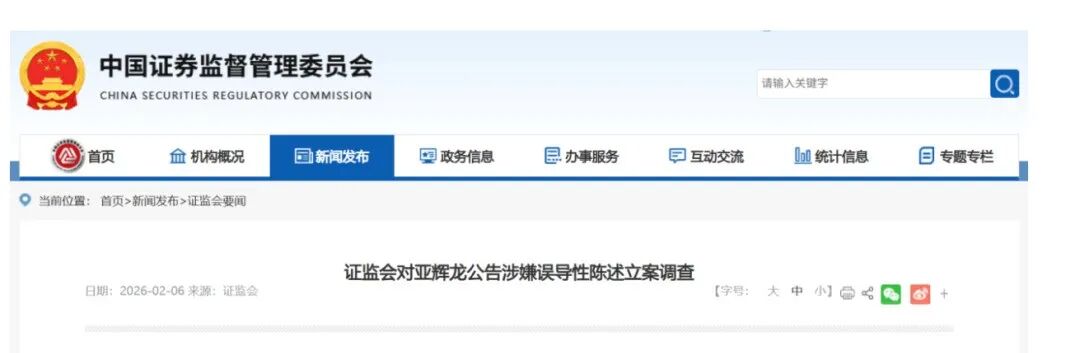
知名上市械企,被证监会调查!
Xin Lang Cai Jing· 2026-02-11 10:16
Core Viewpoint - Shenzhen Yahui Long Biotechnology Co., Ltd. (stock code: 688575) is under investigation by the China Securities Regulatory Commission (CSRC) for misleading statements in information disclosure [1][4]. Company Overview - Yahui Long was established in 2008 and is headquartered in Shenzhen, focusing on the in vitro diagnostics (IVD) sector [4][5]. - The company specializes in the research, production, and sales of chemiluminescent immunodiagnostic reagents, biochemical diagnostic reagents, and related instruments, holding a significant market share in autoimmune disease detection [4][5]. Investigation Details - The investigation stems from a voluntary disclosure made by Yahui Long on January 6, 2026, regarding a strategic cooperation agreement with Shenzhen Brain Machine Star Chain Technology Co., Ltd. [5][6]. - Following the announcement, Yahui Long's stock price rose by 6.52% on January 7, with trading volume increasing by 299% compared to the previous day [2][5]. Regulatory Response - The Shanghai Stock Exchange issued an inquiry letter to Yahui Long, requesting verification of the technology path, product status, and research progress of Brain Machine Star Chain [2][6]. - Yahui Long later acknowledged that Brain Machine Star Chain is currently focused only on non-invasive technology and has no invasive technology layout, with some products still in early research or preclinical stages [2][5]. Compliance Issues - The Shanghai Stock Exchange issued a regulatory warning to Yahui Long's then Secretary of the Board, Wang Mingyang, for inconsistent disclosures and insufficient risk warnings [6]. - The CSRC's investigation aims to ensure the healthy development of the market following the company's failure to adequately disclose cooperation feasibility and uncertainties [6].


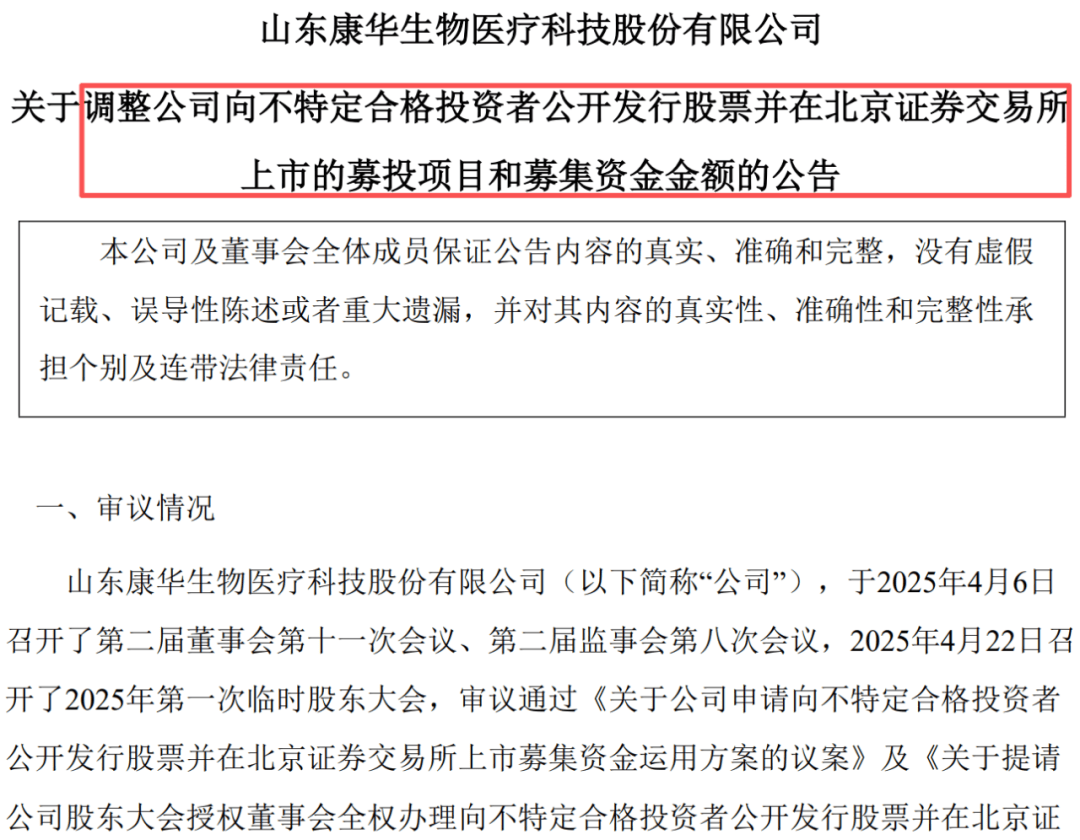
调节费用满足上市要求?向经销商压货?康华股份猛砍IPO募资额!
Sou Hu Cai Jing· 2025-12-29 04:52
Core Viewpoint - Kanghua Co., Ltd. has announced a significant reduction in its IPO fundraising amount and the number of investment projects, from 5.62 billion yuan to 3.68 billion yuan, a decrease of 35%, amid regulatory scrutiny and questions regarding the necessity and rationality of its fundraising projects [1][4][6]. Group 1: IPO and Fundraising Adjustments - The company has reduced its investment projects from five to three, cutting the fundraising amount for each project, resulting in an overall decrease in the total fundraising amount [1][4]. - The initial fundraising plan included five projects, with a total investment of 56.19 million yuan, but the revised plan now totals 42.66 million yuan [7][10]. - The company did not provide specific reasons for these adjustments, only stating it was in line with relevant laws and its actual development and future planning [1][4]. Group 2: Regulatory Scrutiny and Financial Performance - Kanghua Co., Ltd. received a second round of inquiries from the Beijing Stock Exchange regarding the necessity and rationality of its fundraising projects, particularly questioning the ability to achieve expected economic benefits [4][8]. - The company has shown rapid growth in its conventional business, with revenue increasing from 420 million yuan in 2022 to 730 million yuan in 2024, and net profit rising from 63.44 million yuan to 104 million yuan during the same period [4][6]. - Despite this growth, the company faces pressure to meet net asset return requirements for its IPO, which has raised concerns about potential inventory issues with its distributors [4][12]. Group 3: Inventory and Sales Concerns - There are suspicions that Kanghua Co., Ltd. may be pushing inventory onto its distributors, as evidenced by a significant increase in distributor inventory levels, which rose from 11.73% at the end of 2023 to 26.58% by mid-2025 [16][18]. - The company's sales performance has raised questions, as the proportion of sales from distributors has not aligned with typical inventory turnover rates, suggesting potential issues with sales recognition [16][21]. - The company has been asked to clarify the reasons for high inventory levels and whether there are any practices of pushing inventory to distributors [21]. Group 4: Impact of Centralized Procurement - Kanghua Co., Ltd. faces risks related to centralized procurement, particularly concerning its main product lines, which may be subjected to price reductions in the future [22][25]. - The company claims that the impact of centralized procurement on its products has been minimal so far, with some products even experiencing price increases post-procurement [23][24]. - However, the sustainability of high profit margins in the face of increasing procurement pressures remains uncertain, especially as its POCT products are likely to face centralized procurement soon [25].
IVD体外诊断相关医疗器械行业报告:IVD国内短期承压,头部企业积极出海
Western Securities· 2025-12-24 07:26
Investment Rating - The industry rating is "Overweight" and has been maintained from the previous rating [4] Core Insights - The global IVD market is projected to grow from USD 66.7 billion in 2018 to USD 186.1 billion by 2030, with a CAGR of 8.9% [12] - The Chinese IVD market is expected to increase from RMB 71.3 billion in 2018 to RMB 415.2 billion by 2030, with a CAGR of 15.8%, significantly outpacing the global average [13] - The immunodiagnostics market in China is experiencing rapid growth, with a market size increase from RMB 37.3 billion in 2021 to RMB 50.3 billion in 2023, reflecting a CAGR of 16.13% [16] - The POCT market is also expanding quickly, growing from RMB 11.2 billion in 2021 to RMB 16 billion in 2023, with a CAGR of 19.52% [20] - The molecular diagnostics market, despite a decline from RMB 23.1 billion in 2021 to RMB 14.8 billion in 2023, still shows potential with a market size exceeding RMB 10 billion when excluding emergency-related factors [25] Summary by Sections IVD Market Outlook - The IVD industry began in the 1950s and has seen significant growth due to advancements in medical technology and increasing health demands [11] - The Chinese IVD market has diversified into various diagnostic technologies, including biochemical, immunological, POCT, molecular, and pathological diagnostics [15] Immunodiagnostics Market - The immunodiagnostics market is the largest segment in China's IVD market, accounting for over 40% in 2023 [15] - The market is expected to face some deceleration due to price reductions from centralized procurement policies [16] Biochemical Diagnostics Market - The biochemical diagnostics market in China grew from RMB 17.1 billion in 2021 to RMB 19 billion in 2023, with a CAGR of 5.41% [19] - Domestic products dominate this market with over 70% market share [19] POCT Market - The POCT market is driven by convenience and increased demand for home testing, growing from RMB 11.2 billion in 2021 to RMB 16 billion in 2023 [20] Molecular Diagnostics Market - The molecular diagnostics market has faced challenges, declining from RMB 23.1 billion in 2021 to RMB 14.8 billion in 2023, primarily due to reduced demand post-pandemic [25] Pathogen Microbiology Market - The pathogen microbiology diagnostics market in China is projected to grow from RMB 16.82 billion in 2018 to RMB 90.27 billion by 2030, with a CAGR of 15.0% [30]



西部证券:IVD国内短期承压 头部企业积极出海
智通财经网· 2025-12-24 07:09
Group 1 - The global in vitro diagnostics (IVD) market is projected to grow from $66.7 billion in 2018 to $186.1 billion by 2030, with a compound annual growth rate (CAGR) of 8.9% [1][2] - China's IVD industry has experienced rapid development and is transitioning into an upgrade and replacement phase, with diverse diagnostic technologies such as biochemical, immunological, POCT, molecular, and pathological diagnostics [2][3] - The market for immunodiagnostics in China is expected to grow from 37.3 billion yuan in 2021 to 50.3 billion yuan in 2023, with a CAGR of 16.13% [2] Group 2 - The biochemical diagnostics market in China is competitive, with domestic products holding over 70% market share, and the market size is projected to grow from 17.1 billion yuan in 2021 to 19.0 billion yuan in 2023, with a CAGR of 5.41% [3] - The POCT market in China is anticipated to grow from 11.2 billion yuan in 2021 to 16.0 billion yuan in 2023, with a CAGR of 19.52%, driven by the convenience of POCT applications and increased demand for rapid pathogen testing [3] - The molecular diagnostics market in China, while starting later, has reached a scale exceeding 10 billion yuan, supported by rising demand for precision medicine, technological advancements, and favorable national policies [3][4] Group 3 - The Chinese pathogen microbiological diagnostics market is projected to grow from 16.82 billion yuan in 2018 to 90.27 billion yuan by 2030, with a CAGR of 15.0% [4] - Companies to watch in the IVD sector include Mindray Medical (300760.SZ), New Industries (300832.SZ), Antu Bio (603658.SH), YHLO (688575.SH), Dirui Medical (300396.SZ), and Adeept Bio (300685.SZ) [4]

斥资17.33亿元,利德曼入主先声祥瑞
Huan Qiu Lao Hu Cai Jing· 2025-11-14 10:11
Core Viewpoint - Lidman plans to acquire 70% of Xiansheng Xiangrui for 1.733 billion yuan, aiming to enter the high-barrier bioproducts industry and transform its business model to include both bioproducts and in vitro diagnostics [1][2] Group 1: Acquisition Details - The acquisition involves cash payment to three entities: Shanghai Baijiahui Investment Management Co., Nanjing Baijiarui Enterprise Management Consulting Partnership, and Hainan Xiansheng Baijiahui Technology Development Co. [1] - After the transaction, Lidman will hold 70% of Xiansheng Xiangrui, consolidating it into its financial statements [1] Group 2: Strategic Rationale - The acquisition allows Lidman to quickly penetrate the bioproducts market, which has high barriers to entry and significant growth potential [2] - Xiansheng Xiangrui is recognized as a "little giant" enterprise in Beijing and holds a vaccine production license, with unique technologies in TB-PPD and BCG-PPD preparation [2] Group 3: Financial Performance - Xiansheng Xiangrui's projected revenues for 2023, 2024, and the first seven months of 2025 are 653 million yuan, 582 million yuan, and 228 million yuan, respectively, with net profits of 210 million yuan, 180 million yuan, and 59.68 million yuan [2] - Lidman expects the acquisition to turn its consolidated net profit positive [2] Group 4: Lidman's Current Situation - Lidman, established in 1997, focuses on in vitro diagnostic reagents and instruments but has faced revenue fluctuations due to increased competition and centralized procurement [3] - For 2024, Lidman's revenue is projected at 370 million yuan, with a net loss of 75.1 million yuan; the first three quarters of this year showed a 10.49% revenue decline [3] - As of the end of Q3, Lidman had cash reserves of 618 million yuan, and the acquisition will result in approximately 1.019 billion yuan of goodwill on its balance sheet [3]

前景研判!2025年中国生化诊断行业市场发展概况分析及投资前景预测(智研咨询)
Sou Hu Cai Jing· 2025-09-18 05:07
Core Insights - The biochemical diagnosis industry in China is projected to reach a market size of 29.2 billion yuan in 2024, reflecting a year-on-year growth of 5.80% driven by increasing medical demand and advancements in diagnostic technology [2][8]. Industry Overview - Biochemical diagnosis, also known as clinical biochemical testing, is a crucial branch of in vitro diagnostics (IVD) that utilizes biochemical methods to measure specific biochemical indicators in body fluids for disease diagnosis, treatment monitoring, and health assessment [3][4]. Industry Chain - The upstream of the biochemical diagnosis industry includes biological raw materials such as enzyme preparations, antigens, antibodies, and chemical raw materials like sodium chloride and amino acids. The midstream focuses on the research and production of diagnostic reagents and instruments, while the downstream applications are found in hospitals, clinics, independent medical laboratories, health examination centers, and blood stations [6]. Market Demand Drivers - The aging population and increasing health awareness are driving the demand for medical services, with the number of hospitals in China expected to reach 38,700 in 2024, a 0.90% increase year-on-year. This growth in hospital numbers is expected to boost the demand for biochemical diagnostic products and services [8]. Technological Advancements - Recent advancements in biochemical diagnostic technology, including new enzyme detection methods and high-throughput detection platforms, have improved testing efficiency and accuracy while reducing costs, further stimulating market demand [2][8]. Relevant Policies - The Chinese government has introduced various policies to promote the healthy development of the biochemical diagnosis industry, including the "Measurement Support for New Quality Productivity Development Action Plan (2025-2030)" aimed at enhancing measurement and quality evaluation technologies in key health sectors [9][12].
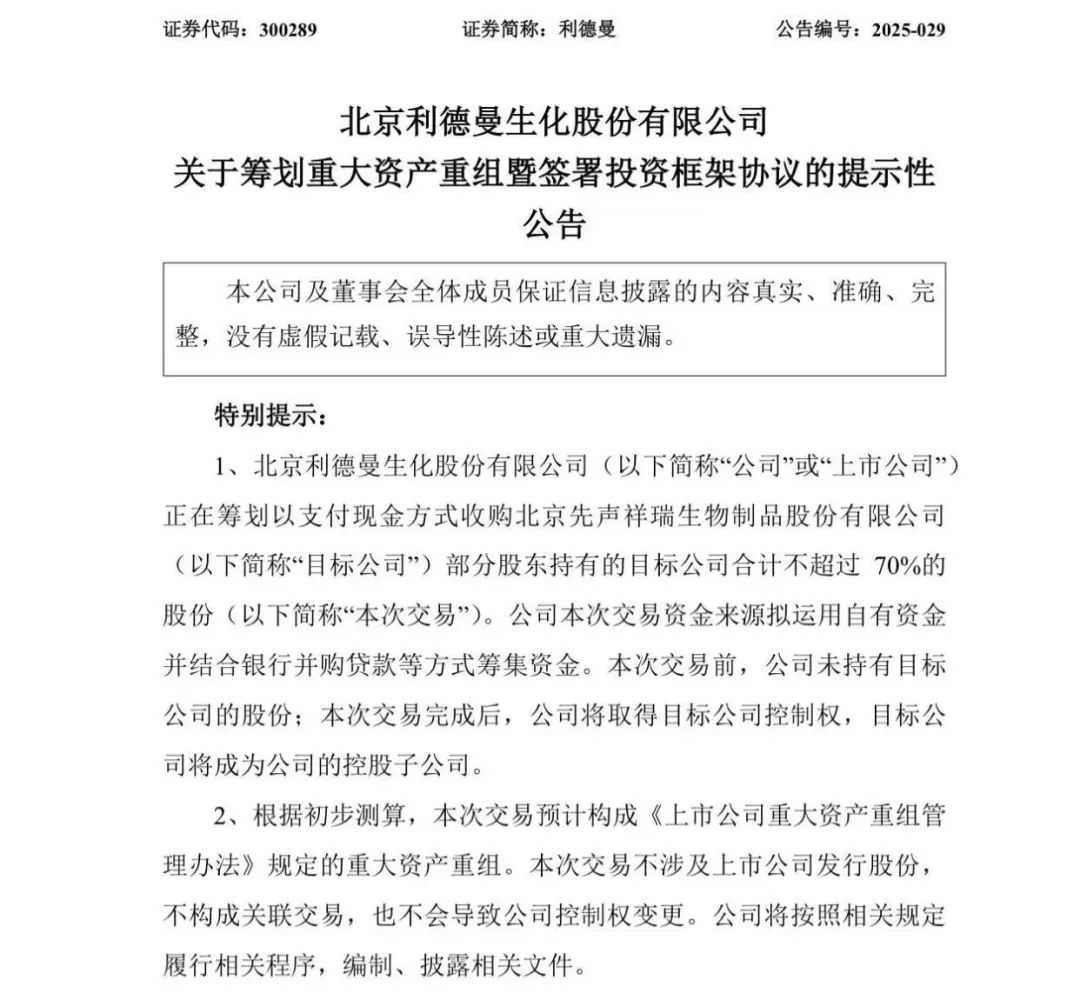
300289,拟重大资产重组!不停牌
Zhong Guo Zheng Quan Bao· 2025-07-30 15:10
Core Viewpoint - Lidman is planning to acquire up to 70% of Beijing Xiansheng Xiangrui Biological Products Co., Ltd. through cash payment, which is expected to constitute a major asset restructuring [1][4]. Group 1: Acquisition Details - The acquisition will be funded through self-owned funds and bank merger loans, with Lidman not holding any shares in the target company prior to the transaction [4]. - Upon completion of the acquisition, Lidman will gain control of the target company, which will become a subsidiary [4]. - The investment framework agreement signed with the target company and its shareholders is only a preliminary agreement, with specific terms to be defined in formal agreements [4]. Group 2: Target Company Overview - The target company operates in the biopharmaceutical manufacturing industry, focusing on in vitro diagnostic reagents and human vaccines [4]. - Its main products include tuberculin purified protein derivative, bacillus Calmette-Guérin purified protein derivative, and specific cell immune response test kits for tuberculosis screening, diagnosis, treatment, and innovative vaccine development [4]. Group 3: Financial Performance - In 2024, Lidman reported a revenue of approximately 370 million yuan, a year-on-year decrease of 19.79%, with a net profit of -75.1 million yuan [6]. - The in vitro diagnostic reagent business remains the primary revenue source, generating about 297 million yuan, down 22.06%, accounting for 80.29% of total revenue [6]. - The first quarter of 2025 saw revenues of approximately 78.9 million yuan, a year-on-year decline of 16.61%, with a net profit of -1.25 million yuan [6]. Group 4: Market Position - As of July 30, Lidman's stock price was 5.87 yuan per share, with a market capitalization of 3.2 billion yuan [7].

九强生物: 北京九强生物技术股份有限公司相关债券2025年跟踪评级报告
Zheng Quan Zhi Xing· 2025-06-26 16:06
Core Viewpoint - The credit rating agency has maintained a stable credit rating for Beijing Jiukang Biotechnology Co., Ltd., reflecting its strong technical advantages and profitability in the biochemical immunology and pathological diagnosis sectors, while also highlighting potential risks due to increasing competition in the medical consumables industry [3][5][8]. Company Overview - Beijing Jiukang Biotechnology Co., Ltd. focuses on the research, production, and sales of in vitro diagnostic reagents, with a strong presence in biochemical immunology and pathological diagnosis [3][5]. - The company has a credit rating of AA- with a stable outlook, indicating robust financial health and operational stability [3][8]. Financial Performance - The company's total assets reached 56.31 billion, with equity attributable to shareholders at 42.20 billion as of March 2025 [3][4]. - Revenue for 2024 was reported at 16.59 billion, a decrease of 4.75% year-on-year, while net profit was 5.31 billion, reflecting a decline of 32.08% in the first quarter of 2025 [3][7][17]. - The gross profit margin increased by 3.84 percentage points to 78.50% in 2024, driven by higher sales from its subsidiary, Mai Xin Biotechnology [5][17]. Research and Development - The company increased its R&D investment to 1.89 billion in 2024, a growth of 15.73% year-on-year, with R&D expenses accounting for 11.36% of revenue [5][20]. - The number of medical device registration certificates rose to 379 by the end of 2024, with 228 patents held, indicating a strong focus on innovation [5][19]. Market Position and Competition - The company faces increasing competition in the medical consumables sector, which may impact revenue and profit margins if its technological advantages diminish [6][7]. - The in vitro diagnostic market in China is projected to grow, with a market size expected to exceed 1,200 billion by 2024, driven by rising health awareness and aging population [15][16]. Risks and Challenges - The company has significant goodwill from acquisitions, which accounted for 29.70% of total assets as of March 2025, posing a risk of impairment if acquired entities do not perform as expected [7][8]. - There is a reliance on imported raw materials for production, which could lead to supply shortages or price instability [6][23].

利德曼收盘上涨1.36%,最新市净率1.71,总市值28.40亿元
Sou Hu Cai Jing· 2025-06-12 08:52
Group 1 - The core business of Lidman includes research, production, sales, and service of in vitro diagnostic reagents, diagnostic instruments, and biochemical raw materials [1] - The company has received multiple accolades, including "National High-tech Enterprise" and "Beijing Specialized and Innovative Enterprise" [1] - As of the first quarter of 2025, Lidman reported a revenue of 78.91 million yuan, a year-on-year decrease of 16.61%, and a net profit of -1.25 million yuan, a year-on-year increase of 53.73% [1] Group 2 - The latest closing price of Lidman was 5.22 yuan, with a market capitalization of 2.84 billion yuan and a price-to-book ratio of 1.71, marking a new low in 79 days [1] - The company is held by three institutions, with a total holding of 263.08 million shares valued at 1.24 billion yuan [1] - The industry average price-to-earnings ratio (PE) is 50.99, while Lidman's PE (TTM) is -38.56, indicating a significant divergence from industry norms [2]
利德曼收盘上涨1.41%,最新市净率1.65,总市值27.47亿元
Sou Hu Cai Jing· 2025-06-03 09:25
Group 1 - The core viewpoint of the news highlights the recent performance and financial metrics of Lidman Biochemical Co., Ltd, including its stock price, market capitalization, and financial results for Q1 2025 [1] - On June 3, Lidman closed at 5.05 yuan, up 1.41%, with a latest price-to-book ratio of 1.65, marking a new low in 49 days and a total market value of 2.747 billion yuan [1] - The company experienced a net outflow of main funds amounting to 8.4668 million yuan on June 3, with a total outflow of 25.8327 million yuan over the past five days [1] Group 2 - Lidman specializes in the research, production, sales, and service of in vitro diagnostic reagents, diagnostic instruments, and biochemical raw materials, with key products including biochemical diagnostic reagents and automated chemiluminescence immunoassay analyzers [1] - The company has received multiple accolades, including "National High-tech Enterprise" and "Beijing Specialized and New Small and Medium-sized Enterprises," and has been recognized as a leading enterprise in the Beijing biopharmaceutical industry [1] - The latest financial report for Q1 2025 shows that the company achieved operating revenue of 78.9087 million yuan, a year-on-year decrease of 16.61%, and a net profit of -1.25172554 million yuan, a year-on-year increase of 53.73%, with a gross sales margin of 53.56% [1] Group 3 - The price-to-earnings (P/E) ratio for Lidman is reported at -37.30 (TTM) and -36.58 (static), with a price-to-book ratio of 1.65 and a total market capitalization of 2.747 billion yuan [2] - The industry average P/E ratio is 50.80 (TTM) and 49.07 (static), with an average price-to-book ratio of 4.67 and a total market capitalization of 108.36 billion yuan [2] - The industry median P/E ratio stands at 36.71 (TTM) and 36.84 (static), with a median price-to-book ratio of 2.48 and a total market capitalization of 50.19 billion yuan [2]