电站业务

Search documents
隆基绿能涨2.03%,成交额12.67亿元,主力资金净流入2980.92万元
Xin Lang Cai Jing· 2026-01-22 03:00
Group 1 - The core viewpoint of the news is that Longi Green Energy's stock has experienced fluctuations, with a recent increase in share price despite a year-to-date decline [1][2] - As of January 22, Longi Green Energy's stock price was 17.57 yuan per share, with a market capitalization of 133.15 billion yuan and a trading volume of 1.267 billion yuan [1] - The company has seen a net inflow of 29.81 million yuan from major funds, with significant buying and selling activity from large orders [1] Group 2 - Year-to-date, Longi Green Energy's stock has decreased by 3.46%, with a 5-day decline of 5.03%, a 20-day decline of 2.50%, and a 60-day decline of 7.04% [2] - The company, established in 2000 and listed in 2012, specializes in the research, production, and sales of monocrystalline silicon rods, wafers, cells, and modules, contributing 93.51% of its revenue from photovoltaic product sales [2] - As of December 19, the number of shareholders was 821,800, a decrease of 0.84%, with an average of 9,220 circulating shares per person, an increase of 0.85% [2] Group 3 - Longi Green Energy has distributed a total of 9.271 billion yuan in dividends since its A-share listing, with 4.32 billion yuan distributed in the last three years [3] - As of September 30, 2025, the top ten circulating shareholders include Hong Kong Central Clearing Limited and several ETFs, with notable reductions in holdings among these entities [3]

锦浪科技(300763):业绩如预期强势 费用管控良好
Xin Lang Cai Jing· 2025-08-26 00:44
Core Insights - Company achieved revenue of 3.794 billion yuan in H1 2025, a year-on-year increase of 13.09%, and a net profit of 602 million yuan, up 70.96% [1] - In Q2 2025, revenue reached 2.276 billion yuan, growing 16.25% year-on-year and 50% quarter-on-quarter, with net profit of 407 million yuan, a year-on-year increase of 22.75% and a quarter-on-quarter increase of 109.27% [1] Inverter Business - In H1 2025, inverter sales reached 466,000 units, with expected growth in both grid-connected and energy storage inverters in Q2 [2] - The gross margin for grid-connected inverters was 26.1%, up 7.6 percentage points year-on-year, while energy storage inverters had a gross margin of 30.3%, an increase of 2.7 percentage points year-on-year [2] - The previous year's H1 gross margins were lower due to raw material procurement timing, which has now normalized [2] Power Station Business - Revenue from the power station business in H1 2025 was 1.11 billion yuan, with a slight year-on-year increase, and expected revenue growth in Q2 due to peak generation season [2] - The gross margin exceeded 55% in H1 2025, with a slight year-on-year decline, but Q2 margins are expected to remain strong due to scale effects [2] Financial Metrics - The expense ratio for H1 2025 was 19.5%, with Q2 at 18.7%, showing a decrease of 2.0 percentage points quarter-on-quarter and 1.6 percentage points year-on-year, marking the lowest level since Q3 2023 [2] - The reduction in expense ratio is attributed to effective cost control and increased revenue scale [2] - In Q2, asset impairment of 17 million yuan and credit impairment of 14 million yuan impacted profit release [2] Future Outlook - Company anticipates maintaining a relatively full production schedule, with European demand potentially fluctuating due to holidays, while Australia and Asia-Africa-Latin America show strong performance [3] - The company expects industrial storage to double year-on-year over the next two years, with revenue gradually catching up to household storage [3] - Household storage is also projected to continue steady growth [3] Profit Forecast - Company is expected to achieve profits of 1.3 billion yuan and 1.6 billion yuan in 2025 and 2026, respectively, corresponding to PE ratios of 20 and 16 [4]
光伏行业仍处于调整阵痛期,隆基绿能近十年首现亏损
Nan Fang Du Shi Bao· 2025-05-30 06:55
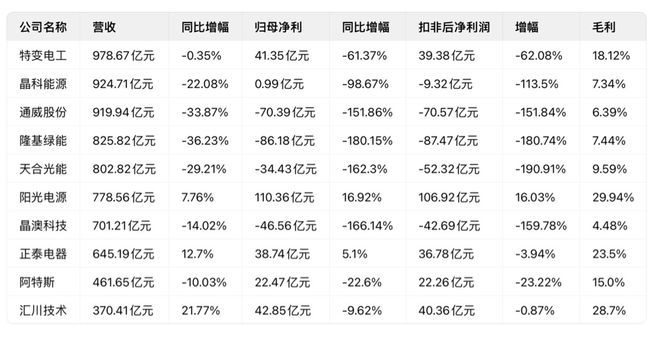
Core Insights - The photovoltaic industry is currently experiencing a phase of pain due to an adjustment cycle, with many companies facing losses. Among the top ten photovoltaic companies by revenue, 70% reported a decline in revenue, and 40% are operating at a loss, with Longi Green Energy facing the largest loss of over 8.6 billion yuan in 2024, marking its first annual loss in a decade [1][2][7]. Industry Overview - The industry is characterized by a temporary oversupply of production capacity, leading to significant losses for major players. Longi Green Energy's revenue fell by 36.23% to 82.58 billion yuan, with a net profit loss of 8.6 billion yuan, a staggering 180.15% decline year-on-year [2][5]. - The overall gross margin for Longi Green Energy dropped to 7.44%, a decrease of over 10 percentage points compared to the previous year. The gross margin for its silicon wafer and rod business was negative at -14.31%, while the module and battery segment also saw a significant decline [5][12]. Company Performance - Longi Green Energy's performance is indicative of broader industry trends, with other companies like Trina Solar and JinkoSolar also reporting substantial losses due to supply-demand imbalances and increased competition [7][8]. - In contrast, companies in the photovoltaic equipment supply sector, referred to as "selling shovels," such as Jiejia Weichuang, reported strong performance, with a revenue increase of over 116% to 18.9 billion yuan and a net profit of 2.76 billion yuan, reflecting a more favorable position in the current market [8][9]. Market Dynamics - The photovoltaic industry is undergoing a deep adjustment phase, with excess capacity and a lack of demand leading to significant financial strain on many companies. The industry is expected to see a clearing of outdated capacities and less competitive firms [7][12]. - Despite the challenges, there is an expectation that companies with core technological capabilities and strong cost control will emerge more resilient and may benefit from recovery opportunities in the future [12].