
百度昆仑芯P800

Search documents
阿里首次证实自研AI芯片PPU存在,大规模出货已有一年
3 6 Ke· 2026-01-29 03:32
Core Insights - Alibaba has confirmed the existence of its self-developed AI chip, PPU, named Zhenwu 810E, which utilizes GPGPU technology and is designed for AI training, inference, and autonomous driving applications [1][3] - The PPU chip has been in development since 2020 and has recently begun commercial sales to various domestic computing service providers and server manufacturers [2][3] - As of early 2026, the PPU chip has been widely deployed, serving over 400 clients, including major organizations like State Grid and Xpeng Motors [3] Group 1: Chip Development and Technology - The Zhenwu 810E chip features 96G HBM2e memory and an interconnect bandwidth of 700GB/s, positioning it competitively against NVIDIA's GPUs [1] - The chip's development was kept internal until its recent unveiling, indicating a strategic approach to market entry [1][2] - Internal evaluations suggest that the Zhenwu 810E outperforms NVIDIA's A800 and is comparable to the H20 model [3] Group 2: Market Position and Competition - By early 2025, Alibaba began actively selling the PPU chip, indicating a shift towards commercialization [2] - In the first half of 2025, Alibaba's market share in the domestic AI chip market ranked second, following Huawei's Ascend series [3] - The emergence of multiple AI chip companies with significant shipment volumes indicates a growing competitive landscape in the domestic market [4][5] Group 3: Industry Trends and Future Outlook - The increasing shipment volumes of AI chips, with at least nine companies exceeding 10,000 units, reflect a maturation of the domestic AI chip industry [4][5] - The price range for domestic AI chips is between 30,000 to 200,000 yuan per unit, suggesting a market acceptance of their performance and stability [5] - Industry experts anticipate a surge in the shipment of domestic AI inference chips as manufacturing capacities improve in 2026 [5][6]

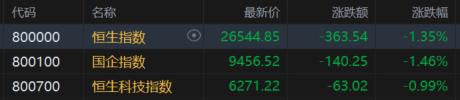
港股收评:午后大跳水!恒指跌1.35%,半导体全天强势
Ge Long Hui· 2025-09-18 08:28
Market Overview - The Hong Kong stock market experienced a significant decline in the afternoon, with major indices dropping over 2% after reaching recent highs earlier in the day. The Hang Seng Index closed down 1.35%, while the Hang Seng China Enterprises Index and the Hang Seng Tech Index fell by 1.46% and 0.99%, respectively [1][2]. Sector Performance - The technology sector, which had previously driven market gains, saw a broad pullback, with major financial stocks (banks, insurance, and brokerage firms) collectively dragging the market down. Real estate stocks faced substantial declines, reflecting ongoing market adjustments, with coal, home appliance, education, catering, gaming, and gold stocks also experiencing losses [2][3]. - Semiconductor stocks maintained strong performance amid news of anti-dumping investigations and rumors of a ban on Nvidia, with Huahong Semiconductor rising by 8.6% and leading firm SMIC reaching a historical high [2][10]. Notable Stock Movements - Major technology stocks such as Xpeng Motors, Haier Smart Home, and Bilibili saw declines exceeding 3%, while Tencent, Alibaba Health, and Midea Group also fell [4][5]. - Real estate stocks collectively dropped, with Country Garden falling over 10% and other firms like Jin Hui Holdings and Oceanwide Holdings declining by more than 7% [6]. - Chinese brokerage stocks also fell, with Hongye Futures down over 5% and other firms like Zhongzhou Securities and CITIC Securities following suit [7][8]. - Education stocks faced significant declines, with China Education Industry dropping over 9% and other firms like Zhongjiao Holdings and Huazhong Education also experiencing losses [9]. - The semiconductor and chip sectors saw gains, with ASMPT and Huahong Semiconductor both rising over 8% [10]. - The innovative drug sector performed well, with companies like Crystal Technology and Heng Rui Pharmaceutical seeing increases of over 5% [11]. Capital Flows - Southbound capital recorded a net inflow of HKD 6.288 billion, with net purchases of HKD 1.907 billion through the Shanghai-Hong Kong Stock Connect and HKD 4.382 billion through the Shenzhen-Hong Kong Stock Connect [13]. Future Outlook - Analysts predict a "super long bull market" for Hong Kong stocks, with expectations that the Hang Seng Index could reach around 28,000 points by November, and the Hang Seng Tech Index may target a range of 6,000 to 6,200 points [15].



Tokens需求爆发撬动千亿算力!寒武纪单日飙涨20%,半导体产业ETF(159582)成交放量暗藏Alpha机会
Xin Lang Cai Jing· 2025-08-12 06:30
Core Viewpoint - The A-share semiconductor sector has experienced a significant rally, driven by strong performance in AI-related stocks and ETFs, indicating a positive market sentiment and increased trading activity in the industry [1][2][3]. Group 1: Market Performance - The semiconductor sector saw notable gains, with stocks like Shanghai Hejing and Cambricon-U20CM hitting the daily limit, and others like Shengke Communication and Ashi Chuang rising over 15% [1]. - The semiconductor industry ETF (159582) surged nearly 3%, with a trading volume close to 250 million and a turnover rate exceeding 12%, reflecting active trading [1]. - The Sci-Tech Chip ETF (588990) also rose over 3%, with a trading volume near 200 million and a turnover rate close to 10%, indicating strong investor interest [1]. Group 2: Demand and Supply Dynamics - On the demand side, global AI product iterations have significantly increased token consumption, with Google's monthly token processing reaching approximately 980 trillion, doubling from May [2]. - Domestic demand is also surging, with ByteDance's "Doubao" averaging over 16.4 trillion tokens daily by the end of May, a year-on-year increase of 137 times [2]. - On the supply side, domestic collaboration in the "chip-system-ecosystem" is advancing, with Huawei previewing a breakthrough technology aimed at hardware and software integration [2]. Group 3: Investment Sentiment and Trends - Upcoming AI conferences and the release of GPT-5 are expected to enhance industry engagement and capital interest, contributing to a favorable investment climate [3]. - The trading environment is characterized by a stable index and strong sector performance, with a focus on sectors like CPO and computing power chips [3]. - The current market trend suggests a potential replication of the overseas model where increased token usage leads to capital expenditure growth in the industry [3]. Group 4: ETF Characteristics - The semiconductor industry ETF (159582) closely tracks the CSI Semiconductor Industry Index, covering key segments of semiconductor materials, equipment, and applications, indicating high industry purity and representativeness [4]. - The Sci-Tech Chip ETF (588990) tracks the Shanghai Stock Exchange Sci-Tech Board Chip Index, focusing on high-growth potential within the domestic chip ecosystem, thus offering complementary investment opportunities [4].
