真武

Search documents
技术为骨、生态为翼:千问“春节战役”引发的AI生活变革
Xin Hua Ri Bao· 2026-02-17 04:01
Core Insights - The core theme of the articles revolves around the significant advancements in artificial intelligence (AI) during the Chinese New Year of 2026, particularly highlighting Alibaba's AI initiatives and the rapid adoption of its AI shopping assistant, Qianwen [1][4][5]. Group 1: AI Adoption and User Engagement - During the Spring Festival, over 130 million people experienced AI shopping for the first time, with users making 5 billion requests to "Qianwen help me," marking a substantial increase in user engagement [4]. - The Qianwen app launched a "30 billion big free order" campaign, generating over 10 million AI orders within 9 hours, leading to a daily active user (DAU) count of 73.52 million, approaching industry-leading products [4]. - Qianwen has evolved from a "chatbot" to a "task assistant," enabling users to perform various tasks such as ordering food, booking flights, and planning family trips with simple voice commands [4]. Group 2: Technological Advancements - Alibaba released its new open-source model Qwen3.5-Plus, which boasts 397 billion parameters, surpassing the previous flagship model Qwen3-max and competing favorably with top closed-source models like GPT-5.2 and Gemini3pro [5][6]. - The API pricing for Qwen3.5-Plus is set at 0.8 yuan per million tokens, significantly lower than Gemini3pro's pricing, showcasing a strategic advantage in cost-effectiveness [6]. - Innovations in model architecture, including the integration of gating technology and a hybrid architecture, have led to enhanced model efficiency, activating only 17 billion parameters out of 397 billion [6]. Group 3: Strategic Integration and Market Position - Alibaba's AI strategy has achieved dual victories with Qianwen becoming a "national AI" and Qwen3.5 being recognized as the strongest open-source model globally, reflecting a decade of strategic development [7]. - The collaboration between Alibaba's self-developed AI chip "Zhenwu," cloud services, and large models forms a unique vertical integration system, enhancing resource efficiency and performance [6][7]. - Alibaba's comprehensive ecosystem, combining top-tier model capabilities with extensive real-world applications, positions it to redefine industry competition and establish a dominant voice in the AI landscape [7].



21评论|黄仁勋的新年第一站,从中国开始
2 1 Shi Ji Jing Ji Bao Dao· 2026-01-29 16:15
Core Insights - Huang Renxun, CEO of Nvidia, emphasizes the importance of the Chinese market during his recent visits, highlighting the company's strategic focus on China [1][2] - Nvidia has not yet received orders for its H200 AI chips from Chinese customers due to pending import decisions from the Chinese government [1] - The H200 chip is positioned as a transitional power support for large model inference and training, with significant specifications [5][6] Company Strategy - Huang's travel itinerary indicates a strong emphasis on the Asia-Pacific region, particularly China, Japan, and India, reflecting Nvidia's strategic priorities [1] - The company employs approximately 36,000 people globally, with significant representation in China (11%) and India (14%) [1] - Huang's approach in China includes a mix of business and cultural engagement, showcasing a more public relations-focused strategy compared to other regions [4][5] Market Dynamics - The Chinese AI chip market is becoming increasingly competitive, with local companies like Huawei, Alibaba, and Baidu developing their own AI chips [6] - TrendForce predicts that the proportion of AI servers in China using imported chips will decrease from 63% in 2024 to 42% in 2025, indicating a rise in domestic chip suppliers [6] - The competition between the US and China in the computing power sector highlights each country's strengths, with the US excelling in chip computing and AI models, while China benefits from low-cost energy and manufacturing capabilities [6][7] Ecosystem Development - The AI ecosystem is complex, involving data, energy, chip manufacturing, and AI models, necessitating global collaboration for advancement [7] - Huang's background and Nvidia's role position the company as a key player in building this ecosystem, with China capable of being a significant contributor [7]

黄仁勋的新年第一站,从中国开始
2 1 Shi Ji Jing Ji Bao Dao· 2026-01-29 15:22
Core Insights - Huang Renxun, CEO of Nvidia, emphasizes the importance of the Chinese market during his annual visit, highlighting the urgency to revitalize business in China [1][2] - Nvidia has not yet received orders for the H200 AI chips from Chinese customers due to pending import decisions by the Chinese government, although the chip is deemed suitable for the market [1][3] - The global AI chip landscape is competitive, with Chinese companies like Huawei, Alibaba, and Baidu emerging as significant players, potentially reducing reliance on foreign chips [4][5] Group 1: Nvidia's Strategic Focus - Huang Renxun's travel itinerary reflects a strategic focus on the Chinese market, with significant visits to China, Japan, and India, indicating a prioritization of the Asia-Pacific region [2] - Nvidia employs approximately 36,000 people globally, with 11% in China, suggesting a substantial commitment to the Chinese market despite geopolitical tensions [2] - The H200 chip, which is currently under U.S. export license approval, is positioned as a transitional power support for large model inference and training, featuring 141GB HBM3e and 4.8TB/s bandwidth [3] Group 2: Competitive Landscape and Market Dynamics - The Chinese AI server market is projected to see a decrease in reliance on foreign chips, with local suppliers expected to increase their market share from 2024 to 2025 [4] - The competitive advantages in the AI field are split between the U.S. and China, with the U.S. excelling in chip computing power and AI models, while China benefits from lower energy costs and extensive application scenarios [5] - The AI ecosystem is complex, involving data, energy, chip manufacturing, and AI models, indicating that collaboration across global players is essential for advancement [5]
AI进化速递 | 阿里平头哥上线自研AI芯片“真武”
Di Yi Cai Jing· 2026-01-29 13:04
Group 1 - Nvidia, Microsoft, and Amazon are in talks to invest approximately $60 billion in OpenAI [6] - A new artificial intelligence industry fund has been established in Kunshan with a total scale of 5 billion yuan [1] - Alibaba's T-head has launched its self-developed AI chip "Zhenwu" [2] Group 2 - Beijing has officially launched its first humanoid robot pilot verification platform, expected to have an annual production capacity of 5,000 units [3] - 360 has announced the public testing of its industrial-grade AI comic intelligent agent production platform, named "Nano Comic Production Line" [7] - Kunlun Wanwei has released the Mureka V8 music large model [8] Group 3 - MiniMax Music 2.5 has been officially released [4] - Yushu has open-sourced UnifoLM-VLA-0 [5] - Songyan Power has announced its partnership as the humanoid robot collaborator for the 2026 CCTV Spring Festival Gala [9]
阿里自研高端AI芯片“真武”亮相!涨价潮蔓延,“全芯”科创芯片ETF(589190)水下溢价高企,彰显高人气
Xin Lang Cai Jing· 2026-01-29 03:29
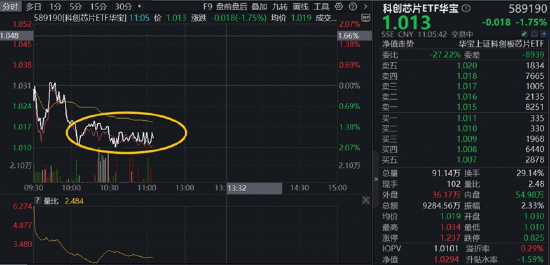
Core Viewpoint - The semiconductor sector is experiencing a short-term pullback, with the Huabao ETF (589190) showing a decline of 1.75% after an initial rise, indicating active buying interest during dips [1][11]. Group 1: Market Performance - The semiconductor sector shows mixed performance, with leading companies like Zhongwei, Lanke Technology, and SMIC experiencing declines of over 4% and 3% respectively [3][11]. - The Huabao ETF tracks the Shanghai Stock Exchange's semiconductor index, which includes 50 companies across various semiconductor sectors, maintaining a high technology barrier and significant weight in core areas [4][14]. Group 2: Price Adjustments - A new wave of price increases in the semiconductor industry has been reported, with Samsung and SK Hynix raising prices for LPDDR memory used in iPhones by over 80% and nearly 100% respectively [3][13]. - Domestic companies like Zhongwei Semiconductor and Guokewai have announced price hikes for MCU and Norflash products ranging from 15% to 50%, and KGD products by 40% to 80% [3][13]. Group 3: Future Outlook - CITIC Securities forecasts a high certainty in computing power development by 2026, highlighting opportunities in super-node technology and the competitive strength of domestic computing power manufacturers [3][13]. - Donghai Securities anticipates significant growth in the performance of domestic A-share companies related to AI by 2025, recommending a focus on computing power chips, semiconductor equipment, and storage [3][13]. Group 4: Index Performance - As of the end of 2025, the annualized return of the Shanghai Stock Exchange's semiconductor index is 17.93%, outperforming similar indices and showing a better risk-return profile [6][16]. - The index has shown varying annual performance, with a notable increase of 61.33% projected for 2025 [6][17].