神经处理单元(NPU)

Search documents
韩国计划到2047年投入700万亿韩元,打造全球最大芯片集群
Xin Lang Cai Jing· 2025-12-10 07:31
Core Viewpoint - The South Korean government has announced a comprehensive strategy to establish the country as a leading player in the global semiconductor industry by creating the world's largest chip cluster, with a total investment of 700 trillion KRW (approximately 476 billion USD) by 2047 [1][4]. Investment and Development Plans - The plan includes the construction of 10 new semiconductor manufacturing plants to position South Korea as the largest chip production center globally [1][4]. - By 2032, the government will invest 215.9 trillion KRW to develop next-generation storage chip technologies, including Neural Processing Units (NPU) and Processing In Memory (PIM) [1][4]. AI and Semiconductor Technology - The government will invest 12.7 trillion KRW over the next five years to develop semiconductors suitable for artificial intelligence, with an additional 26.01 trillion KRW allocated for compound semiconductors and 36.06 trillion KRW for advanced packaging technologies by 2031 [2][5]. - A collaborative ecosystem will be established to enhance capabilities in the relatively weaker system semiconductor sector, focusing on AI technologies and intermediate technology semiconductors [2][5]. Manufacturing and Ecosystem Development - The government and private sector will jointly establish South Korea's first "cooperative foundry" to allocate dedicated production capacity for domestic non-foundry companies, aiding in the manufacturing of intermediate technology chips [2][5]. - Efforts will be made to improve the competitiveness of materials, components, and equipment in the semiconductor industry, alongside the cultivation of advanced talent [2][5]. Talent Development - Plans are in place to increase the number of semiconductor graduate schools from 6 to 10 by 2030 [3][6]. - A preliminary agreement has been signed with UK semiconductor design company Arm to train 1,400 chip design experts in South Korea [3][6]. Regional Development Initiatives - The semiconductor development plan will be integrated with regional balanced development initiatives, establishing specialized parks for advanced chip packaging in Gwangju, power semiconductor industry in Busan, and semiconductor materials and components in Gumi [3][6].
AMD要自研独立NPU
半导体芯闻· 2025-07-31 10:23
Core Viewpoint - AMD is exploring the potential of a dedicated neural processing unit (NPU) as an alternative to GPUs for AI workloads in PCs, indicating a shift in the processing hierarchy for handling AI and machine learning tasks [1][2][5] Group 1: AMD's NPU Development - AMD is in discussions with clients regarding the use cases and potential opportunities for a dedicated accelerator chip, which is likely to be an NPU rather than a GPU [1][2] - The company is leveraging AI engine technology acquired from Xilinx to enhance the performance of future discrete NPU products [3] - AMD's NPU solutions are expected to consume less energy compared to traditional GPUs, which is a significant advantage for AI workloads [4][5] Group 2: Market Trends and Competitors - Major OEMs like Lenovo, Dell, and HP are beginning to explore the use of independent NPUs and other dedicated accelerator chips as alternatives to GPUs for AI workloads [2][6] - Dell has announced the use of Qualcomm's AI 100 PC inference card in its new Dell Pro Max Plus laptops, claiming it to be the world's first workstation equipped with an enterprise-level independent NPU [6] - Other companies, such as Encharge AI, are also developing independent NPU solutions, showcasing a growing trend in the market towards dedicated AI processing capabilities [6]


心智观察所:车载通信为何是国产替代的薄弱环节
Guan Cha Zhe Wang· 2025-05-11 01:15
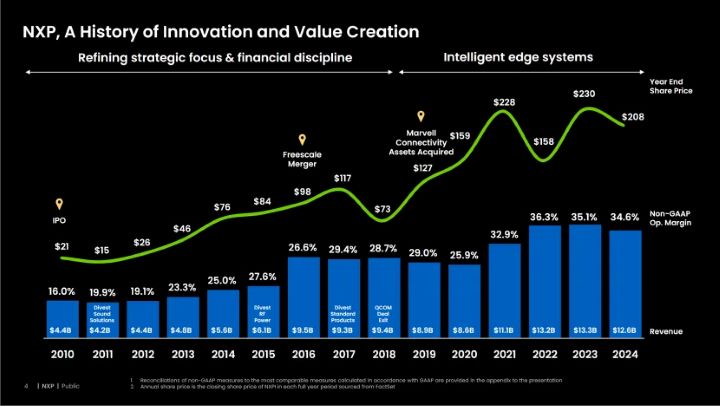
Group 1: Company Performance - NXP reported Q1 revenue of $2.84 billion, a year-over-year decline of 9% and a quarter-over-quarter decline of 9% [1] - Following the earnings report, NXP's stock price dropped over 7% in after-hours trading, resulting in a market value loss of approximately $4.5 billion [1] - The company announced the retirement of CEO Kurt Sievers at the end of the year, with Rafael Sotomayor set to take over [1] Group 2: Market Conditions - The global automotive and industrial chip market has been experiencing a downturn since 2024, with companies facing challenges in inventory clearance [1][2] - The global automotive chip inventory turnover period has extended by 30%-50% year-over-year due to a significant drop in demand from automakers [2] Group 3: Strategic Moves - NXP made notable strategic moves, including a $307 million acquisition of AI chip startup Kinara Inc. and the launch of the new S32K5 series MCU, which features embedded MRAM technology [4][5] - The acquisition of Kinara is part of NXP's broader strategy to enhance its AI capabilities and provide a comprehensive AI platform [5] - NXP's focus remains on enhancing automotive and industrial communication capabilities through edge AI tools [5][6] Group 4: Industry Trends - The automotive communication market is undergoing significant changes, driven by the evolution of the automotive concept and increasing demands for computing power and integration in vehicle communication chips [7] - The shift towards software-defined vehicles (SDVs) necessitates a deep integration of communication chips and computing units, testing manufacturers' full-stack capabilities [8]