私募量化产品

Search documents
调查|险资“灰色”投资私募量化,中小险企借道MOM试水
券商中国· 2026-01-23 06:59
Core Viewpoint - Insurance funds are increasingly investing in private quantitative products, particularly since the positive changes in the capital market following the "9·24" event in 2024, with several small and medium-sized insurance companies participating in this trend [3][4][8]. Investment Trends - There is a noticeable trend of insurance capital investing in private quantitative products, with a focus on quantitative index enhancement strategies that have shown strong performance [2][4]. - Quantitative index enhancement products have outperformed traditional public funds, leading insurance companies to prefer these private offerings [5][10]. Investment Structure - Insurance funds typically invest in private quantitative products indirectly through a "Manager of Managers" (MOM) structure, where they invest in a single asset management plan managed by a brokerage, with the private fund acting as an advisor [3][11]. - This structure allows insurance companies to navigate regulatory uncertainties while still accessing the benefits of private quantitative strategies [11][12]. Performance and Market Conditions - In a low-interest-rate environment, insurance companies are compelled to seek alternative investment avenues, with private quantitative products providing a potential solution for enhancing returns [8][9]. - The performance of small-cap index enhancement products has been particularly strong, with some achieving returns exceeding 50% in a favorable market [4][8]. Regulatory Environment - The regulatory stance on insurance funds investing in private quantitative products remains ambiguous, with existing guidelines generally excluding private securities funds from eligible investment categories [11][12]. - There is speculation that regulatory bodies may eventually clarify the rules surrounding these investments, potentially imposing stricter requirements on the management of insurance funds [12]. Industry Sentiment - While there is enthusiasm for the potential of private quantitative investments, there are also concerns regarding compliance and the inherent risks associated with private fund management [9][10]. - Some industry insiders advocate for a cautious yet open approach to these investment strategies, recognizing them as a necessary exploration for small and medium-sized insurance companies seeking to improve their returns [10].


中小险企试水私募量化 借道MOM投资引关注
Zheng Quan Shi Bao· 2026-01-22 18:21
Core Viewpoint - Insurance funds are increasingly investing in private quantitative products, particularly since the "9·24" market rally in 2024, with several small and medium-sized insurance companies participating in this trend [1][2][5]. Group 1: Investment Trends - There is a noticeable trend of insurance capital investing in private quantitative index-enhanced products, which have shown strong performance [1][4]. - The preference among insurance funds is shifting towards quantitative index-enhanced products due to their better explainability and relatively stable performance compared to subjective products [2][4]. - Small and medium-sized insurance companies are primarily experimenting with private quantitative investments, with investments still at a small scale and not yet a major part of their portfolios [6][7]. Group 2: Market Environment - The current low-interest-rate environment poses significant challenges for insurance investments, leading to a necessity for exploring private quantitative options to enhance returns [7][8]. - In a bull market, quantitative index-enhanced products are attractive as they often outperform the index, while in a bear market, the demand for such products may decrease [5][7]. Group 3: Regulatory Landscape - The regulatory framework regarding insurance capital investing in private products remains unclear, with existing guidelines generally excluding private securities funds from eligible investment categories [10][11]. - There is an expectation that regulatory bodies may refine existing regulations to clarify the compliance of such investments, potentially introducing specific requirements for the management of insurance funds [11]. Group 4: Performance and Risk - Quantitative strategies are perceived to mitigate some risks associated with traditional private investments, such as performance sustainability and governance issues [9]. - Despite the potential benefits, there are concerns regarding compliance and the regulatory status of private investments, which could pose risks for insurance companies [8][10].
招商证券定量研究2026年度十大展望
CMS· 2026-01-20 07:35
Quantitative Models and Construction Methods Model 1: Active Quantitative Stock Selection Based on Free Cash Flow - **Model Name**: Active Quantitative Stock Selection Based on Free Cash Flow - **Model Construction Idea**: The model aims to select stocks with high free cash flow quality and enhance the selection with valuation, quality, dividend, and momentum factors[27] - **Model Construction Process**: 1. **Sample Space**: Exclude newly listed stocks (less than one year), ST and *ST stocks, and stocks in the comprehensive financial, banking, non-bank financial, and real estate sectors[29] 2. **Initial Screening**: Retain stocks with positive free cash flow, positive enterprise value, and positive net cash flow from operating activities over the past five years. Exclude stocks in the bottom 20% of profitability quality[29] 3. **Free Cash Flow Selection**: Construct free cash flow factors from valuation, quality, and growth dimensions. Neutralize these factors by market value and industry, then combine them equally to form a comprehensive free cash flow factor. Select the top 50% of stocks based on this factor to form a self-built cash flow stock pool[29] 4. **Enhancement Dimensions**: Introduce valuation, quality, dividend, and momentum factors to further enhance the stock pool[29] - **Model Evaluation**: The model has shown stable performance with an annualized return of 32.28% and an annualized excess return of 26.68% relative to the CSI 500, with an information ratio (IR) of 2.42[30] Model 2: High Dividend Stock Selection Strategy - **Model Name**: High Dividend Stock Selection Strategy - **Model Construction Idea**: The model focuses on selecting stocks with high dividend yields and stable dividend payments to construct a high dividend investment strategy[33] - **Model Construction Process**: 1. **High Dividend Base Stock Pool**: Select the top 20% of companies in each CITIC first-level industry based on dividend yield[35] 2. **Avoid Dividend Trap**: Select companies with an average dividend yield greater than 2% over the past three years and a standard deviation of dividend yield less than 2%[35] 3. **Avoid Low Valuation Trap**: Select companies with the current quarterly ROE greater than or equal to the same quarter last year and with a positive consensus forecast for future compound growth rate[35] 4. **High Dividend Yield Portfolio**: Select the top 30 companies based on dividend yield from the remaining stock pool[35] - **Model Evaluation**: The model has achieved an annualized excess return of 16.42% relative to the CSI Dividend Index, with an IR of 2.42[37] Model 3: Technical Growth Expectation Stock Selection Strategy - **Model Name**: Technical Growth Expectation Stock Selection Strategy - **Model Construction Idea**: The model aims to identify high-growth opportunities by constructing a future growth portfolio based on current growth indicators and enhancing it with technical factors[39] - **Model Construction Process**: 1. **Growth Expectation Portfolio Construction**: Select companies with the latest quarterly net profit growth to form the base stock pool. Exclude companies in the bottom 20% of quarterly ROE and select the top 50% based on the slope of quarterly ROE[41] 2. **Technical Enhancement**: Select the top 30% of companies based on the standardized unexpected earnings (SUE) indicator and the top 100 stocks based on excess returns on the day after earnings announcements. Further select the top 30 stocks based on the standard deviation of turnover rate moving average[41] - **Model Evaluation**: The model has shown an annualized return of 40% and an annualized excess return of 32.13% relative to the CSI 500, with an IR of 2.91[42] Model Backtest Results Active Quantitative Stock Selection Based on Free Cash Flow - **Annualized Return**: 32.28% - **Annualized Excess Return**: 26.68% - **Information Ratio (IR)**: 2.42[30] High Dividend Stock Selection Strategy - **Annualized Excess Return**: 16.42% - **Information Ratio (IR)**: 2.42[37] Technical Growth Expectation Stock Selection Strategy - **Annualized Return**: 40% - **Annualized Excess Return**: 32.13% - **Information Ratio (IR)**: 2.91[42] Quantitative Factors and Construction Methods Factor 1: Free Cash Flow Factor - **Factor Name**: Free Cash Flow Factor - **Factor Construction Idea**: The factor aims to capture the quality of free cash flow from valuation, quality, and growth dimensions[29] - **Factor Construction Process**: 1. **Valuation Dimension**: Free Cash Flow to Firm/Enterprise Value (FCFF/EV) 2. **Quality Dimension**: Free Cash Flow to Firm/EBITDA (FCFF/EBITDA) 3. **Growth Dimension**: Free Cash Flow Growth Rate (FCFF Growth Rate) 4. **Combination**: Neutralize these factors by market value and industry, then combine them equally to form a comprehensive free cash flow factor[29] - **Factor Evaluation**: The factor has shown long-term effectiveness and stability in predicting future dividends and achieving excess returns[27] Factor Backtest Results Free Cash Flow Factor - **Annualized Return**: 32.28% - **Annualized Excess Return**: 26.68% - **Information Ratio (IR)**: 2.42[30]
9月私募备案同比激增171%
Guo Ji Jin Rong Bao· 2025-10-10 13:36
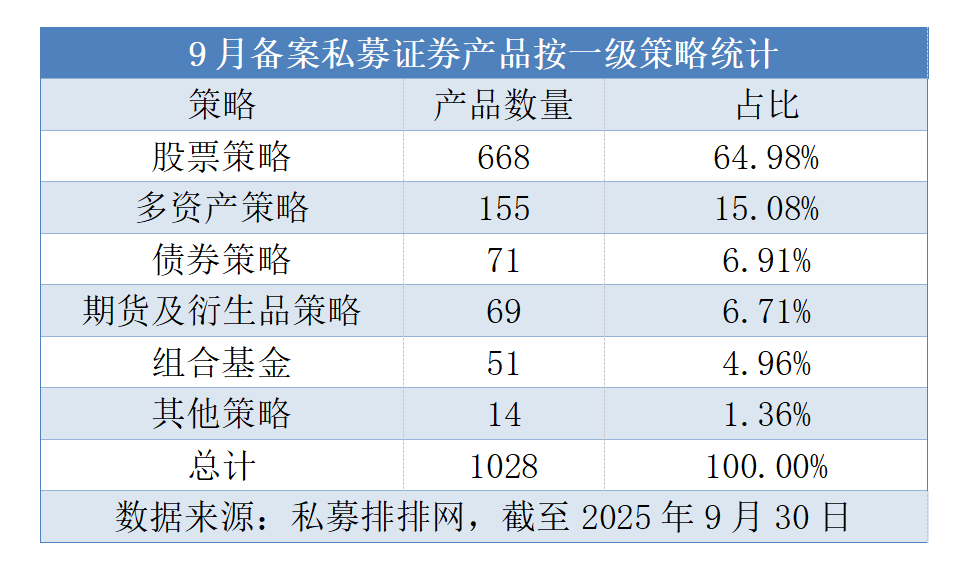
Core Insights - In September, a total of 1,028 private securities products were registered, representing a 10.22% decrease from August's 1,145 products, but a significant year-on-year increase of 171.24% compared to 379 products in the same month of 2024 [1] Strategy Distribution - Among the registered products, equity strategies dominated with 668 products, accounting for 64.98% of the total. Multi-asset strategies followed with 155 products (15.08%), while bond strategies (71 products, 6.91%) and futures and derivatives strategies (69 products, 6.71%) were nearly equal in scale. Combination funds were relatively niche with 51 products (4.96%) [1][2] Quantitative Products Performance - Quantitative products showed strong performance in September, with 364 products registered, making up 35.41% of the total. Within this category, equity strategies contributed the most, with 166 long-only quantitative products (45.6%) and 69 market-neutral equity strategies (18.96%). In the futures and derivatives category, quantitative CTA strategies stood out with 45 products (12.36%) [2][3] Manager Distribution - The majority of registered products came from leading private equity firms, indicating a growing industry concentration. The top firm, Liwei Private Equity, registered 23 products, followed by Maoyuan Quantitative (13 products) and Yinye Investment (12 products). Among the 27 firms that registered at least five products, 16 were over 10 billion in assets, while 4 were between 5 billion and 10 billion, with top firms accounting for 74.07% of the total [3][4] Market Trends - Since the "9.24" market event, the profitability of equity markets has gradually become apparent, and policies continue to support sectors like technology innovation and high-end manufacturing. This has enhanced the appeal of equity strategies, leading to a rise in investor willingness to allocate to equity assets, thus maintaining high registration numbers for these strategies [4] Competitive Landscape - The registration advantages of leading private equity firms reflect resource aggregation. Large firms with assets over 10 billion have stronger research capabilities, risk control systems, and brand reputation, making it easier for them to gain recognition and funding. In contrast, smaller firms struggle with fundraising and research resources, further reinforcing the trend of industry concentration [4]