
管材

Search documents
未知机构:13月31日3月PMI数据将公布-20260330
未知机构· 2026-03-30 01:40
Summary of Key Points from Conference Call Records Industry or Company Involved - **Manufacturing and Non-Manufacturing Sectors**: The PMI data indicates trends in these sectors - **Photovoltaic Industry**: Changes in export tax policies affecting this sector - **Semiconductor Industry**: Price adjustments by major companies - **Paper and Steel Industries**: Price increases announced by key players - **U.S. Employment and Economic Indicators**: Upcoming reports that may impact market sentiment Core Points and Arguments 1. **PMI Data Release**: The manufacturing PMI for February was reported at 49.0%, a decrease of 0.3 percentage points from the previous month, while the non-manufacturing business activity index was at 49.5%, an increase of 0.1 percentage points [1] 2. **Export Tax Changes for Photovoltaic Products**: Starting April 1, 2026, the VAT export rebate for battery products will be reduced from 9% to 6%, and will be completely eliminated by January 1, 2027. This is expected to pressure export companies and shift the photovoltaic industry towards high-quality development rather than low-cost competition [1] 3. **Semiconductor Price Increases**: Major companies like Texas Instruments, NXP, and Infineon are raising prices on select products starting April 1, with Texas Instruments seeing increases up to 85% and Infonion's mainstream products expected to rise by 5% to 15% [2] 4. **Fuel Surcharge Adjustments**: Domestic airlines are expected to raise fuel surcharges, following the trend set by major carriers [2] 5. **Unlocking of Restricted Shares**: A total of 28 restricted shares will be unlocked next week, with a total market value of nearly 29.3 billion yuan, led by Hongri Da at 10.846 billion yuan [2] 6. **New Stock Issuances**: Three new stocks are set to be issued, including Saiying Electronics and Yuyuan Composites [2] 7. **Price Increases in Passive Components**: Murata has announced price hikes of 15% to 35% for AI server and high-end automotive MLCC products, effective April 1 [2] 8. **Paper Industry Price Increases**: Yueyang Lin Paper and Chenming Paper have announced price increases of 200 yuan per ton for various paper products starting April 1, 2026 [3] 9. **Steel Industry Price Adjustments**: Baosteel, Ansteel, and Benxi Steel are all raising base prices by 200 yuan per ton for multiple steel products in April [3] 10. **Upcoming Financial Reports**: A peak in domestic earnings reports is expected, with several key companies set to announce their financial results [3] Other Important but Possibly Overlooked Content 1. **U.S. Employment Reports**: The U.S. will release the non-farm payroll report for March, with expectations of a rebound to an increase of 55,000 jobs after a surprising decrease in February [4] 2. **G7 Meeting on Strategic Oil Reserves**: Discussions were held regarding the release of strategic oil reserves, which could impact global oil prices [4] 3. **Geopolitical Tensions**: The U.S. is reportedly preparing for ground operations in Iran, which could have significant geopolitical implications [5]
中东战局升级,终于开始影响普通人的生活了
吴晓波频道· 2026-03-22 00:52
Core Viewpoint - The escalation of the Middle East conflict has led to a significant increase in oil prices, which has a direct impact on the costs of travel, commuting, shopping, and dining for ordinary people [2][6]. Group 1: Oil Price Impact on Travel - The tourism market is particularly affected, with rising fuel surcharges leading to increased travel costs. For example, Spring Airlines announced a fuel surcharge increase of over 50% for certain routes [10][15]. - Specific routes have seen fuel surcharges rise from 200 CNY to 312 CNY, indicating a substantial increase in travel expenses [11]. - Predictions suggest that domestic fuel prices may rise again, with 92 and 95 octane gasoline expected to increase by 1.60 CNY and 1.69 CNY per liter, respectively [17][18]. Group 2: Broader Economic Effects - The rise in oil prices is expected to trigger a price increase across various sectors, including textiles, construction materials, and consumer goods [26][30]. - The price of polyester, a key material in outdoor clothing, surged by 67.56%, with some textile companies already announcing price hikes [27][28]. - Construction materials are also seeing price increases of 5% to 10%, affecting items like waterproofing and paint, which are derived from petroleum [30][32]. Group 3: Agricultural Sector Implications - The agricultural sector is facing rising costs for fertilizers and pesticides, which are heavily reliant on oil derivatives. Fertilizer prices have already increased by 30% to 40% [43]. - The Chinese government has paused fertilizer exports to ensure domestic supply during the critical spring planting season, reflecting the tight global fertilizer market [42]. - Predictions indicate that if the conflict continues, prices for major agricultural products like wheat and corn may rise significantly, with wheat projected to reach 6.5 USD per bushel [43]. Group 4: Long-term Outlook and Policy Response - Despite the current volatility, China's policy toolbox for stabilizing prices is considered robust, with mechanisms in place to prevent excessive price increases [51]. - China's oil reserves are estimated to support consumption for 110 to 140 days, providing a buffer against supply disruptions [51]. - The diversification of energy sources in China, including a strong renewable energy sector, is expected to enhance resilience against future shocks [52].


天工股份(920068):钛材行业小巨人,消费电子迎春风
Soochow Securities· 2026-03-18 11:04
Investment Rating - The report assigns an "Accumulate" rating for Tiangong Co., Ltd. (天工股份) [1] Core Viewpoints - Tiangong Co., Ltd. is a specialized manufacturer of titanium and titanium alloy products, focusing on technological innovation to strengthen competitive barriers [15] - The company has established a comprehensive production system from sponge titanium to finished products, ensuring stable and efficient production [55] - The titanium industry is experiencing growth, with high-end applications in various sectors such as chemical, aerospace, and consumer electronics, indicating significant market potential [33][37] Summary by Sections 1. Company Overview - Tiangong Co., Ltd. specializes in the research, production, and sales of titanium and titanium alloy materials, with products widely used in chemical and consumer electronics industries [15] - The company is recognized as a national-level "specialized and innovative" small giant enterprise and a high-tech enterprise, emphasizing technological innovation [15][16] 2. Industry Growth - The titanium processing industry in China has shown resilience, with production increasing from 48,600 tons in 2015 to 159,100 tons in 2023, achieving a compound annual growth rate of 15.97% [34] - The demand for titanium in the chemical sector accounted for 51.23% in 2023, with significant growth potential in 3D printing and biomedical applications [37][39] 3. Product Innovation - The company has developed various titanium materials tailored for consumer electronics, achieving performance superior to domestic and international peers [49][51] - Innovations include advanced melting techniques and production processes that enhance product quality and production efficiency [51][52] 4. Financial Performance - Revenue projections for Tiangong Co., Ltd. are expected to reach 631 million yuan in 2025, with net profits of 140 million yuan, reflecting a strong growth trajectory [1][12] - The company has maintained stable gross and net profit margins, with a gross margin of 30.40% in 2024 [22][24] 5. Funding and Expansion - The company plans to invest 360 million yuan in a new production line for high-end titanium and titanium alloy rods and wires, supporting sustainable strategic development [3][16]
天工股份:钛材行业小巨人,消费电子迎春风-20260318
Soochow Securities· 2026-03-18 09:40
Investment Rating - The report gives an "Accumulate" rating for Tiangong Co., Ltd. (天工股份) [1] Core Viewpoints - Tiangong Co., Ltd. is a specialized manufacturer of titanium and titanium alloy products, focusing on technological innovation to strengthen competitive barriers [15][48] - The company has established a comprehensive production system from sponge titanium to finished products, ensuring stable and efficient production [55][56] - The titanium industry is experiencing high-end globalization, with significant growth potential in various sectors such as chemicals, 3D printing, and biomedicine [33][37] Summary by Relevant Sections 1. Company Overview - Tiangong Co., Ltd. specializes in the research, production, and sales of titanium and titanium alloy materials, with a focus on high-end applications in various industries [15][48] - The company has been recognized as a national-level "specialized and innovative" small giant enterprise and a high-tech enterprise [15] 2. Industry Growth and Potential - The titanium industry in China has shown resilience and growth potential, with titanium processing material production increasing from 48,600 tons in 2015 to 159,100 tons in 2023, achieving a compound annual growth rate of 15.97% [34][36] - The demand for titanium in the chemical sector accounted for 51.23% in 2023, indicating strong market potential [39] 3. Product Innovation and Production Efficiency - The company has developed various innovative titanium materials tailored for consumer electronics, achieving superior performance compared to domestic and international peers [49][51] - Tiangong Co., Ltd. has implemented several breakthroughs in production processes, enhancing efficiency and product quality [51][52] 4. Financial Performance and Forecast - The company’s revenue is projected to reach 631 million yuan in 2025, with a net profit of 140 million yuan, reflecting a strong growth trajectory [1][21] - The report anticipates a significant increase in revenue and net profit for the years 2025 to 2027, with corresponding P/E ratios indicating favorable valuation [1][21]
关税和数据中心需求重振美国铜制造商
Wen Hua Cai Jing· 2026-02-27 10:26
Group 1 - The core viewpoint is that Revere Copper Products is increasing its investment in the U.S. due to a surge in demand for copper driven by tariffs and data center needs [2][3] - The company plans to expand its capital expenditures to $30 million this year, a significant increase from previous years where expenditures were around $2 million or lower [2] - Revere aims to double the capacity of its North Carolina plant and increase production at its Rome, New York facility by 100% to meet the demand from artificial intelligence data centers [2] Group 2 - The acceleration in new orders is attributed to a 50% tariff imposed by the U.S. government on imported semi-finished copper in August [3] - With the increase in domestic copper production capacity, it is expected that U.S. copper imports may significantly decline by 2027, as current domestic refined copper production is insufficient to meet manufacturer demand [4] - Additional measures are needed to prevent low-cost imports to support domestic manufacturing amid the accelerating demand from data centers [5]
《供水条例》6月1日起施行 现代化供水管网改造释放市场机遇
Xin Lang Cai Jing· 2026-02-26 13:34
Core Viewpoint - The newly announced Water Supply Regulations aim to promote high-quality development in the water supply sector, ensuring safety and improving service levels to meet the needs of economic and social development as well as the public [2]. Group 1: Overall Requirements and Modernization - The regulations emphasize a people-centered approach, urban-rural coordination, and the combination of water source development and conservation, enhancing the security of water supply and promoting equal access to services [3]. - The introduction of the regulations marks a shift from a focus on construction to a balanced approach of construction and management, indicating a move towards modern governance in the water supply industry [3][4]. Group 2: Water Source and Infrastructure Development - The regulations call for increased efforts in securing water sources, promoting a multi-source approach to ensure water supply safety, and enhancing the quality of drinking water sources [4]. - Local governments are required to update and renovate water supply facilities, with clear responsibilities for quality assurance and infrastructure development [4]. Group 3: Operational Responsibilities and Service Expansion - Water supply units are mandated to maintain and operate facilities according to national standards, ensuring safety and regular inspections [5]. - The scope of service for water supply units will expand to include direct service to end-users, which will require improvements in technical capabilities and service systems [5]. Group 4: Product Regulation and Market Impact - The regulations stipulate that products related to drinking water safety must meet national health standards, which is expected to phase out low-end, non-compliant products and benefit qualified brands [6]. - The need for large-scale updates of old facilities and standardized construction of new projects will create stable demand for high-quality materials and smart water management solutions [6].

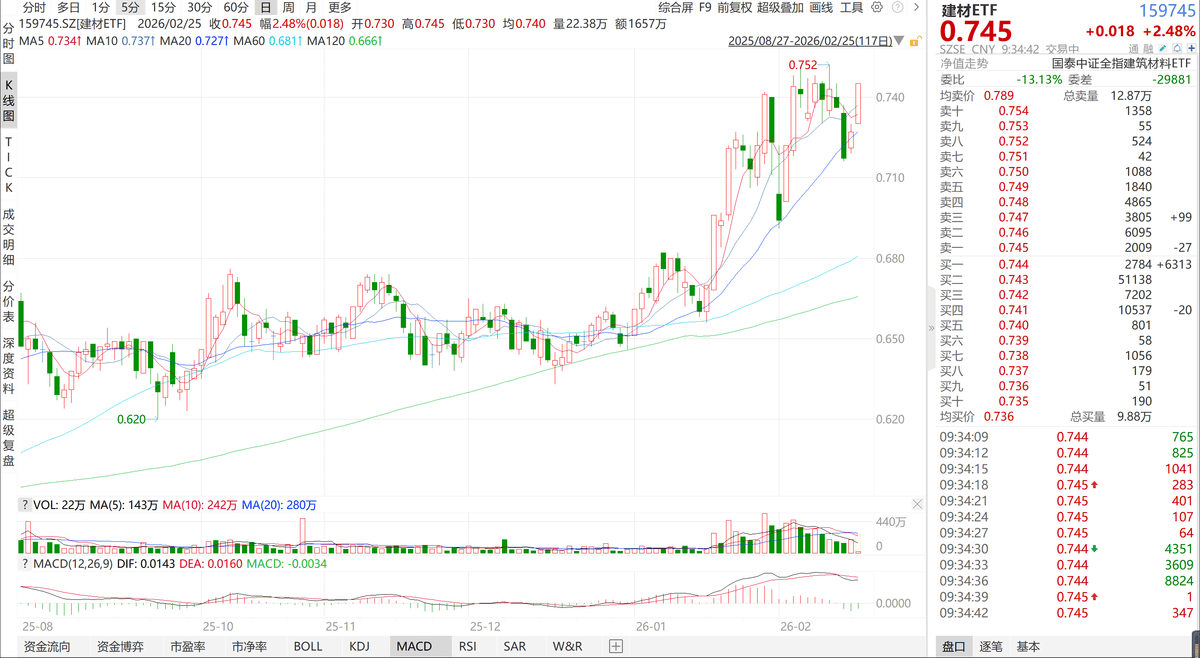
建材ETF(159745)强势领涨超2% 政策驱动+需求回暖 建材板块迎来布局良机
Sou Hu Cai Jing· 2026-02-25 01:49
Core Viewpoint - The recent strong performance of the building materials sector in the A-share market is attributed to multiple favorable factors, including macroeconomic policies, gradual improvement in industry fundamentals, and consensus on low-level capital allocation [1][3]. Policy Support - The real estate sector is experiencing a combination of policies aimed at stabilizing expectations, sales, and construction, which have led to increased demand for construction materials such as waterproofing, coatings, pipes, and tiles [3]. - Infrastructure investment continues to support the economy, with local governments accelerating the issuance of special bonds and major projects commencing, leading to a steady recovery in demand for traditional cyclical building materials like cement, glass, and fiberglass [3]. Cost and Profitability - Prices of core raw materials for building materials, such as coal, soda ash, and natural gas, have decreased, effectively lowering production costs and enhancing profit margins for companies [3]. - Ongoing supply-side reforms, including staggered production and capacity regulation, are clearing out outdated capacities, leading to increased industry concentration and improved profitability for leading companies [3]. Future Outlook - The investment opportunities in the building materials sector are clear, driven by both cyclical recovery and growth upgrades, with short-term benefits expected from accelerated construction and demand recovery [4]. - Long-term demand will be supported by urban renewal and the promotion of green and energy-efficient materials, while new materials like fiberglass and advanced composites are expected to grow due to high demand in new energy and AI sectors [4]. - The building materials sector is characterized by low valuations and high dividends, providing room for continued valuation recovery, supported by favorable policies, improving demand, and rising profitability [4]. Investment Strategy - For investors, the building materials ETF (159745) is recommended as an efficient tool for exposure to the sector, tracking the CSI All Share Construction Materials Index and covering a full industry chain [4]. - The ETF allows for easy trading, low fees, and risk diversification, making it suitable for both trend-following and value-oriented investors [4][5].
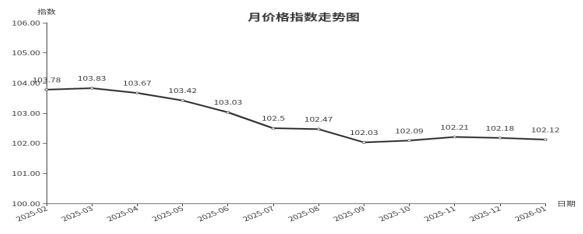
2026年1月临沂商城月价格总指数为102.12点,环比下跌0.06点
Zhong Guo Fa Zhan Wang· 2026-02-24 06:36
Core Viewpoint - The overall price index of Linyi Mall decreased slightly this month, indicating a mixed trend in various product categories with some experiencing price increases while others saw declines [1][13]. Price Index Summary - The total price index for Linyi Mall is 102.12 points, down 0.06 points month-on-month, a decrease of 0.06%, and down 1.72 points year-on-year, a decrease of 1.66% [1]. - Among 14 categories, 6 experienced price increases, 2 remained stable, and 6 saw price declines [3]. Category-Specific Price Changes Building and Decoration Materials - The price index for building and decoration materials rose to 107.90 points, an increase of 1.41 points month-on-month [5]. - The increase was driven primarily by the rise in prices of decorative materials, which increased by 1.50 points, while structural materials saw a slight decline [6]. Hardware and Electrical Materials - The price index for hardware and electrical materials reached 119.99 points, up 0.20 points month-on-month [9]. - The increase was influenced by a significant rise in copper prices, which raised production costs for electrical cables, leading to higher selling prices [9]. Educational and Office Supplies - The price index for educational and office supplies fell to 106.60 points, down 2.02 points month-on-month [10]. - The decline was mainly due to a significant drop in the prices of sports and entertainment products, which decreased by 5.09 points [10]. Steel Products - The price index for steel products decreased to 95.29 points, down 0.39 points month-on-month [12]. - The decline was attributed to weak demand in the real estate market, leading to reduced end-user demand and a cautious outlook among market participants [12].
未知机构:天风建筑建材新材料周观点20260223节前12-20260224
未知机构· 2026-02-24 03:55
Summary of Conference Call Records Industry Overview - The focus is on the **building materials and new materials** industry, particularly in relation to AI computing and electronic materials, with a notable emphasis on special electronic fabrics and PCB substrates [1][2]. Key Insights and Arguments 1. **AI-Driven Growth**: - The main growth drivers in the building materials sector are AI computing-related electronic materials, with special electronic fabrics leading the fiberglass segment. In the new materials sector, PCB substrates and semiconductor packaging materials are at the forefront [1]. 2. **Supply-Demand Dynamics**: - The electronic fabric market is experiencing a supply-demand imbalance, with an overall industry supply gap of approximately **20%**. Since January 2026, all categories of electronic fabrics have faced supply tightness, with companies holding orders for about **2 months** [1]. - The production capacity for standard electronic fabrics is shifting towards high-end products, resulting in a **60%** loss in capacity. This ongoing contraction in supply is expected to persist [1]. 3. **Price Increases**: - The electronic fabric industry has seen a price increase of **10%** in 2026, following **4-5** price hikes in 2025. High-end products like DK fabric, Q fabric, and CTE fabric are still in an upward price trend [1]. 4. **Production Bottlenecks**: - High-end product production relies on Toyota's advanced weaving machines, which have a delivery cycle of **1-2 years**. However, breakthroughs in pool kiln methods could lead to increased supply by 2029, potentially resulting in oversupply [1]. 5. **Inventory Levels**: - Inventory levels for CCL and electronic fabric factories are at historical lows, approximately **one week**, with PCB manufacturers extending their stocking period from the usual **1 month** to over **2 months** [1]. 6. **Profitability**: - High-end specialty electronic fabrics can achieve gross margins of **40%-50%**, with potential increases beyond **50%** as yield rates improve [1]. Recommendations 1. **Key Companies to Watch**: - Recommended companies include **Macro Technology**, **International Composites**, **China Jushi**, and **China National Materials**. Other notable mentions are **Philips**, **Gobi Technology**, and PCB-related firms like **China Tungsten High-Tech**, **Lianrui New Materials**, and **Dongcai Technology** [2]. 2. **Consumer Building Materials**: - The industry is nearing a bottoming phase, with significant price wars easing. Leading companies are shifting focus from price competition to quality and profitability recovery, with expectations for stabilization in 2026 and performance elasticity in 2027 [2]. 3. **Segment Differentiation**: - The waterproof segment shows signs of ending price wars, while the renovation of existing properties is becoming a core growth driver. Leading firms are enhancing their C-end and overseas strategies [2]. 4. **Strategic Focus**: - Major companies are prioritizing profitability recovery, channel optimization, and product diversification, while also accelerating overseas expansion to create a second growth curve [2]. 5. **Recommended Stocks**: - Elastic stocks include **Keshun Co.**, **Oriental Yuhong**, and **Hankao Group**. Stable stocks to consider are **Rabbit Baby**, **Sankeshu**, **Dongpeng Holdings**, **Monalisa**, and **China Liansu** [2]. Additional Insights - Traditional cyclical products are highlighted, with a focus on local state-owned enterprises like **Sichuan Road and Bridge**, **Shandong Road and Bridge**, and **China Railway**. The steel structure sector is represented by companies like **Honglu Steel Structure** and **Jinggong Steel Structure** [3]. - The cement sector is advised to focus on regional leaders such as **Western Cement**, **Huaxin Cement**, and **Shangfeng Cement** [3]. - Other new materials and robotics sectors are also mentioned, with companies like **Pana Micro透**, **TianYue Advanced**, and **Jing Sheng Co.** being noted [3].






国机通用(600444):中标中海油深圳海洋工程技术服务有限公司采购项目,中标金额为1568.43万元
Xin Lang Cai Jing· 2026-02-14 05:35
Group 1 - Company Guoji General Machinery Technology Co., Ltd. won a procurement project from CNOOC Shenzhen Marine Engineering Technology Service Co., Ltd. with a bid amount of 15.6843 million yuan [1][2] - In 2024, the company's operating revenue is projected to be 766 million yuan, with a growth rate of 1.47%, and a net profit attributable to the parent company of 40 million yuan, reflecting a growth rate of 0.28% [1][2] - For the first half of 2025, the company reported an operating revenue of 412 million yuan, a growth rate of 5.09%, and a net profit attributable to the parent company of 32 million yuan, showing a significant growth rate of 43.85% [1][2] Group 2 - The company operates in the industrial sector, focusing on products such as polymer materials, system integration services, and professional consulting services [1][2] - The main product composition for the 2024 report includes environmental equipment (52.81%), standard fluid machinery products (20.55%), testing devices (19.81%), other products (4.76%), and pipe and fitting manufacturing (2.07%) [1][2]
