素圈手镯

Search documents
国泰海通|批零社服:春节消费高景气,关注性价比、情绪价值和体验——2026年春节消费调研观察
国泰海通证券研究· 2026-02-26 13:59
Core Viewpoint - The article highlights the high consumer sentiment in offline retail and service consumption during the Spring Festival, with increased foot traffic in lower-tier markets and a surge in offline spending [1]. Group 1: Investment Insights - The tourism and travel sector exceeded expectations during the Spring Festival, with a positive outlook for related sectors such as hotels and scenic spots [2]. - Certain brands experienced long queues during the holiday, indicating potential for better-than-expected data [2]. - The adjustment of China-US tariffs is recommended to benefit cross-border e-commerce [2]. - The report includes insights from various cities, focusing on the performance of gold and jewelry, dining, hotels, supermarkets, and trendy toys during the Spring Festival [2]. Group 2: Sector Performance - **Hotels**: Leading hotel groups are expanding into lower-tier markets, with minimal price differences among brands. Many consumers in these areas are less familiar with hotel brands, relying on online travel agencies for bookings [2]. - **Dining and Tea**: Warm weather, new product launches, and subsidies contributed to strong offline consumption, with lower-priced tea and fast food performing better in lower-tier markets compared to high-tier cities [2]. - **Gold and Jewelry**: Expectations for price increases in gold by February 28, with promotional activities during the Spring Festival leading to high demand. Consumers are becoming more price-sensitive, with a focus on value [3]. - **Supermarkets**: There is a noticeable difference in customer flow, with lower-tier markets showing strong demand for experiential shopping. Popular items include prepared foods and gift boxes, with a preference for offline purchases [3]. - **Trendy Toys**: Young consumers drive demand, with holiday traffic boosted by student vacations. Limited edition and IP collaboration products are particularly popular [3].


2026年春节消费调研观察:春节消费高景气,关注性价比、情绪价值和体验
GUOTAI HAITONG SECURITIES· 2026-02-26 00:44
Investment Rating - The report assigns an "Overweight" rating for the industry [3] Core Insights - The report highlights a strong performance in offline retail and service consumption during the Spring Festival, particularly in lower-tier markets, indicating a robust consumer sentiment and demand [2][4] - Key investment opportunities are identified in the tourism and hospitality sectors, with specific recommendations for hotel groups and scenic spots [5][6] Summary by Relevant Sections Tourism and Hospitality - The overall travel and tourism during the Spring Festival exceeded expectations, with recommendations for hotel groups such as Huazhu Group, ShouLai Hotel, and JinJiang Hotels, as well as scenic spots like Emei Mountain A and Huangshan Tourism [5][6] - Major hotel chains are expanding into lower-tier markets without significant price differences, with local residents increasingly viewing high-end hotel restaurants as premium venues for gatherings [6] Retail and Consumer Goods - Certain brands experienced long queues during the Spring Festival, suggesting potential for exceeding sales expectations, with recommendations for CaiBai Co., LaoPu Gold, and LiuFu Group [5][6] - The report notes that consumer sensitivity to prices has increased, particularly in the gold and jewelry sector, with LaoPu Gold expected to raise prices on February 28, 2026 [6] Food and Beverage - The food and beverage sector saw strong performance due to favorable weather and new product launches, with lower-priced tea and fast food performing better in lower-tier markets compared to higher-tier cities [6] - High-priced dining benefited from the "reverse reunion" trend during the Spring Festival, particularly in higher-tier cities [6] E-commerce and Cross-border Trade - The report suggests investment in cross-border e-commerce due to adjustments in US-China tariffs, recommending companies like Anker Innovations and Green Union Technology [5][6] Other Notable Stocks - Additional recommendations include ZhuMian Group, Jiangsu Guotai, SuMeida, and HaiDiLao, indicating a broad range of investment opportunities across various sectors [5][6]


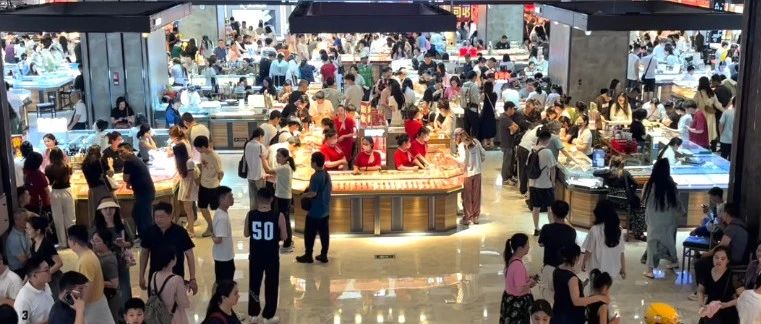
价格“跳水”!这地人山人海,引爆抢购潮!有游客拖箱扫货
第一财经· 2025-05-03 07:27
Core Viewpoint - The recent drop in gold prices has led to a surge in market activity, with many consumers flocking to purchase gold, particularly in Shenzhen's Shui Bei area [2][3]. Price Trends - As of May 1, the spot gold price fell over 2%, nearing $3,220 per ounce, and remained under $3,245 per ounce as of the report [2]. - In Shenzhen, the real-time gold price dropped to 780 RMB per gram [2]. Market Activity - On May 2, Shui Bei experienced a significant increase in foot traffic, with many consumers purchasing gold, including large investment pieces [6]. - A consumer from Guangxi purchased over 100,000 RMB worth of gold, indicating a trend of consumers buying in bulk during price dips [6]. Consumer Preferences - Popular items among consumers included investment gold, simple bangles, and gold bars, with lower processing fees compared to banks [7]. - The price difference for certain items, such as a high-quality imitation piece, was noted to be significant, with a drop of over 2,000 RMB in just over a week [7]. Supply and Demand - Following the price drop, there was a temporary shortage of larger investment gold pieces, but supply has since stabilized [9]. - Retailers in Shui Bei have maintained a fixed price of 780 RMB per gram during the holiday period, despite fluctuations in international gold futures [9]. Recovery Market - The gold buyback market has also seen increased activity, with many customers looking to sell their gold at higher prices than they purchased [10]. - A Hong Kong investor noted a profit of approximately 250 RMB per gram when selling gold back, highlighting the lucrative nature of the current buyback market [12]. Future Outlook - Analysts suggest that gold prices may experience short-term volatility, with several factors contributing to potential downward pressure [14]. - Key concerns include a significant reduction in the U.S. fiscal deficit, crowded long positions in gold, and a disparity between actual trading volume and potential investor capital [14].