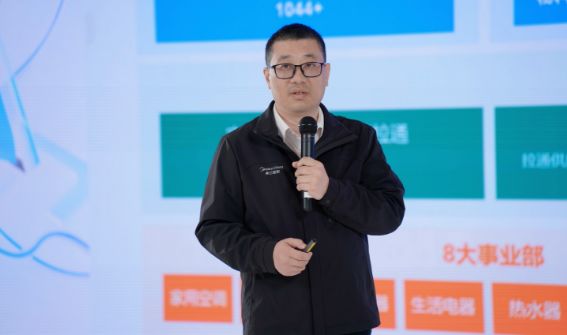
美擎AIGC3.1平台

Search documents
美云智数研发中心总经理兼CTO宋云报:打造“统一底座”推动AI在制造业规模化应用
Zheng Quan Ri Bao Zhi Sheng· 2026-02-01 16:14
Core Viewpoint - The manufacturing industry is at a critical juncture of transitioning from "digitalization" to "intelligentization," facing challenges in AI application due to issues like usability, traceability, and IT governance [1]. Group 1: AI Application Challenges - Companies often encounter three main challenges in AI application: high development barriers leading to reliance on a few experienced engineers, lack of traceability and explainability in AI results, and ineffective IT governance resulting in limited application scenarios [2]. - The establishment of a unified platform, such as the Meiqing AIGC platform, is essential for overcoming these challenges by connecting existing systems and providing open access to computing power and algorithms [2][3]. Group 2: Standardization and Scalability - The Meiqing AIGC platform aims to transform AI development from "custom development" to "replicable assets" through standardized processes, including over 50 intelligent agent templates and 500 enterprise connectors, significantly lowering development barriers [3][4]. - The platform incorporates three standardization dimensions: construction standardization, evaluation standardization, and operational standardization, allowing for effective management of the entire development cycle [3]. Group 3: Knowledge Management and Decision-Making - The platform emphasizes knowledge as an "engineering capability," focusing on the entire process from collection to governance, which is crucial for building trust in AI outputs among business personnel and management [5]. - The Meiqing AIGC platform boasts a semantic retrieval accuracy rate over 20% higher than mainstream open-source solutions, providing features like knowledge error correction and traceability to enhance the professionalism of intelligent agents [5][6]. Group 4: Industry Focus and Future Outlook - The company is committed to focusing on industrial scenarios rather than participating in generic model development, leveraging its parent company's extensive manufacturing experience to create barriers that cannot be easily replicated [6]. - By 2025, the application of AI technology is expected to generate over 600 million yuan in efficiency gains for the parent company, with cost savings in certain scenarios reaching up to 90% [6]. - The integration of AI capabilities is viewed as a necessity for enhancing core competitiveness in the manufacturing sector, with the depth of AI integration determining the success or failure of enterprises [6][7].

美云智数研发中心总经理兼CTO宋云报:打造“统一底座” 推动AI在制造业规模化应用
Zheng Quan Ri Bao· 2026-02-01 16:12
Core Viewpoint - The manufacturing industry is at a critical juncture transitioning from "digitalization" to "intelligence," facing challenges in AI application due to issues like usability, interpretability, and IT governance [2][3]. Group 1: AI Platform Development - Midea Group's subsidiary, Meiyun Zhishu, launched the Meiqing AIGC 3.1 platform, aimed at addressing the difficulties in AI implementation within manufacturing [2][3]. - The success of AI applications relies on establishing a platform that supports the long-term operation of intelligent agents, rather than on specific models or applications [3]. - The Meiqing AIGC platform is designed as a unified base that connects existing enterprise systems like ERP, PLM, and MES, while also providing external computational power and algorithm support [4]. Group 2: Standardization and Scalability - The platform aims to transform intelligent agents from "custom development" to "replicable assets" through standardized development, evaluation, and operation processes [4]. - It includes over 50 intelligent agent templates and 500 enterprise connectors, significantly lowering the development threshold using no-code or low-code technologies [4]. - A standardized evaluation system with over 20 metrics is established to quantify the performance of intelligent agents before deployment [4]. Group 3: Knowledge Management and Decision-Making - The platform treats knowledge as an "engineering capability," emphasizing the entire process from collection to governance, which is crucial for building trust in AI outputs [5]. - The Meiqing AIGC platform boasts a semantic retrieval accuracy rate that exceeds mainstream open-source solutions by over 20% [5]. - It enables business personnel to directly pose questions in natural language, facilitating actionable insights rather than mere data interpretation [5][6]. Group 4: Industry Focus and Future Outlook - Meiyun Zhishu focuses on industrial scenarios rather than generic model development, leveraging Midea Group's extensive manufacturing experience [7]. - By 2025, Midea Group anticipates achieving over 600 million yuan in efficiency gains through AI applications, with cost reductions in certain scenarios reaching up to 90% [7]. - The integration of AI capabilities is viewed as essential for enhancing core competitiveness in the manufacturing sector, with the goal of creating scalable value through the Meiqing AIGC platform [7].

美云智数总裁金江:美的累计打造超1.3万个智能体 约千分之二可商业化
Mei Ri Jing Ji Xin Wen· 2026-01-20 12:41
Core Insights - The AI agent market is expected to accelerate its commercialization and application in various sectors by 2026, with a focus on unlocking the next wave of AI business value [3][4] - Midea Group has launched the Meiqing AIGC 3.1 platform and intelligent factory solutions, emphasizing the importance of AI strategy and the development of AI agents [2][5] Group 1: Midea Group's AI Strategy - Midea Group aims to enhance its AI strategy significantly by 2025, focusing on building AI agent capabilities [2] - The company has developed over 13,000 AI agents in the past three years, with 158 agents contributing 95% of the value output, although only 0.2% have been commercialized [2][5] - Midea plans to achieve cost reductions of 600 million yuan (approximately 84 million USD) through AI by 2025 and over 900 million yuan (approximately 126 million USD) by 2026 [2][5] Group 2: Market Trends and Predictions - The AI agent industry is projected to grow from 5.1 billion USD in 2024 to 47.1 billion USD by 2030, with a compound annual growth rate of 44.8% [5] - Predictions for 2026 include a shift in AI competition from parameter comparison to practical implementation, with the year being termed as the "Year of the Billion AI Agents" [3][4] Group 3: Product Development and Market Positioning - Midea Group plans to release 20 to 30 new AI agent products, expanding its offerings to over 40 agents for external sales [3][4] - The newly launched AI products will target general scenarios as well as specific applications in manufacturing, research and development, marketing, and supply chain [4] - Midea aims to establish a competitive edge by focusing on domain-specific AI agents, recognizing the barriers to understanding application scenarios [5]
美云智数总裁金江:美的累计打造超1.3万个智能体,约千分之二可商业化
Mei Ri Jing Ji Xin Wen· 2026-01-20 12:19
Core Insights - The core viewpoint of the articles emphasizes the accelerating commercialization of AI agents, with a focus on how companies are leveraging AI to unlock new business value and enhance operational efficiency in various sectors [1][2][4]. Group 1: AI Agent Development and Commercialization - In 2026, the competition in AI agents will shift towards unlocking the next wave of commercial value, with a significant increase in the number of AI agents being developed and deployed [2][4]. - Midea Group has launched the Meiqing AIGC 3.1 platform and intelligent agent factory solutions, highlighting the importance of AI strategy and the construction of agent capabilities [1][3]. - Midea has created over 13,000 AI agents in the past three years, with 158 agents contributing 95% of the value output, although only 0.2% have been commercialized [1][4]. Group 2: Financial Impact and Projections - Midea Group aims to reduce costs by 600 million yuan in 2025 and over 900 million yuan in 2026 through AI initiatives [1][4]. - The AI agent market is projected to grow from $5.1 billion in 2024 to $47.1 billion by 2030, with a compound annual growth rate of 44.8% [4]. Group 3: Strategic Focus and Future Plans - Midea's strategy involves a phased approach to AI capabilities, progressing from embedding AI in processes to collaborative work with AI, and ultimately to full automation through agents [4]. - The company plans to release 20 to 30 new AI agent products, expanding its offerings to over 40 agents for external sales, focusing on general and manufacturing-specific applications [2][3].
对话美云智数总裁金江:美的累计打造了1.3万个智能体,千分之二可商业化,希望以领域智能体构建护城河
Mei Ri Jing Ji Xin Wen· 2026-01-16 09:54
Core Insights - The AI agent industry is expected to mature significantly by 2026, with a focus on unlocking the next wave of AI commercial value [3] - Midea Group has launched the Meiqing AIGC 3.1 platform and intelligent agent factory solutions, emphasizing the importance of AI in its strategic development [1] - Midea aims to achieve cost reductions of 1.8 billion yuan in 2024, 6 billion yuan in 2025, and over 9 billion yuan in 2026 through AI implementation [5] Group 1 - Midea Group has developed over 13,000 AI agents in the past three years, with 158 agents contributing 95% of the value output, although only 0.2% have been commercialized [1][5] - The company plans to release 20 to 30 new AI agent products in 2026, expanding its offerings to over 40 agents for external sales [3][4] - The market for AI agents is projected to grow from $5.1 billion in 2024 to $47.1 billion by 2030, with a compound annual growth rate of 44.8% [4] Group 2 - Midea's AI strategy involves a three-step approach: from embedding AI in processes, to co-piloting with AI, and finally to full automation with AI agents [5] - The focus on domain-specific AI agents is seen as a way to build a competitive advantage, as general-purpose agents have a relatively low barrier to entry [5] - The company aims to effectively capture market share and customer mindshare by launching its AI capabilities at the beginning of 2026 [4]