工业AI

Search documents
思谋科技冲港股IPO引争议:对赌赎回条款压顶、高管股权激励“零元购”
凤凰网财经· 2026-03-27 12:15
Core Viewpoint - SmartMore Inc. is aiming to become the first publicly listed company in the global industrial AI sector by submitting its IPO application to the Hong Kong Stock Exchange, with significant backing from major financial institutions [1][3]. Group 1: Company Overview - SmartMore Inc. was founded in 2019 by Dr. Jiajiaya, focusing on providing industrial AI solutions, including robotics, edge AI sensors, and intelligent software systems, primarily in consumer electronics and new energy battery sectors [5]. - The company has established a strong client base, including Tesla and Luxshare Precision, and has delivered nearly 140,000 intelligent units to over 730 global enterprise clients [6]. Group 2: Financial Performance - The company has shown rapid revenue growth, with projections indicating an increase from 485 million yuan in 2023 to 1.086 billion yuan in 2025, representing a compound annual growth rate (CAGR) of approximately 49.7% [6]. - Despite the revenue growth, SmartMore has faced significant losses, with net losses of 546 million yuan, 735 million yuan, and 991 million yuan over the past three years, totaling 2.272 billion yuan [7]. - The company's total liabilities are projected to reach 5.334 billion yuan by the end of 2025, with a significant portion being current liabilities, indicating a tight cash flow situation [7]. Group 3: Market Position and Competition - SmartMore claims to hold the largest market share in the industrial AI sector at 5.8%, but the competition is fierce, with the second-largest player holding a 5.3% market share, and major companies like Huawei and Siemens posing significant challenges [6][8]. - The company plans to invest 394 million yuan in R&D by 2025, which will account for 36.3% of its revenue, but the rapid pace of technological change in the industrial AI field raises uncertainties regarding the return on these investments [8]. Group 4: Controversies and Concerns - The company has faced scrutiny over its stock option plan, which allows executives to purchase shares at a significantly low price, raising concerns about the fairness and transparency of the compensation structure [9][11]. - The high costs associated with stock-based compensation are expected to increase significantly, with share-based payment expenses projected to reach 475 million yuan in 2025, accounting for nearly 80% of administrative expenses [11]. - The ongoing high losses and the pressure to complete the IPO due to redemption clauses in preferred shares have raised questions about the company's long-term viability and strategic direction [7][12].


制造业与其养“龙虾”,不如造一把“AK47”
虎嗅APP· 2026-03-23 10:24
Core Insights - The article discusses the rise of industrial AI, particularly focusing on the company Melody, which aims to transform manufacturing processes through AI solutions. The founder emphasizes the need for simplicity and usability in AI applications, likening it to the AK47 for its ease of use and reliability [6][34]. Group 1: Company Overview - Melody is a startup focused on AI transformation for manufacturing, specifically targeting procurement and process optimization [6][10]. - The company has established a valuation of 300 million yuan during its angel round and is currently seeking further investment [9]. - The founder, Xu Zhongren, emphasizes the importance of understanding client needs and addressing the root causes of issues within manufacturing processes [21][22]. Group 2: Industry Context - The industrial AI sector is experiencing a dichotomy where advanced AI applications are rapidly being adopted in various verticals, while many traditional manufacturing practices remain outdated [7][10]. - There is a significant gap between the promises of AI in manufacturing and the actual implementation results, with many companies still relying on manual processes and lacking proper data management [10][11]. - The article highlights the challenges faced by large enterprises in adopting AI solutions, often due to their reliance on generic models that do not cater to specific operational needs [15][41]. Group 3: Challenges and Solutions - Many manufacturing companies have previously invested in digital solutions that failed to deliver, leading to skepticism about new AI initiatives [25][28]. - Melody's approach involves conducting a thorough "health check" of a company's data processes before implementing AI solutions, which is a departure from previous information technology initiatives that created isolated data silos [12][20]. - The company aims to simplify the data collection and analysis process, ensuring that AI applications are user-friendly and can be operated by individuals with minimal technical expertise [34][36]. Group 4: Market Position and Strategy - Melody's strategy involves focusing on specific pain points within manufacturing, such as procurement and process efficiency, rather than offering broad, generic solutions [18][33]. - The company has a competitive advantage due to its ability to deliver tailored solutions quickly, contrasting with larger firms that may take significantly longer to implement similar projects [41]. - The founder believes that addressing complex scenarios in manufacturing will yield higher value and create more significant opportunities for growth [37][38].

IPO周报|宇树科技科创板IPO获受理;思谋科技冲刺港交所
IPO早知道· 2026-03-22 12:58
Core Viewpoint - The article provides an overview of recent IPO activities in the Hong Kong, US, and A-share markets, highlighting key companies such as Yushu Technology, Deshi Biotechnology, and SmartMore Inc. Group 1: Yushu Technology - Yushu Technology's IPO application was accepted on March 20, aiming to raise CNY 4.202 billion [3] - Founded in 2016, Yushu Technology focuses on self-research in general robotics, achieving significant market share in quadruped and humanoid robots, especially overseas [3] - The company sold over 30,000 quadruped robots from 2022 to 2024, establishing a strong position in the global market [3] - Yushu Technology's revenue is projected to reach CNY 1.708 billion in 2025, with a year-on-year growth of 335.36%, and a net profit of CNY 600 million, up 674.29% [4] - Major investors include Meituan, Sequoia China, and Matrix Partners, with Meituan holding 9.65% of shares [4] Group 2: Deshi Biotechnology - Deshi Biotechnology commenced its IPO process on March 19, with plans to list on the Hong Kong Stock Exchange under the code "2526" [6] - The company aims to raise up to HKD 900 million through the issuance of 7,999,200 shares, with a market valuation potentially reaching nearly HKD 10 billion [6] - Deshi Biotechnology specializes in medical imaging products, with its core product, AI AutoVision®, designed for chromosome karyotype analysis, already completing clinical trials [7] - The company holds a 30.6% market share in China's chromosome karyotype analysis sector, leading the market as of 2024 [8] Group 3: SmartMore Inc. - SmartMore Inc. submitted its IPO application to the Hong Kong Stock Exchange on March 16, aiming to become the first "Industrial AI Intelligent Agent" stock [10][11] - The company provides a comprehensive AI technology system for manufacturing, serving over 730 clients globally, including Tesla and BOE [11] - Revenue projections for SmartMore Inc. are CNY 485 million in 2023, CNY 756 million in 2024, and CNY 1.086 billion in 2025, with growth rates of 55.9% and 43.7% respectively [11] - The company has received investments from notable firms, achieving a valuation of USD 1.23 billion before its IPO [12][13]

贾佳亚创办的思谋科技冲刺港交所:或成「工业AI智能体第一股」,年营收近11亿元
IPO早知道· 2026-03-16 07:00
Core Viewpoint - SmartMore Inc. aims to redefine the global manufacturing operating system using AI, positioning itself as the first "Industrial AI Intelligent Agent" stock in the market [3][4]. Company Overview - Founded in 2019 by Dr. Jiajiaya, SmartMore has over 25 years of experience in academia and technology, with a focus on AI applications in manufacturing [3][4]. - The company provides industrial AI intelligent agents, including robots, edge AI sensors, and intelligent software systems, enhancing autonomy and automation in manufacturing [4][6]. Market Position - By December 31, 2025, SmartMore is projected to serve over 730 clients globally, including major companies like Tesla and BOE Technology Group, across various industry verticals [4][6]. - SmartMore is recognized as the largest provider of industrial AI intelligent agents in China by 2025, with a comprehensive ecosystem built on proprietary technology [6][10]. Product Offerings - SmartMore's industrial AI intelligent agents consist of three main components: robots for adaptive and efficient production, edge AI sensors for real-time processing, and intelligent software systems for complex decision-making [8]. - The company has achieved several industry-first breakthroughs, including comprehensive visual inspection of complex surfaces and real-time identification challenges in harsh environments [8]. Financial Performance - Revenue projections for SmartMore from 2023 to 2025 are 485 million, 756 million, and 1.086 billion CNY, with year-on-year growth rates of 55.9% and 43.7% for 2024 and 2025, respectively [9]. - The gross profit margin is expected to rise from 30.5% in 2023 to 37.3% in 2025, indicating a positive trend in profitability [9]. Industry Insights - The global industrial AI intelligent agent market is expected to grow from 14.6 billion CNY in 2023 to 36.7 billion CNY by 2025, with a compound annual growth rate (CAGR) of 58.6% [10]. - The Chinese market for industrial AI intelligent agents is projected to expand from 5.8 billion CNY in 2023 to 14.8 billion CNY by 2025, with a CAGR of 59.9% [10]. Investment and Valuation - SmartMore has attracted investments from notable firms, including IDG Capital and Sequoia China, and achieved a valuation of 1.23 billion USD prior to its IPO [11][12]. - The funds raised from the IPO will primarily be used for technology and product development, commercial expansion, strategic partnerships, and general corporate purposes [12].

IDC:到2028年中国工业企业AI支出规模将接近90亿元 年复合增长率达38%
智通财经网· 2026-02-06 05:52
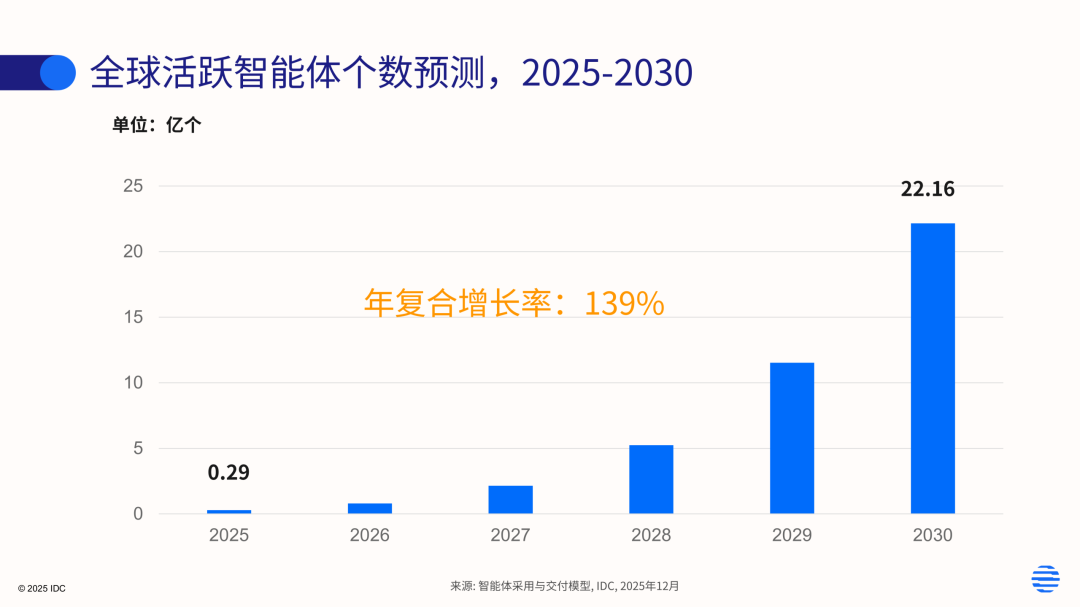
Core Insights - The demand for industrial AI has shifted from exploratory investments by leading enterprises to a necessity for quality improvement, cost reduction, and efficiency enhancement across all industries. IDC predicts that by 2028, AI spending in China's industrial sector will approach 9 billion RMB, with a compound annual growth rate (CAGR) of 38% [1][2] - By 2030, the number of active intelligent agents globally is expected to exceed 2.216 billion, with a CAGR of 139%, making industrial active agents a crucial component [1][2] Domestic Market - The dual resonance of large-scale implementation of industrial AI and explosive growth of intelligent agents is evident. The rapid increase in the number of intelligent agents will resonate with the demand for large-scale industrial AI, driven by stronger needs for cross-system collaboration and process closure [2] - The Chinese government has initiated a systematic layout for industrial AI, aiming to launch 1,000 high-level industrial intelligent agents by 2027, marking a shift from voluntary enterprise exploration to national-level strategic planning [4] Technological Evolution - Industrial intelligent agents are evolving towards a technology route characterized by strong professional attributes and high adaptability. Specialized intelligent agents are rapidly increasing to meet the unique demands of various industrial processes, such as design, testing, quality inspection, and energy management [5] Global Market - IDC forecasts that by 2028, global industrial AI spending will approach 2.2 trillion RMB, with a CAGR of 63%. Compared to China, the overseas market presents greater opportunities in terms of demand volume, industry diversity, and payment capacity [6] - There is a noticeable differentiation in industrial AI demand across global regions. In developed markets like Europe and North America, industrial enterprises prefer systematic, high-end customized solutions, while emerging markets like Southeast Asia show strong willingness for implementation but lack suitable localized solutions [6] - Chinese industrial AI firms are encouraged to leverage their strengths in specific scenarios such as industrial vision and energy optimization to fill gaps in overseas markets, focusing on lightweight deployment and rapid effectiveness [6]
美云智数研发中心总经理兼CTO宋云报: 打造“统一底座”推动AI在制造业规模化应用
Zheng Quan Ri Bao· 2026-02-01 22:44
Core Viewpoint - The manufacturing industry is at a critical juncture of transitioning from "digitalization" to "intelligentization," facing challenges in AI application due to issues like usability, interpretability, and IT governance [1] Group 1: AI Platform Development - Midea Group's subsidiary, Meiyun Zhishu, launched the Meiqing AIGC 3.1 platform aimed at addressing the difficulties in AI implementation within manufacturing [1] - The success of AI applications depends on establishing a platform that supports the long-term operation of intelligent agents, rather than relying on specific models or applications [2] - The Meiqing AIGC platform is designed as a unified base that connects existing enterprise systems (ERP, PLM, MES) and provides external computational power and algorithm support [2] Group 2: Standardization and Scalability - The platform aims to transform intelligent agents from custom developments into replicable assets through standardized construction, evaluation, and operation [3] - It includes over 50 intelligent agent templates and 500 enterprise connectors, significantly lowering development barriers with no-code or low-code technologies [3] - A standardized evaluation system with over 20 metrics is established to quantify the performance of intelligent agents before deployment [3] Group 3: Knowledge Management and Decision-Making - The integration of intelligent agents into key business processes is hindered by the "hallucination" effect, which is linked to the governance of knowledge [4] - The Meiqing AIGC platform treats knowledge as an engineering capability, emphasizing the entire process from collection to governance to ensure trust in the outputs [4] - The platform boasts a semantic retrieval accuracy rate that exceeds mainstream open-source solutions by over 20% [4] Group 4: Focus on Manufacturing Scenarios - Meiyun Zhishu is committed to focusing on industrial scenarios rather than participating in generic model development, leveraging Midea Group's extensive manufacturing experience [6] - By 2025, Midea Group anticipates achieving over 600 million yuan in efficiency gains through AI applications, with cost reductions in certain scenarios reaching up to 90% [6] - The company has developed over 13,000 intelligent agents internally, identifying high-value scenarios for commercialization [6]

美云智数研发中心总经理兼CTO宋云报:打造“统一底座”推动AI在制造业规模化应用
Zheng Quan Ri Bao Zhi Sheng· 2026-02-01 16:14
Core Viewpoint - The manufacturing industry is at a critical juncture of transitioning from "digitalization" to "intelligentization," facing challenges in AI application due to issues like usability, traceability, and IT governance [1]. Group 1: AI Application Challenges - Companies often encounter three main challenges in AI application: high development barriers leading to reliance on a few experienced engineers, lack of traceability and explainability in AI results, and ineffective IT governance resulting in limited application scenarios [2]. - The establishment of a unified platform, such as the Meiqing AIGC platform, is essential for overcoming these challenges by connecting existing systems and providing open access to computing power and algorithms [2][3]. Group 2: Standardization and Scalability - The Meiqing AIGC platform aims to transform AI development from "custom development" to "replicable assets" through standardized processes, including over 50 intelligent agent templates and 500 enterprise connectors, significantly lowering development barriers [3][4]. - The platform incorporates three standardization dimensions: construction standardization, evaluation standardization, and operational standardization, allowing for effective management of the entire development cycle [3]. Group 3: Knowledge Management and Decision-Making - The platform emphasizes knowledge as an "engineering capability," focusing on the entire process from collection to governance, which is crucial for building trust in AI outputs among business personnel and management [5]. - The Meiqing AIGC platform boasts a semantic retrieval accuracy rate over 20% higher than mainstream open-source solutions, providing features like knowledge error correction and traceability to enhance the professionalism of intelligent agents [5][6]. Group 4: Industry Focus and Future Outlook - The company is committed to focusing on industrial scenarios rather than participating in generic model development, leveraging its parent company's extensive manufacturing experience to create barriers that cannot be easily replicated [6]. - By 2025, the application of AI technology is expected to generate over 600 million yuan in efficiency gains for the parent company, with cost savings in certain scenarios reaching up to 90% [6]. - The integration of AI capabilities is viewed as a necessity for enhancing core competitiveness in the manufacturing sector, with the depth of AI integration determining the success or failure of enterprises [6][7].
美云智数研发中心总经理兼CTO宋云报:打造“统一底座” 推动AI在制造业规模化应用
Zheng Quan Ri Bao· 2026-02-01 16:12
Core Viewpoint - The manufacturing industry is at a critical juncture transitioning from "digitalization" to "intelligence," facing challenges in AI application due to issues like usability, interpretability, and IT governance [2][3]. Group 1: AI Platform Development - Midea Group's subsidiary, Meiyun Zhishu, launched the Meiqing AIGC 3.1 platform, aimed at addressing the difficulties in AI implementation within manufacturing [2][3]. - The success of AI applications relies on establishing a platform that supports the long-term operation of intelligent agents, rather than on specific models or applications [3]. - The Meiqing AIGC platform is designed as a unified base that connects existing enterprise systems like ERP, PLM, and MES, while also providing external computational power and algorithm support [4]. Group 2: Standardization and Scalability - The platform aims to transform intelligent agents from "custom development" to "replicable assets" through standardized development, evaluation, and operation processes [4]. - It includes over 50 intelligent agent templates and 500 enterprise connectors, significantly lowering the development threshold using no-code or low-code technologies [4]. - A standardized evaluation system with over 20 metrics is established to quantify the performance of intelligent agents before deployment [4]. Group 3: Knowledge Management and Decision-Making - The platform treats knowledge as an "engineering capability," emphasizing the entire process from collection to governance, which is crucial for building trust in AI outputs [5]. - The Meiqing AIGC platform boasts a semantic retrieval accuracy rate that exceeds mainstream open-source solutions by over 20% [5]. - It enables business personnel to directly pose questions in natural language, facilitating actionable insights rather than mere data interpretation [5][6]. Group 4: Industry Focus and Future Outlook - Meiyun Zhishu focuses on industrial scenarios rather than generic model development, leveraging Midea Group's extensive manufacturing experience [7]. - By 2025, Midea Group anticipates achieving over 600 million yuan in efficiency gains through AI applications, with cost reductions in certain scenarios reaching up to 90% [7]. - The integration of AI capabilities is viewed as essential for enhancing core competitiveness in the manufacturing sector, with the goal of creating scalable value through the Meiqing AIGC platform [7].
上海精智深度分析:工业AI领军者的护城河与增长路径
Feng Huang Wang Cai Jing· 2026-01-27 05:13
Group 1 - The core viewpoint of the article highlights Shanghai Jingzhi's significant milestone in the industrial AI sector with its IPO application, showcasing its leadership in smart manufacturing solutions and its unique "data + manufacturing + AI" closed-loop ecosystem [1] - The global manufacturing industry is at a critical juncture of intelligent transformation, with China's industrial AI solutions market projected to grow from RMB 5.8 billion in 2024 to RMB 93.5 billion by 2030, reflecting a compound annual growth rate of 58.8% [2] - Shanghai Jingzhi has a first-mover advantage with nearly 20 years of data accumulation, serving leading clients in automotive, communication, and robotics sectors, which has resulted in a rich industrial data resource [2][3] Group 2 - The company has launched multiple commercial AI products that cover core manufacturing processes, significantly reducing production planning time and enhancing defect detection capabilities [3] - Shanghai Jingzhi's unique model of using its own factory for training AI algorithms sets it apart from traditional equipment manufacturers and pure software startups, allowing it to address real industrial needs effectively [4] - The company aims to deepen its core AI products and explore SaaS offerings, with a long-term vision of building an industrial AI ecosystem platform that leverages data feedback loops to enhance algorithm advantages [4] Group 3 - The IPO of Shanghai Jingzhi serves as an important window for observing the effectiveness of industrial AI implementation, with its value stemming from its data moat, productization capabilities, and industry positioning [5] - The company represents a stable and growth-oriented investment opportunity, benefiting from its manufacturing foundation and the growth potential brought by AI empowerment [5] - Shanghai Jingzhi's nearly two decades of manufacturing experience is a valuable intangible asset, establishing a barrier that is difficult to disrupt through short-term capital or algorithmic innovation [5]
重大!明天这四个方向要盯紧了,政策与全球巨头都在猛推,节奏别踏错
Sou Hu Cai Jing· 2026-01-10 01:11
Market Overview - The market is expected to face a technical test on January 8, with the index deviating from the 5-day moving average, indicating a potential need for a pullback or consolidation [1] - The market may attempt to test resistance around 4098 points, but caution is advised as a quick rise could lead to a pullback [3] - Key support levels to watch are around 4071 points and 4056 points, indicating a current state of consolidation [3] Sector Focus - **Commercial Aerospace**: Driven by SpaceX's ambitious plans to scale production, the domestic industry is seeing advancements in reusable rocket technology and increased visibility of orders. Key companies include Zhongguang Fanglong and Aerospace Development [5] - **Semiconductors**: The demand for high-performance storage chips is rising due to AI applications, with companies like SanDisk experiencing significant stock price increases. The advanced packaging market is also growing rapidly, particularly in China [7][8] - **Industrial AI**: Supported by government initiatives, the integration of AI in manufacturing processes is expected to enhance efficiency and reduce costs. Companies like Hand Information and Baoxin Software are positioned well in this sector [10] - **Robotics**: The open-source movement led by NVIDIA is accelerating the development of robots, particularly humanoid robots, making them more accessible for various applications. The global humanoid robot market is projected to grow over 26% annually [12] Investment Opportunities - The market is in a phase of sector rotation, with a focus on commercial aerospace, semiconductors, industrial AI, and robotics as key areas for potential investment. These sectors align with global trends and domestic policy support [13]