股票类基金

Search documents
【中诚研究】2025年四季度公募基金市场表现及展望
Sou Hu Cai Jing· 2026-01-23 00:56
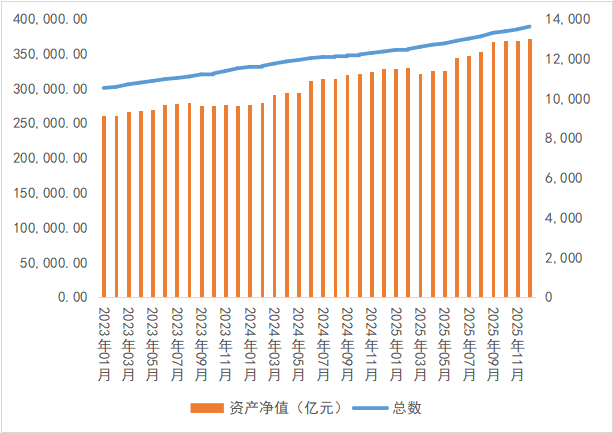
Core Viewpoint - The public fund market in China is experiencing rapid growth in net asset value, driven by domestic economic recovery, Federal Reserve interest rate cuts, and increased issuance of new funds, particularly FOF funds, despite a slowdown in stock fund performance [1][2][3]. Group 1: Overall Characteristics of the Public Fund Market - The public fund market shows a rapid year-on-year growth in net asset value, with a total scale reaching 316,492.31 billion yuan, reflecting a year-on-year growth rate of 5.03% [3]. - The net asset value of funds reached 371,462.44 billion yuan, with a year-on-year growth rate of 13.14% [3]. - The structure of newly issued funds indicates a stable proportion of stock funds, while bond funds have seen a year-end rebound, and FOF funds have experienced significant growth [2][3]. Group 2: New Fund Issuance - In Q4, 2,798.74 billion yuan of new public funds were established, marking a year-on-year increase of 5.35% [7]. - The monthly establishment scale increased from 742.86 billion yuan in October to 1,109.21 billion yuan in December [7]. - The market's performance has been mixed, with the Shanghai Composite Index slightly rising by 2.22%, while the Shenzhen Component Index and CSI 300 experienced slight declines [7]. Group 3: FOF Fund Growth - The issuance scale of FOF funds surged, with their proportion rising from 0.98% in September to 23.92% in October, and maintaining 17.95% and 9.70% in November and December, respectively [11]. - FOF funds have become a highlight due to their cross-asset allocation capabilities amid market fluctuations [11]. Group 4: Performance of Various Fund Types - Stock fund performance has slowed, with only 38.63% of ordinary stock funds achieving positive returns in the last three months [13]. - Passive index funds showed significant style differentiation, with 46.94% achieving positive returns, driven by sectors like industrial metals and insurance [16]. - Bond funds have shown recovery, with 97.30% of medium- to long-term pure bond funds achieving positive returns [19]. Group 5: Commodity Fund Performance - Among commodity funds, 96.36% achieved positive returns, with the highest being the Guotou Ruijin Silver Futures A, yielding 62.43% [22]. - The demand for strategic resources has increased, highlighting the financial attributes of metals like copper and tin [22]. Group 6: Future Outlook for the Public Fund Market - The economic strategy for 2026 emphasizes "stability while seeking progress" and aims to implement more proactive macro policies to expand domestic demand [23]. - The Federal Reserve's recent interest rate cut and asset purchasing program are expected to improve liquidity conditions, benefiting global markets and commodities priced in dollars [23]. - Investment strategies should remain moderately aggressive, increasing equity asset allocation, particularly in technology and cyclical sectors [23].

债基地震!基金C份额“废”了?简评《公募销售费用管理规定》对个人投资者的影响
市值风云· 2025-09-10 10:11
Core Viewpoint - The article discusses the recent regulatory changes in public fund sales fees, emphasizing their significant impact on individual investors and the public fund industry as a whole [3][5]. Summary by Sections Regulatory Changes - The new regulations aim to lower subscription and sales service fees for public funds and redefine redemption fee requirements, mandating a minimum 0.5% redemption fee for investors who redeem before holding for six months [4][6]. Impact on Bond Funds - The introduction of a 0.5% redemption fee for bond funds will discourage individual investors from investing in short-term bond products, as many bond funds have only generated around 0.5% returns this year [7][9]. - Investors are advised to prepare for holding bond funds for at least six months to avoid redemption fees, which may lead to a shift towards bond ETFs for liquidity [9][10]. Changes in Fund Classes - The new rules diminish the advantages of Class C shares, which previously offered lower redemption fees for short-term investors, making Class A shares more appealing for most investors [11][14]. - The article highlights that the previous strategy of using Class C shares for short-term trading will likely become obsolete due to the new regulations [14]. Shift Towards ETFs - The regulatory changes are expected to drive more individual investors towards bond ETFs and other liquid investment products, as public bond funds may lose their role as liquidity management tools [15][18]. - The article notes a growing trend of institutional investors embracing ETFs, indicating a shift in investment strategies within the market [15][16].