
脑电采集设备

Search documents
2025年中国脑机接口行业上游市场分析 脑电电极以无创电极为主【组图】
Qian Zhan Wang· 2026-02-03 08:08
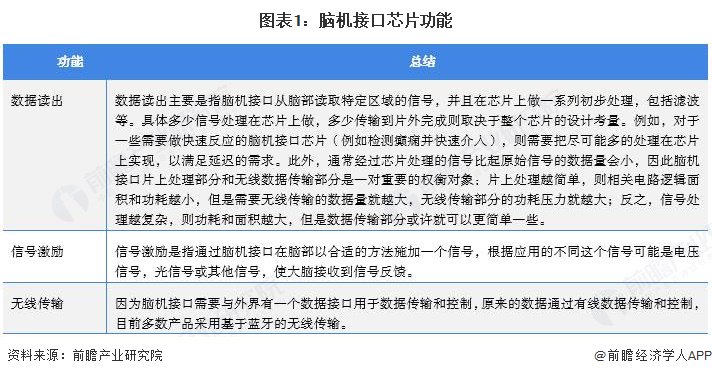
Core Insights - The article discusses the development prospects and investment opportunities in the brain-computer interface (BCI) industry, highlighting key players and technological advancements in the field [1] Group 1: Market Overview - The BCI hardware mainly consists of brain signal acquisition devices and BCI chips, with invasive chips requiring higher standards than non-invasive ones [1] - The BCI chip market is becoming increasingly competitive, with major players like Neuralink and NeuroSky launching specialized chips [4] - Hainan University has developed a series of core technologies and products for implantable BCIs, including high-throughput neural signal acquisition chips, which signify a move towards self-sufficiency in BCI technology in China [4][6] Group 2: Chip Analysis - Invasive BCI chips perform data readout and signal stimulation, with design considerations affecting the balance between on-chip processing and wireless data transmission [2] - The article mentions specific chips developed by various companies, including the SX-R128S4, SX-S32, and SX-WD60 from Hainan University, which together form a closed-loop technology covering the entire BCI chain [6] Group 3: EEG Acquisition Devices - EEG acquisition devices are categorized into non-invasive and invasive electrodes, with non-invasive electrodes being less accurate due to noise interference [7] - As of October 2025, 50 EEG electrode products have received NMPA certification in China, with 84% being domestically produced [9] - Among the certified products, non-invasive electrodes dominate, accounting for 74%, while invasive electrodes have seen an increase in market share compared to 2024 [11]

开年探“实”
Ren Min Ri Bao· 2026-01-29 23:21
Group 1 - The core message emphasizes the importance of a practical performance outlook, urging all levels of government to focus on real results and effective execution to meet the goals set for the 14th Five-Year Plan [1][15] - The focus on practical implementation is evident in the ongoing construction projects, such as the Wuhan urban circle expressway, which aims for completion by 2027, showcasing a commitment to timely execution [2][3] - The "Two New" policy in Guangxi has led to significant consumer benefits, with a reported 22.8% year-on-year increase in sales due to the implementation of a subsidy program for energy-efficient appliances [4][6] Group 2 - The emphasis on local adaptation and practical solutions is highlighted as a key strategy for regional development, aligning with national goals while addressing local needs [7][11] - The integration of digital technology in agriculture, such as in Anhui's tomato cultivation, demonstrates how data-driven approaches can enhance productivity and quality, with reported yield increases of 30% compared to traditional methods [11] - The ongoing initiatives in various provinces, including the establishment of smart home systems for the elderly and labor rights protections for gig workers, reflect a commitment to improving living standards and addressing social issues [12][14]
“新字号”强壮记丨脑机接口点亮新医疗——翔宇医疗实现意念控物
He Nan Ri Bao· 2026-01-21 23:37
Core Insights - The article highlights the advancements in brain-computer interface (BCI) technology, particularly in rehabilitation medical devices, as demonstrated by Xiangyu Medical in Anyang, Henan province [1][2]. Company Overview - Xiangyu Medical is a leading enterprise in China's rehabilitation medical device industry, focusing on integrating cutting-edge technologies like BCI into their products [1]. - The company has successfully adapted 27 rehabilitation devices to BCI technology as of December 31, 2025, with a goal to reach nearly 100 devices by the end of 2026 [3]. Technology and Innovation - The BCI technology showcased includes non-invasive methods that convert brain signals into device commands, allowing users to control rehabilitation equipment through thought alone [1][2]. - The company emphasizes the safety and convenience of non-invasive BCI compared to invasive methods, which require surgical implantation and carry higher risks and costs [2]. Industry Context - The domestic BCI industry is experiencing rapid technological advancements and expanding application scenarios, with both invasive and non-invasive approaches being developed [2]. - Xiangyu Medical collaborates with 62 upstream and downstream companies within the rehabilitation equipment industry park in Neihuang County, creating a comprehensive industrial chain that supports research, manufacturing, and service [3]. Future Goals - The company aims to establish a complete brain-controlled rehabilitation ecosystem by integrating mainstream rehabilitation devices with BCI technology over the next five years [3]. - Xiangyu Medical is committed to accelerating the clinical application of BCI products to benefit patients, leveraging its extensive experience in industry-academia-research collaboration [3].

脑机接口点亮新医疗(“新字号”强壮记)
He Nan Ri Bao· 2026-01-21 22:39
Core Insights - The article highlights the advancements in brain-computer interface (BCI) technology, particularly in rehabilitation medical devices, as demonstrated by Xiangyu Medical Equipment Co., Ltd. [1][2] Company Overview - Xiangyu Medical is a leading enterprise in China's rehabilitation medical device industry, focusing on innovative technologies such as brain-computer interfaces [1]. - The company has successfully adapted 27 rehabilitation devices to BCI technology as of December 31, 2025, with a goal to achieve nearly 100 BCI-enabled rehabilitation devices by the end of 2026 [3]. Technology Development - The BCI industry in China is experiencing rapid technological iteration and expanding application scenarios, with both invasive and non-invasive technologies being developed [2]. - Non-invasive BCI technology, which uses devices like EEG caps to collect brain signals, is considered safer and more convenient for large-scale promotion in rehabilitation and health management [2]. Industry Collaboration - Xiangyu Medical collaborates with 62 upstream and downstream companies within the rehabilitation equipment industrial park in Neihuang County, creating a complete industrial chain that includes research, manufacturing, and service [3]. - The company aims to accelerate the transformation of innovative results into clinical applications through collaborative innovation and established market channels [3].
脑机接口新团标发布 河南力量“添翼”新赛道
He Nan Ri Bao· 2026-01-18 23:45
Group 1 - The brain-computer interface (BCI) industry has introduced a new standard titled "Technical Requirements and Testing Methods for EEG-based Fatigue State Monitoring Systems," which aims to fill the existing gap in industry standards [1] - The standard was developed by the China Academy of Information and Communications Technology in collaboration with over 30 institutions, including Capital Medical University Xuanwu Hospital, Zhejiang University, and Tsinghua University, to clarify the working principles, structure, technical requirements, and testing methods of relevant systems [1] - Henan Xiangyu Medical Equipment Co., Ltd. played a significant role in drafting the standard, leveraging its expertise in rehabilitation and BCI technology integration [1] Group 2 - The BCI industry is currently experiencing a critical period of technological iteration and expansion of application scenarios, with both invasive and non-invasive technology paths developing concurrently [1] - Invasive technology requires surgical implantation of electrodes for high-precision brain signal acquisition, which limits its scalability due to high risks and costs, while non-invasive technology, such as EEG caps, is safer and more convenient for health monitoring and rehabilitation [2] - The rehabilitation equipment industrial park in Anyang City has attracted 62 upstream and downstream enterprises, including Xiangyu Medical, creating a complete industrial chain that integrates research, manufacturing, and services [2]
河南力量“添翼”新赛道
He Nan Ri Bao· 2026-01-18 22:46
Group 1 - The core viewpoint of the article highlights the recent release of the industry standard "Technical Requirements and Testing Methods for Fatigue State Monitoring Systems Based on EEG," which aims to regulate the brain-computer interface (BCI) sector and enhance product stability [1] - The standard was developed by the China Academy of Information and Communications Technology in collaboration with over 30 institutions, including major universities and hospitals, to fill the existing gap in industry standards [1] - Xiangyu Medical, a leading rehabilitation medical company based in Henan, has actively participated in the standard formulation, leveraging its expertise in BCI technology and establishing a comprehensive system for research, clinical application, and results transformation [1] Group 2 - The policy environment is favorable for the BCI industry, as the 14th Five-Year Plan emphasizes the cultivation of emerging and future industries, with BCI officially included as a key development area [1] - The domestic BCI industry is currently experiencing a critical phase of technological iteration and expansion of application scenarios, with both invasive and non-invasive technology paths being developed simultaneously [1] - Non-invasive technology, which utilizes devices like EEG caps for safe and convenient brain signal collection, is more suitable for widespread application in health monitoring and rehabilitation compared to invasive methods that require surgical implantation [2]
翔宇医疗20251227
2025-12-29 01:04
Summary of Xiangyu Medical Conference Call Company Overview - **Company**: Xiangyu Medical - **Industry**: Rehabilitation Medical Devices, Brain-Computer Interface (BCI) Key Points and Arguments R&D Investment and Focus - Approximately **60%** of R&D expenses in the first three quarters were allocated to the brain-computer interface (BCI) sector, involving collaboration across **20+** departments to enhance technology and product iterations [2][5] - The company has established a **brain science laboratory** and developed five major technology platforms, leading to the launch of **14** BCI rehabilitation devices, with plans to introduce nearly **30** more products by the upcoming Spring Festival [3][9] Clinical and Market Development - BCI products have been introduced to over **500** top clinical institutions in China, receiving positive feedback [3] - The company is actively pursuing product certification and clinical promotion, collaborating with local health authorities to expedite registration processes [2][6] - The establishment of demonstration wards in collaboration with hospitals is aimed at promoting clinical research and accumulating data [7][8] Commercialization Strategy - The pricing for BCI-related devices ranges from **300,000 to 500,000** yuan, primarily targeting **tertiary hospitals** with substantial research funding [19] - The company aims for a **20%** growth target, leveraging BCI products and expanding into home care and overseas markets to achieve clearer data-driven goals [4][18] Future Revenue Expectations - Current revenue contribution is projected to be less than **10 million yuan** for 2025, with a target to exceed **100 million yuan** in 2026 as more products gain certification and market traction [16][9] - The anticipated revenue from BCI technology is expected to grow significantly, with a sales growth rate potentially exceeding **20% to 30%** over the next **3 to 5 years** [22] Regulatory and Competitive Landscape - The company is compliant with national regulations for BCI product classification, with ongoing efforts to ensure rapid approval of integrated devices [11][20] - Xiangyu Medical has filed over **20** invention patents and **40** utility model patents, establishing a strong competitive barrier in the BCI sector [21] Impact of Healthcare Policies - Current healthcare policies are supportive of the BCI industry, with various regions implementing specific reimbursement policies to facilitate innovation [23] Market Trends and Opportunities - The aging population and increasing demand for rehabilitation services are expected to drive market growth, with a focus on expanding into home care and international markets [17][22] - The company is also exploring the medical robotics market, with plans to introduce more products that integrate BCI technology [24][25] Additional Important Insights - The BCI technology is seen as a transformative force in rehabilitation, potentially replacing traditional methods and expanding the market size significantly [22] - The company emphasizes the importance of data accumulation and algorithm optimization to maintain a leading position in the industry [9][12]
先进脑科学解读电影审美密码
Xin Lang Cai Jing· 2025-12-28 18:23
Core Insights - The event showcased the intersection of art and science through the film "Distant Pu Ruo Gang Ri," highlighting the emotional impact of storytelling and its visualization through brain-computer interface technology [1][2] Group 1: Event Overview - The event took place at Tsinghua University, featuring a collaboration between the film's creative team and the university's Biomedical Engineering Department's Neural Engineering Lab, which has over 20 years of experience in brain-computer interface research [1] - The lab's director, Professor Gao Xiaorong, emphasized the importance of emotional transmission in art and its ability to enhance dopamine and endorphin secretion, leading to immediate pleasure and lasting happiness [1] Group 2: Brain-Computer Interface Experiment - A notable segment involved volunteers wearing high-precision EEG devices while watching key scenes from the film, revealing significant brain activation, particularly in the frontal region, during emotionally charged moments [2] - The experiment illustrated how abstract feelings like "emotion" can be transformed into visual data, demonstrating the strong impact of film narratives on viewers [2] Group 3: Artistic and Cultural Insights - Professor Tang Yi from Beijing Normal University discussed the power of body language in Tibetan dance, highlighting how specific movements can activate "mirror neurons" in viewers, evoking deep empathy [3] - The event concluded with interactive sessions where participants used wearable brain-computer interface devices to engage with the film's plot, showcasing the appeal of brain-computer interaction technology [3] Group 4: Innovation and Future Directions - The event served as a platform for interdisciplinary innovation, exploring the integration of technology and humanities, and aligning with national strategies for future industries like brain-computer interfaces [3]