
自动质押融资

Search documents
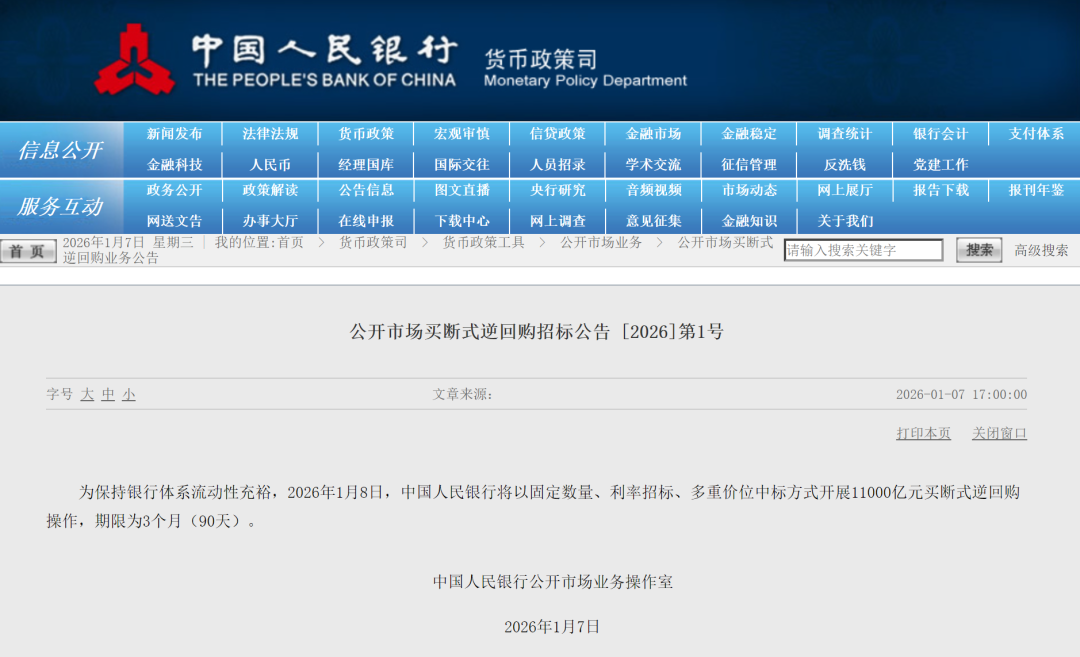
中国人民银行开展11000亿元买断式逆回购操作
Jin Rong Shi Bao· 2026-01-08 01:03
Core Viewpoint - The People's Bank of China (PBOC) is maintaining ample liquidity in the banking system through a series of monetary policy tools, including a 1.1 trillion yuan reverse repurchase operation set for January 8, which is a continuation of previous operations aimed at ensuring liquidity stability in the financial market [1][2]. Group 1: Monetary Policy Operations - On January 8, the PBOC will conduct a 1.1 trillion yuan reverse repurchase operation with a term of three months, marking the third consecutive month of maintaining the same amount for this operation [1]. - The 1.1 trillion yuan reverse repurchase operation on January 8 corresponds to the same amount maturing on that day, indicating a strategy of rolling over liquidity support [1]. - The PBOC has a total of 600 billion yuan in six-month reverse repos maturing in January, suggesting a continued commitment to ensuring liquidity remains abundant [1]. Group 2: Liquidity Management Tools - The PBOC has established a comprehensive set of liquidity management tools that can effectively respond to short-term fluctuations in fiscal revenue and government bond issuance [1]. - China's liquidity tool system aligns with international practices, featuring various tools such as automatic pledge financing, reverse repos, medium-term lending facilities (MLF), and regular lending facilities (SLF) [2]. - The management logic of these tools is consistent with international standards, focusing on banks as primary counterparties and utilizing high liquidity, low-risk assets like government bonds for collateral [2]. Group 3: Economic Impact - The current ample liquidity in China's banking system is crucial for stabilizing the macroeconomic environment and ensuring the healthy operation of financial markets [1]. - Recent innovations in monetary policy tools, such as including government bond trading in the toolkit, are expected to enhance the effectiveness of liquidity management [1][2]. - The multi-faceted liquidity tool system reflects the professionalism and effectiveness of China's monetary policy, creating a conducive liquidity environment for high-quality economic development [2].
11000亿元!央行公布将开展买断式逆回购操作
Jin Rong Shi Bao· 2026-01-07 12:29
Core Viewpoint - The People's Bank of China (PBOC) will conduct a 1.1 trillion yuan reverse repurchase operation on January 8, 2026, to maintain ample liquidity in the banking system, marking the third consecutive month of this policy tool being implemented at the same amount [1][6]. Group 1: Reverse Repo Operations - On January 8, 2026, the PBOC will carry out a fixed quantity, interest rate tender, multi-price bidding reverse repurchase operation amounting to 1.1 trillion yuan, with a term of three months (90 days) [1]. - The operation on January 8 will coincide with the maturity of another 1.1 trillion yuan three-month reverse repurchase, indicating a continuation of the same amount for the third month in a row [6]. - The decision not to increase the amount of the three-month reverse repurchase may relate to the funding demand structure of financial institutions, and does not indicate a reduction in liquidity provision by the PBOC [6]. Group 2: Liquidity Management Tools - The PBOC has established a comprehensive set of liquidity management tools to effectively respond to short-term fluctuations in fiscal revenue, government bond issuance, and maintain overall stability in the monetary market [6]. - Recent innovations in liquidity management include incorporating government bond trading into the monetary policy toolbox and creating two new monetary policy tools to support the capital market, which will enhance the effectiveness of liquidity management [6]. - The liquidity tool system in China aligns with international practices, covering a range of tools that support daily liquidity supply and temporary liquidity needs, reflecting a professional and effective monetary policy adjustment [7].

买断式逆回购将迎连续7月续作 多工具配合提升流动性管理效果
Xin Hua Cai Jing· 2025-12-12 15:20
Core Viewpoint - The People's Bank of China (PBOC) announced a 600 billion yuan reverse repurchase operation to maintain liquidity in the banking system, continuing a trend of liquidity support for seven consecutive months [1] Group 1: Liquidity Management - The PBOC will conduct a fixed-quantity, interest-rate tender reverse repurchase operation of 600 billion yuan with a six-month term on December 15 [1] - This operation is part of a broader strategy to keep liquidity ample, aligning with the central economic work conference's directive to maintain sufficient liquidity [1] - The PBOC has effectively managed short-term fluctuations in fiscal revenue and government bond issuance through various tools, ensuring overall stability in the money market [1] Group 2: Tools and Framework - Various liquidity management tools are employed by central banks globally, categorized into four levels: intraday support, daily supply, temporary supply, and structural supply [2] - China's liquidity tool system aligns with international frameworks, with tools like automatic pledge financing and medium-term lending facilities (MLF) corresponding to daily and structural liquidity needs [2][3] - The management logic of these tools, including counterparty selection and collateral management, is consistent with international practices, focusing on high liquidity and low-risk assets [3] Group 3: Future Expectations - An additional 300 billion yuan in MLF is set to mature on December 25, with expectations for continued operations to inject medium-term liquidity into the market [3] - MLF has maintained a trend of increased operations for nine consecutive months as of November [3]
政策工具箱丰富 央行“组合拳”呵护流动性
Jin Rong Shi Bao· 2025-12-12 10:19
Group 1 - The core viewpoint of the articles emphasizes that China's banking system liquidity remains abundant, which is crucial for stabilizing the macroeconomic landscape and ensuring the healthy operation of financial markets [1] - The People's Bank of China (PBOC) has established a comprehensive set of liquidity management tools to effectively respond to short-term fluctuations caused by fiscal policies and government bond issuances, maintaining overall stability in the money market [1][2] - Recent innovations in liquidity management tools, such as including government bond trading in the monetary policy toolkit and creating two new monetary policy tools to support the capital market, are expected to enhance the effectiveness of liquidity management in China [1] Group 2 - Internationally, central banks utilize various tools for liquidity management, which can be categorized into four levels: intraday liquidity support, daily liquidity supply, temporary liquidity supply, and structural liquidity supply [2] - China's liquidity tool system aligns with the mainstream frameworks in Europe and the U.S., reflecting both international practices and domestic market realities [3] - The management logic of China's liquidity tools is consistent with international practices, focusing on banking institutions as counterparties and using high liquidity, low-risk assets like government bonds for collateral [3]
业内专家:我国流动性工具体系已较为完整,基本覆盖国际通行范围
Sou Hu Cai Jing· 2025-12-12 09:57
Core Viewpoint - The People's Bank of China has effectively managed short-term fluctuations in fiscal revenue, government bond issuance, and overall monetary market stability through various tools, maintaining ample liquidity in the banking system [1] Group 1: Liquidity Management Tools - Recent innovations in liquidity management tools include incorporating government bond trading into the monetary policy toolbox and creating two new monetary policy tools to support the capital market, which will enhance liquidity management effectiveness [1] - The liquidity management framework in China aligns with international standards, categorizing tools into four main levels: intraday liquidity support, daily liquidity supply, temporary liquidity supply, and structural liquidity supply [2] Group 2: Comparison with International Practices - China's liquidity tool system is comprehensive and corresponds with the four major categories used in international frameworks, such as automatic pledge financing for intraday support and reverse repos for daily liquidity supply [2] - The management logic of these tools is consistent with international practices, focusing on bank financial institutions as counterparties and using high liquidity, low-risk assets like government bonds for collateral [2]