芯片组

Search documents
兆芯集成、盛合晶微、中图科技科创板IPO已问询
Xin Lang Cai Jing· 2026-02-02 01:39
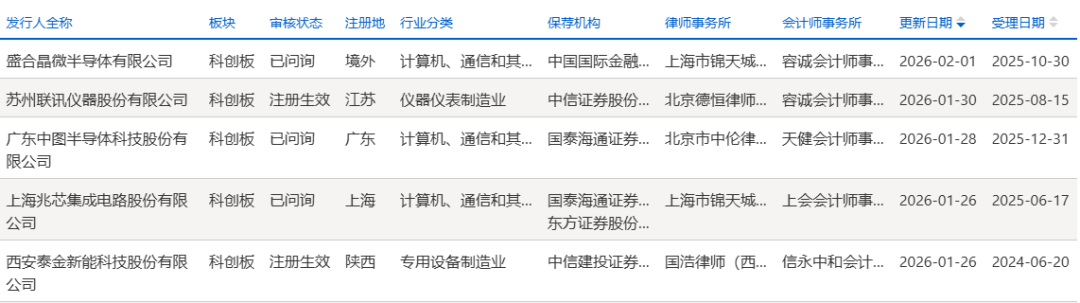
Core Viewpoint - This week, five companies are making progress in their IPO applications for the Sci-Tech Innovation Board, with two companies, Taijin New Energy and Lianxun Instruments, having their registrations effective, while three others, Zhaoxin Integrated, Shenghe Jingwei, and Zhongtu Technology, are under inquiry [2][15]. Group 1: Taijin New Energy - Taijin New Energy's IPO registration has officially become effective, marking it as the first company accepted by the Shanghai Stock Exchange since the release of the new "National Nine Articles" [4][17]. - The company, established through the transformation of scientific research achievements from the Northwest Nonferrous Metal Research Institute, focuses on high-end intelligent electro-copper foil equipment and titanium electrode materials [6][19]. - Financial data shows that from 2021 to the first three quarters of 2025, Taijin New Energy achieved revenues of 1.004 billion, 1.669 billion, 2.194 billion, and 1.713 billion yuan, with net profits of 98.29 million, 155 million, 195 million, and 141 million yuan respectively [6][19]. - The company expects to achieve a revenue of 2.377 billion yuan in 2025, with a year-on-year growth of 8.34% [6][19]. - The initial fundraising target was 1.5 billion yuan, later adjusted to 990 million yuan for projects related to high-end intelligent equipment for green electrolysis [7][20]. Group 2: Lianxun Instruments - Lianxun Instruments' IPO application was registered effective on January 29, 2026, making it the first company to pass the review for the Sci-Tech Innovation Board in 2026 [7][20]. - The company specializes in high-end testing instruments for high-speed communication and semiconductor sectors, providing various core testing equipment [9][21]. - From 2022 to 2024, Lianxun Instruments' revenue grew from 214 million to 789 million yuan, with a compound annual growth rate of 91.79% [10][21]. - The company plans to raise 1.711 billion yuan for the development and industrialization of next-generation optical communication testing equipment and other projects [10][21]. Group 3: Zhaoxin Integrated - Zhaoxin Integrated's IPO status was updated to "under inquiry" on January 28, 2026, being the third unprofitable company accepted for the Sci-Tech Innovation Board in 2025 [12][22]. - Established in 2013, Zhaoxin Integrated focuses on the research and design of general-purpose processors and system platform chips, aiming to provide comprehensive computing solutions [24][22]. - Financial data indicates that from 2022 to the first half of 2025, the company reported revenues of 340 million, 555 million, 889 million, and 341 million yuan, with net losses of 727 million, 676 million, 951 million, and 427 million yuan respectively [24][22]. Group 4: Shenghe Jingwei - Shenghe Jingwei's IPO was accepted on October 30, 2025, and it is one of the first companies in mainland China to achieve mass production of 12-inch high-density bump manufacturing [13][26]. - The company reported revenues of 1.632 billion, 3.038 billion, and 4.705 billion yuan from 2022 to 2024, with a compound annual growth rate of 69.77% [14][26]. - Shenghe Jingwei plans to raise 4.8 billion yuan for investments in advanced packaging projects to expand its production capacity [14][26]. Group 5: Zhongtu Technology - Zhongtu Technology's IPO was accepted on December 31, 2025, and it is making a second attempt after withdrawing its first application in 2022 [15][27]. - The company is a major manufacturer of patterned substrate materials, with products widely used in Mini/MicroLED and automotive lighting applications [15][27]. - Zhongtu Technology aims to raise approximately 1.05 billion yuan for projects related to the industrialization of patterned substrates and semiconductor substrate material research [15][27].

这一芯片问题,不容忽视!
半导体行业观察· 2026-01-10 03:37
Core Viewpoint - The article discusses the increasing complexity and challenges of end-to-end security in semiconductor manufacturing, particularly with the rise of multi-chip packaging and edge computing, which complicates supply chain tracking and security measures [1][2][3]. Group 1: Challenges in Multi-Chip Packaging - Multi-chip packaging enhances performance but complicates supply chain tracking, as components may come from different manufacturers [1]. - The aging of chipsets under different workloads can introduce unforeseen vulnerabilities, especially with new components developed using advanced nodes like 3nm [1]. - The fragmentation of chip production among various suppliers increases complexity, making it difficult to ensure compatibility and security across the supply chain [2]. Group 2: Security Measures and Standards - There is a need for comprehensive security measures throughout the supply chain, from chip manufacturing to final product deployment, to mitigate risks associated with malicious chips [3][4]. - The introduction of the EU's Cyber Resilience Act (CRA) mandates companies to assess their security vulnerabilities and supply chain risks, pushing for a more standardized approach to security [5]. - Companies are encouraged to embed unique identifiers in chips to enhance traceability and security [4][5]. Group 3: Long-Term Security Considerations - The longevity of products necessitates ongoing assessments of potential security vulnerabilities that may arise over time [9][10]. - The automotive industry exemplifies the need for long-term security planning, as vehicles may have lifespans of up to 40 years, requiring continuous updates and risk assessments [10]. - Quantum computing poses a future threat to existing encryption methods, necessitating proactive measures during the design phase [9][10]. Group 4: Role of Artificial Intelligence - AI can be utilized to identify security vulnerabilities that are difficult for humans to detect, enhancing the overall security of systems [11]. - However, AI systems themselves require strict controls to prevent independent communication that could compromise security [11][12]. - The development of unified standards for AI in security is still in progress, with organizations working towards establishing comprehensive guidelines [12]. Group 5: Conclusion on Security Landscape - Security has transitioned from a secondary consideration to a primary focus across all stages of electronic system development, with companies facing significant penalties for neglecting security [12]. - Achieving true end-to-end security remains uncertain, but the motivation for companies to pursue it has increased alongside the challenges they face [12].
芯片市场,1454亿美元
半导体芯闻· 2025-11-19 10:32
Group 1 - The chip market is expected to reach a size of $9.2 billion in 2024 and grow at a compound annual growth rate (CAGR) of 29.1% from 2026 to 2035, reaching $145.4 billion by 2035 [2] - The Japanese chip market is projected to grow at a CAGR of 30.3%, driven by factors such as the domestic IoT ecosystem, aging population leading to increased medical device usage, and the development of robotic infrastructure for AI applications [2] - The chip group market is expanding as chipsets can produce small, independent functional modules, becoming a viable alternative to large single chips, which require significant capital investment and have lower yields [2] Group 2 - CPU chips will dominate the market as the core of computing systems, with 2.5D/3D packaging expected to hold approximately 48% market share [3] - The North American market is experiencing steady growth, primarily due to its leadership in AI cloud infrastructure and high-performance computing [3] - The Asia-Pacific region holds the largest market share at 42% and leads the market with a CAGR of 28.9%, driven by demand for modular chip architectures in consumer electronics, IoT, automotive electrification, and 5G/6G deployment [3]
黄仁勋称英特尔33年试图消灭英伟达,如今双方合作共赢
Xin Lang Ke Ji· 2025-10-09 03:01
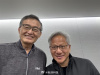
Core Viewpoint - NVIDIA CEO Jensen Huang humorously stated that Intel has spent 33 years trying to eliminate NVIDIA, reflecting on their historical rivalry and recent collaboration [1] Group 1: Historical Context - In the early 21st century, Intel was the dominant player in the computing industry, leading in both consumer and professional markets [1] - NVIDIA initially signed a contract with Intel to manufacture chipsets but later shifted to internal design, leading to a licensing dispute that NVIDIA ultimately won [1] Group 2: Current Collaboration - Huang emphasized that the key to their current partnership is his friendship with Intel's current CEO, Pat Gelsinger [1] - The collaboration is expected to create a win-win situation for both companies in the evolving AI hardware market, with Huang stating, "We are friends, not rivals" [1]