英伟达服务器

Search documents
丢人!超微创始人走私25亿英伟达GPU,美股直接吓崩12%
Sou Hu Cai Jing· 2026-03-22 00:21
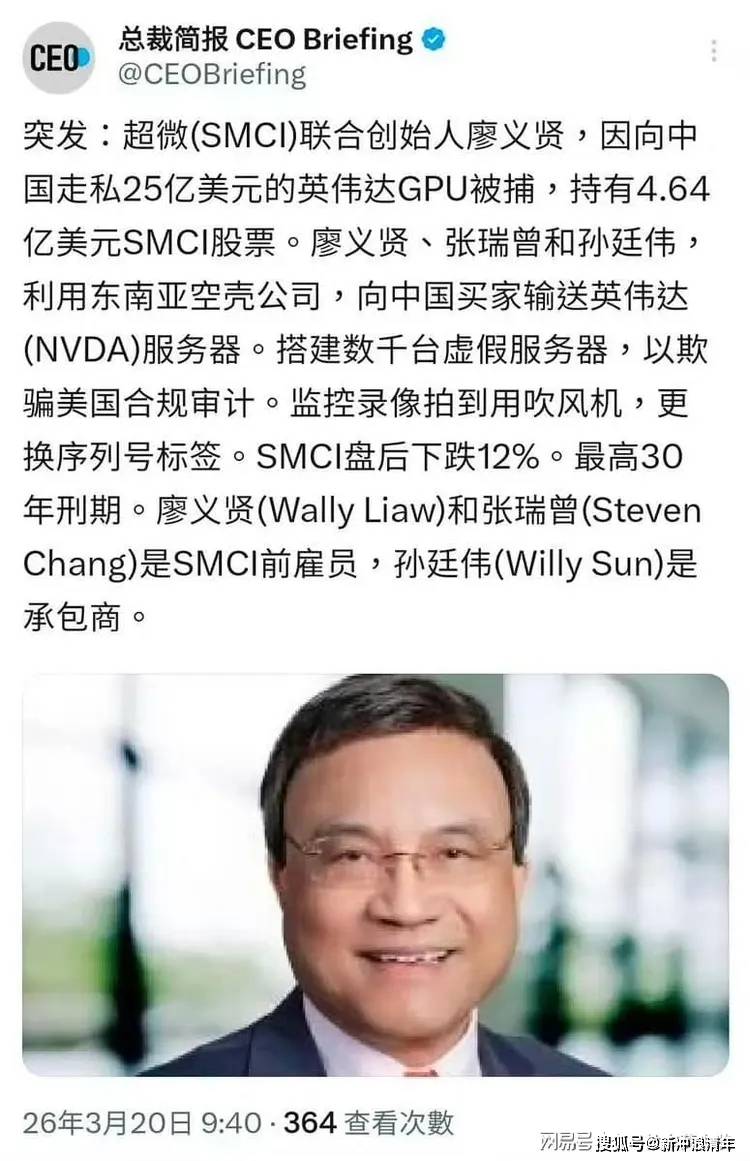
Core Viewpoint - The co-founder of Super Micro Computer Inc. (SMCI), Wally Liaw, was arrested for smuggling $2.5 billion worth of NVIDIA GPUs to China, highlighting severe compliance failures in U.S. export regulations [1][3][6]. Group 1: Company Actions and Reactions - Following the arrest, SMCI immediately announced that Wally Liaw would resign from his board position in an attempt to mitigate the fallout [6]. - The stock price of SMCI dropped by 12% in after-hours trading, resulting in a significant loss of market capitalization [6]. Group 2: Details of the Smuggling Operation - Liaw, along with former employees Steven Chang and contractor Willy Sun, used shell companies in Southeast Asia to facilitate the illegal export of NVIDIA servers to Chinese buyers [1][3]. - They constructed thousands of fake servers to deceive U.S. compliance audits, employing rudimentary methods such as using hair dryers to alter serial number labels [3][4]. Group 3: Legal Consequences and Implications - If convicted, Liaw and his associates could face up to 30 years in prison, underscoring the serious legal ramifications of their actions [1][7]. - The incident serves as a stark reminder of the vulnerabilities in regulatory systems, as the perpetrators exploited these weaknesses despite their high-profile positions and wealth [7][8].



AI资本支出激增,电网更吃紧,高盛大幅上调全球AI用电预期:2030年需求暴增220%
3 6 Ke· 2026-02-25 12:11
Core Insights - The investment in AI is shifting from chips and servers to electricity, with major cloud providers increasing capital expenditures and R&D budgets, leading to a significant rise in data center electricity demand [1][2] - Goldman Sachs has revised its forecast for global data center electricity demand growth from 175% to 220% by 2030, with the U.S. expected to account for approximately 60% of this increase [3][5] - The report highlights the challenges in electricity supply chains, emphasizing that the focus has shifted from whether electricity is needed to whether it can be delivered on time [1][6] Group 1: Electricity Demand Projections - Goldman Sachs estimates that the global data center electricity demand increase will reach 905 TWh by 2030, with the U.S. contributing 60% of this growth [3] - The projected capacity for U.S. data centers is expected to rise to 95 GW by 2030, up from 32 GW in 2025, while overseas capacity is projected to reach 72 GW [3] - The increase in electricity demand is driven by higher expectations for AI server shipments and faster data center capacity expansion [3] Group 2: Investment Trends - Major cloud providers are expected to have a reinvestment rate of nearly 90%, with capital expenditures and R&D projected to double by 2029 compared to 2025 [4] - The report indicates that while investments are increasing, the free cash flow available to shareholders is being squeezed, leading to a greater focus on quantifiable AI revenue growth [4] - An example of quantifiable AI impact is in drug development, where AI has improved success rates and reduced development timelines significantly [4] Group 3: Electricity Supply Challenges - Goldman Sachs has raised its forecast for U.S. electricity demand growth to an annualized 3.2% by 2030, with data centers contributing 2 percentage points to this growth [5][6] - The report notes that a significant portion of new load is being met by behind-the-meter solutions, primarily natural gas, due to challenges in delivering electricity from the grid [6] - The efficiency of new servers is improving, but the overall power consumption is increasing due to higher demand for computational power [7] Group 4: Pricing and Policy Implications - The concept of a "Green Reliability Premium" has emerged, indicating that the cost of reliable clean energy for data centers is higher than the baseline, estimated at $40-$48 per MWh [8] - This premium could lead to an industry expenditure of approximately $37-43 billion by 2030, impacting the profitability of hyperscalers [8] - The report suggests that data center operators will need to provide clearer commitments regarding flexibility and infrastructure costs to mitigate reliability risks [9] Group 5: Labor Market Constraints - Goldman Sachs estimates that approximately 510,000 new jobs will be needed in the U.S. and Europe to meet electricity demand growth from 2023 to 2030, with a significant focus on transmission and distribution roles [10] - The labor market constraints highlight the attractiveness of behind-the-meter solutions, which bypass some of the complexities of grid connections [10] - Companies with advantages in labor acquisition, such as contractors and utility firms, are likely to be revalued in the market [10] Group 6: Broader Investment Themes - The report emphasizes a broader theme of reliability investments across electricity, water, networks, and supply chains, with an estimated annual capital expenditure growth exceeding $80 billion [12] - Data center electricity supply chain stocks have significantly outperformed broader market indices, indicating a shift in investor focus [12] - The report outlines conditions under which the current investment cycle may end, including a decline in AI competitiveness and reduced corporate returns [12] Group 7: AI Investment Cycle - Goldman Sachs places AI within an innovation cycle, currently in the "Appraisal / Hopes & Dreams" phase, with discussions about transitioning to the execution phase intensifying [13] - Three potential triggers for this transition include constrained financial flexibility, declining corporate returns, and oversupply of products [13] - The report concludes that while the infrastructure chain remains favorable in the short term, market scrutiny on AI revenue and cash flow will increase [13]
AI资本支出激增,电网更吃紧!高盛大幅上调全球AI用电预期:2030年需求暴增220%
硬AI· 2026-02-25 09:46
Core Viewpoint - Goldman Sachs has raised its forecast for global data center electricity demand growth by 220% by 2030, with the U.S. accounting for 60% of this increase, indicating a shift in focus from supply to the reliability of power supply chains due to AI investments [2][3][4]. Group 1: Electricity Demand Forecast - Goldman Sachs estimates that the global data center electricity demand increase will reach 905 TWh by 2030, up from a previous estimate of 175% growth to 220% [7]. - The U.S. is projected to account for approximately 60% of this increase, with data center capacity in the U.S. expected to rise to 95 GW by 2030 [7]. - The report highlights that the demand for electricity is not just about need but also about the ability of the supply chain to deliver power on time [3][9]. Group 2: Investment and Capital Expenditure - The report indicates that hyperscale cloud providers are increasing their capital expenditure and R&D budgets significantly, with an upward revision of over $300 billion for 2026-2027 [8]. - The reinvestment rate for these companies is expected to reach 87% and 83% in 2026 and 2027, respectively, indicating a squeeze on free cash flow available to shareholders [8]. - AI's impact on sectors like drug development is highlighted, with significant improvements in success rates and reduced development cycles, showcasing the tangible benefits of AI investments [8]. Group 3: Power Supply and Reliability - The annualized growth rate for U.S. electricity demand has been raised to 3.2% by 2030, with data centers contributing 2 percentage points to this growth [9]. - The report notes that a significant portion of new load is being handled by behind-the-meter solutions, primarily natural gas, due to challenges in the grid supply [9]. - The "Green Reliability Premium" indicates that the cost of reliable clean energy for data centers is approximately $40-$48 per MWh above the baseline [11][12]. Group 4: Labor Market Constraints - Goldman Sachs emphasizes that labor shortages, particularly in transmission and distribution, pose a significant constraint on meeting electricity demand growth, estimating a need for approximately 510,000 new jobs in the U.S. and Europe [14]. - The report suggests that the current number of active apprentices in the energy sector is insufficient to meet future demands, highlighting the urgency of addressing labor constraints [14]. Group 5: Infrastructure Investment Cycle - The report suggests that the current cycle of infrastructure investment is driven by the need for reliability in power, water, and supply chains, with an estimated annual capex growth exceeding $80 billion [15]. - Data center-related power supply stocks have outperformed broader market indices, indicating a strong market for reliability-focused investments [16]. - The report outlines that the cycle will continue unless there is a significant shift in AI competition or a decline in corporate returns [16][18].

AI资本支出激增,电网更吃紧!高盛大幅上调全球AI用电预期:2030年需求暴增220%
Hua Er Jie Jian Wen· 2026-02-25 08:04
Core Insights - The investment in AI is shifting from chips and servers to electricity, with major cloud providers increasing capital expenditures and R&D budgets, leading to a significant rise in data center electricity demand [1][2] - Goldman Sachs has revised its forecast for global data center electricity demand by 220% by 2030 compared to 2023, with approximately 60% of this demand expected to come from the U.S. [3][5] - The report highlights a growing concern about the supply chain's ability to deliver electricity on time, as the integration and delivery cycles for power infrastructure are lengthening [1][6] Electricity Demand Forecast - Goldman Sachs estimates that the global data center electricity demand will increase by 905 TWh by 2030, up from a previous estimate of 175% growth to 220% [3] - The U.S. is projected to account for about 60% of this increase, with data center capacity expected to rise to 95 GW by 2030 [3][5] - The annualized growth rate for U.S. electricity demand has been raised to 3.2%, with data centers contributing 2 percentage points to this growth [5][6] Investment Trends - Goldman Sachs maintains a bullish outlook on data center electricity supply chain stocks, indicating a longer investment cycle in infrastructure to avoid reliability issues [2][12] - The report notes a significant increase in capital expenditures and R&D budgets for hyperscalers, with an expected doubling by 2029 compared to 2025 [4] - The reinvestment rate for hyperscalers is projected to reach 87% in 2026 and 83% in 2027, indicating a squeeze on free cash flow for shareholders [4] Efficiency and Power Consumption - While new server generations are more efficient, the overall demand for computing power is growing faster, leading to higher energy consumption per server [7] - The report identifies 2026 as a critical year for observing whether inference servers will maintain lower power consumption or increase due to higher power server ratios [7] Pricing and Policy Implications - The concept of a "Green Reliability Premium" has emerged, with clean energy supply costs for data centers exceeding baseline prices by approximately $40 to $48 per MWh [8][9] - Goldman Sachs anticipates that the costs associated with reliability and infrastructure will not be passed on to other electricity customers, leading to more contract designs to isolate these impacts [9] Labor Market Constraints - The report emphasizes that labor shortages, particularly in transmission and distribution roles, pose a significant constraint on meeting electricity demand growth [10] - An estimated 510,000 new jobs will be needed in the U.S. and Europe to meet electricity demand from 2023 to 2030, with a focus on training and recruitment [10] Broader Market Dynamics - The report suggests that the reliability theme in infrastructure investment is expected to continue, with annual capital expenditure growth exceeding $80 billion [12] - The performance of data center electricity supply chain stocks has outpaced broader market indices, indicating a shift in investor focus towards reliability and infrastructure [12]
英伟达服务器强劲需求不减,鸿海精密1月营收同比增长35.5%
智通财经网· 2026-02-05 09:07
Group 1 - The core viewpoint of the article highlights that Hong Teng Precision's revenue increased by 35.5% in January, indicating strong demand for NVIDIA servers amid the global AI development wave [1] - Hong Teng Precision reported a revenue of 730 billion New Taiwan Dollars (approximately 23 billion USD) for the last month, with the year-on-year comparison potentially affected by the timing of the Lunar New Year holiday [1] - The company is expected to see a 28% growth in sales for the three months ending in March [1] Group 2 - Hon Hai, responsible for manufacturing servers that store chips in data centers, is a key player in the AI hardware industry surrounding NVIDIA [1] - Despite warnings of overcapacity in the market due to uncertainties in the monetization path of the technology, companies in the U.S., including Meta and Amazon, continue to invest billions of dollars in deploying equipment necessary for training and running AI [1] - Hong Hai benefits from this ongoing investment trend in AI infrastructure [1]
英伟达服务器需求持续强劲 鸿海1月营收飙升35%超预期
Xin Lang Cai Jing· 2026-02-05 08:12
Core Viewpoint - Foxconn's revenue in January increased by 35.5%, indicating strong market demand for Nvidia servers amid the global AI development wave [1] Group 1: Revenue Performance - The company's revenue for January was reported at 730 billion New Taiwan Dollars (approximately 23 billion USD) [1] - The year-on-year comparison may be influenced by the Lunar New Year holiday, with the 2025 Spring Festival falling in January [1] - The company is expected to see a 28% increase in sales for the three months ending in March [1] Group 2: Market Position and Demand - Foxconn is a key player in the AI hardware industry, manufacturing servers that store chips for data centers [1] - Despite warnings of overcapacity in the market due to uncertainties in technology monetization, major U.S. companies like Meta and Amazon are investing billions in deploying equipment necessary for training and running AI [1] - Foxconn benefits from this ongoing investment trend in AI infrastructure [1]
不只是“缺电”,“延误”将成为2026年美国数据中心的“关键主题”
Hua Er Jie Jian Wen· 2025-12-23 00:50
Core Insights - The focus of the industry is shifting from power shortages to project delays, which are expected to be a central theme in 2026, distinguishing top operators from ordinary participants [1] - Delays are caused by various factors, including utility companies failing to meet power commitments, equipment delivery delays, and labor shortages [1] - The complexity of delivering large-scale AI infrastructure is becoming evident, with increasing wait times for generators, transformers, and liquid cooling components [1] Delays and Their Causes - Project delays are not solely due to technical issues but also political resistance from local governments, especially when data center projects scale up significantly [3] - An example includes a project in Saline Township, Michigan, where local opposition led to legal disputes, impacting financing and project timelines [3] - Developers often require over $10 billion in project financing before construction begins, and political resistance can deter investors [3][5] Contractual Issues - Delays can also arise from non-exclusive agreements where developers fail to secure formal leases with clients, as seen with Fermi's project that lost Amazon Web Services as a tenant, resulting in a 40% drop in stock price [4] - Loan institutions typically only release funds after developers secure binding agreements with top-tier clients, making informal agreements insufficient for financing [5] Economic Viability and Contractual Risks - More severe delays involve projects that have already received funding but face client withdrawals due to ongoing issues, threatening project viability [6] - Delays can lead to significant financial repercussions, as clients may negotiate lower rental fees or exit contracts without penalties, undermining the economic feasibility of projects [6] Industry Responses - NVIDIA is actively addressing infrastructure bottlenecks by convening a summit to discuss power supply challenges, emphasizing the need for on-site power generation to bypass lengthy public grid interconnections [7] - The summit included influential companies in the energy and electrical infrastructure sectors, highlighting the urgency of increasing power supply to meet AI demands [7] Market Developments - Google announced a $4.75 billion acquisition of Intersect to secure land for renewable energy sources [8] - Regulatory calls for a pause on AI data center construction have emerged, indicating potential challenges ahead [8] - Texas Pacific Land Corporation has signed a strategic agreement with Bolt Data & Energy to develop large-scale data center parks [8]

“大空头”:AI巨头涉嫌虚增利润
财联社· 2025-11-12 00:24
Group 1 - Michael Burry criticizes major U.S. tech companies for artificially inflating profits through aggressive accounting practices related to AI [1][2] - Burry estimates that from 2026 to 2028, this accounting treatment could underestimate depreciation expenses by approximately $176 billion, exaggerating industry profits [2] - He specifically points out Oracle and Meta, suggesting their profits could be overestimated by about 27% and 21% respectively by 2028 [2] Group 2 - Burry's claims are difficult to verify due to the significant discretion companies have under GAAP in estimating asset depreciation [3] - He has previously warned that the current AI enthusiasm mirrors the tech bubble of the late 1990s [3] - Burry's Scion Asset Management holds significant put options on Nvidia and Palantir, totaling over $1 billion in nominal value, indicating a bearish outlook [4] Group 3 - Nvidia's stock rebounded nearly 6% after a 7% drop, while Palantir rose about 9% following an 11% decline [5] - However, both stocks fell again the following day, indicating ongoing volatility in the market [5] - SoftBank's unexpected decision to liquidate its Nvidia shares for $5.8 billion raises concerns about the AI hype potentially peaking [6][8] Group 4 - The funds from SoftBank's sale will support its $500 billion "Star Gate" project and a $40 billion commitment to OpenAI [7] - Analysts express concerns that SoftBank's sale indicates a belief that Nvidia's stock price surge may be nearing its end [8] - Some analysts caution that SoftBank's timing in the Nvidia investment has historically been poor [8]


存储器市场跟踪
傅里叶的猫· 2025-05-28 14:42
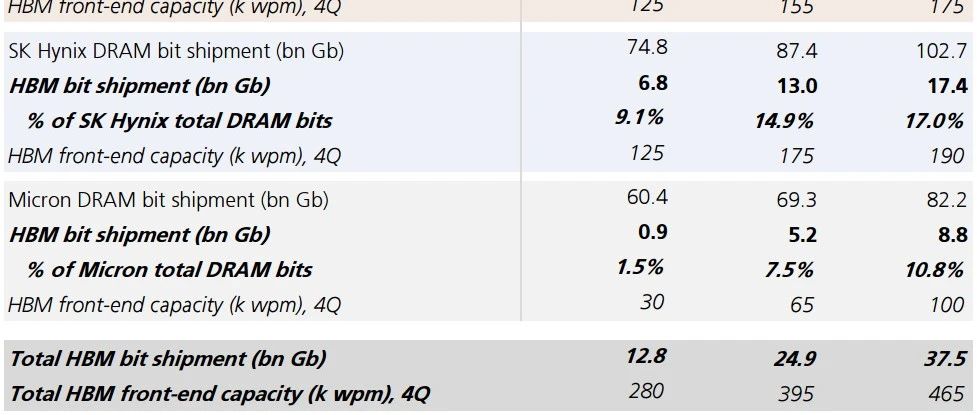
Core Viewpoint - The article discusses the current trends and forecasts in the memory market, particularly focusing on NAND and DRAM, highlighting the demand dynamics and inventory levels of major players like Samsung and SK Hynix [1][2][3]. Summary by Sections Market Overview - The article references UBS research, indicating that Samsung and SK Hynix expect a modest increase in DRAM shipments for Q2 2025, with Samsung projecting less than 10% growth and SK Hynix over 20% for NAND [2]. - UBS has adjusted its NAND price forecast for Q2 from +5% to +3%, citing resistance from customers against rising SSD prices [2]. Demand and Inventory - As of Q1 2025, DRAM inventory levels are decreasing faster than expected, with smartphone customers holding about 10 weeks of inventory and PC manufacturers around 12 weeks [3]. - For NAND, smartphone manufacturers have approximately 9 weeks of inventory, while SSD inventory stands at 11 weeks [3]. HBM Demand Forecast - UBS has revised its HBM demand forecast for 2025 down from 203 billion Gb to 189 billion Gb, reflecting a year-on-year growth of 105%, and for 2026 from 303 billion Gb to 291 billion Gb, with a growth rate of 54% [3][24]. - The demand for ASICs is expected to outpace GPUs, with ASICs accounting for 54% of total HBM demand by 2026, up from 41% in 2025 [3]. Supplier Insights - Samsung's HBM bit shipments are projected to increase from 5.1 billion Gb in 2024 to 11.2 billion Gb by 2026, representing 8.1% of its total DRAM bits [9]. - SK Hynix is expected to grow its HBM shipments from 6.8 billion Gb in 2024 to 17.4 billion Gb by 2026, which will account for 17% of its total DRAM bits [9]. Production Capacity - Longxin's wafer production capacity is expected to reach 170,000 wafers per month by the end of 2024, with plans to increase to 230,000 wafers per month by the end of 2025 [24]. - Yangtze Memory Technologies Company (YMTC) is also expanding its production capacity, aiming for 160-layer technology despite facing challenges due to U.S. restrictions [25]. Competitive Landscape - The article highlights the competitive dynamics among major players, with Samsung and SK Hynix leading in HBM production, while Micron is also increasing its HBM output significantly [9][24]. - The market share of DRAM suppliers is detailed, showing Samsung at 39.5%, SK Hynix at 28.9%, and Micron at 22.9% for 2025 [27]. Future Outlook - The article concludes with a cautious outlook for the memory market, emphasizing the uncertainty due to tariff issues and potential specification downgrades in NAND demand [2][24].