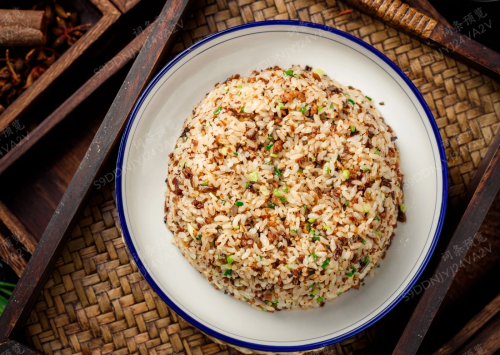
葱花

Search documents
芽菜炒饭做法
Zhong Guo Shi Pin Wang· 2026-01-19 07:04
Group 1 - Key Point 1: Ingredients preparation includes 1 bowl of rice (preferably leftover rice for better texture), 30 grams of chopped Yibin bean sprouts, 1-2 beaten eggs, chopped green onions, 2-3 tablespoons of cooking oil, and a pinch of salt adjusted according to the saltiness of the bean sprouts [1] - Key Point 2: The first step involves frying the eggs in a hot pan with cold oil, quickly scrambling them into small pieces, and setting them aside [2] - Key Point 3: The next step is to add a little oil to the pan and stir-fry the bean sprouts for 1-2 minutes until fragrant [3] Group 2 - Key Point 1: For the fried rice, the leftover rice is added to the pan, and it is broken apart with a spatula, mixing thoroughly with the ingredients while stir-frying over medium heat until the rice grains are distinct [4] - Key Point 2: Seasoning includes adding the scrambled eggs back into the mixture, adjusting with a little salt (considering the inherent saltiness of the bean sprouts) and MSG, followed by adding chopped green onions and stir-frying briefly before serving [4]

从追标准到定标准 “中国蔬菜出口第一县”做对了什么?
Yang Shi Xin Wen Ke Hu Duan· 2025-12-07 04:57
Core Insights - Anqiu City in Shandong Province has developed into "China's No. 1 Vegetable Export County" over 30 years, transitioning from a local agricultural hub to a significant player in the global vegetable market [1][3]. Industry Overview - China is the world's largest vegetable producer and exporter, with Shandong Province accounting for nearly 40% of the country's agricultural export value, making it the largest vegetable-exporting province [2]. - Anqiu's agricultural exports have reached over 2 billion USD, with a growth rate of 30% in 2007 after overcoming a significant export crisis [10]. Historical Development - The first successful export of preserved vegetables from Anqiu occurred in 1993, marking the beginning of its journey into international markets [3][4]. - By 1996, Anqiu was exporting over 20 containers of green onions weekly, showcasing rapid growth in agricultural exports [6]. Challenges and Adaptations - Anqiu faced a severe export crisis around 2006 due to new stringent food safety regulations from the EU and Japan, which led to significant losses for local farmers [9][10]. - In response, Anqiu established a high-standard agricultural safety management system to meet international standards, which included forming a local agricultural product testing institution [10][12]. Current Status and Future Prospects - Anqiu has developed an international, high-standard testing and certification system, allowing it to participate in setting global vegetable trade standards [11][12]. - The city has seen a rise in young farmers who are adopting modern agricultural practices, including organic farming, which has led to increased demand and higher prices for organic vegetables [14][15].
广西壮族自治区市场监督管理局食品安全监督抽检信息通告(2025年第108期)
Zhong Guo Zhi Liang Xin Wen Wang· 2025-11-04 08:10
Core Points - The Guangxi Zhuang Autonomous Region Market Supervision Administration conducted a food safety inspection, testing 834 samples across 19 categories of food products, resulting in 8 batches of non-compliant samples primarily due to microbial contamination, heavy metal pollution, pesticide residue, and excessive use of food additives [2][3][4]. Microbial Contamination Issues - A product named "Bubble Duck Wings (Irradiated Food)" sold by Guangxi Pan Ning Investment Co., Ltd. was found to have a total bacterial count exceeding the national food safety standards [2]. Heavy Metal Pollution and Pesticide Residue Issues - The "Yellow Ginger" sold by a local store in Nanning was found to have lead levels exceeding the standard, while "Local Small Tai Mango" and "Chives" had pesticide residues (pyraclostrobin and thiamethoxam) that did not meet safety standards [3][7]. Excessive Use of Food Additives Issues - "Beef Balls" and "Pork Balls" sold by Yang Ji Fu Xing Meatball Shop in Guigang were found to have levels of benzoic acid and sorbic acid exceeding the permissible limits according to national food safety standards [4][8]. Follow-up Actions - The Guangxi Zhuang Autonomous Region Market Supervision Administration has mandated local regulatory bodies to take legal action against the entities involved with non-compliant products, including product recalls and risk control measures [5].