
装饰画

Search documents
“广味”年货搭乘中欧班列奔赴欧洲
Xin Lang Cai Jing· 2026-02-13 10:07
Core Insights - The Guangzhou Railway Logistics Center has been actively facilitating the export of Chinese New Year goods to Europe, with a total of 57 freight trains dispatched since December, carrying over 5,000 containers valued at more than 1.3 billion yuan [1][2] Group 1: Logistics and Operations - The logistics center has implemented a "New Year Goods Supply" special mechanism to ensure efficient export, providing prioritized services for planning, space allocation, loading, and release of the New Year freight trains [1] - The logistics process for e-commerce goods at the logistics park is streamlined, allowing for completion of warehouse consolidation, security checks, customs clearance, and train dispatch within just four days [2] Group 2: Economic Impact - The logistics park is a key hub for the China-Europe freight trains in the Guangdong-Hong Kong-Macao Greater Bay Area, with plans to operate a total of 297 international trains by 2025, serving over 10,000 foreign trade enterprises and achieving a total cargo value exceeding 8 billion yuan [1]
马年载心,踏路而行
Xin Lang Cai Jing· 2026-02-12 22:40
Core Viewpoint - The articles reflect on the cultural significance of horses, particularly in the context of the Year of the Horse, symbolizing hope, perseverance, and the pursuit of dreams through various narratives and traditions [1][2][3][5]. Group 1: Cultural Significance of Horses - Horses are depicted as symbols of strength, freedom, and success, with references to historical and literary contexts that highlight their importance in Chinese culture [1][3]. - The imagery of horses is prevalent in traditional celebrations, such as the Lunar New Year, where they represent good fortune and prosperity [3][4]. Group 2: Personal Reflections and Aspirations - The narrative emphasizes personal growth and the journey of self-discovery, likening the pursuit of dreams to the qualities of a horse, such as resilience and determination [2][5]. - The concept of "Longma Spirit" is introduced, merging the qualities of a dragon and a horse, symbolizing both ambition and groundedness in one's endeavors [5]. Group 3: Community and Tradition - The Hakka community's customs during the Year of the Horse are highlighted, showcasing their unique cultural practices and the importance of family and heritage [3]. - Traditional crafts and art forms, such as embroidery and decorations featuring horses, are used to convey blessings and strengthen community bonds [3].
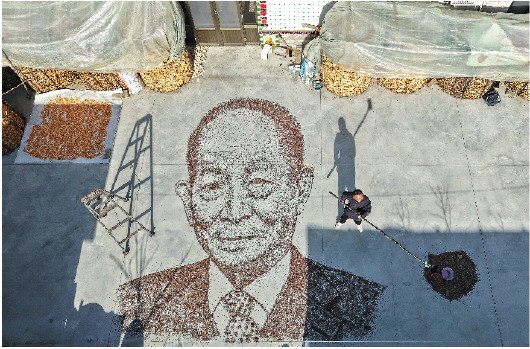
大地为纸粮食为墨
Xin Lang Cai Jing· 2026-01-16 18:02
Core Viewpoint - The article highlights the unique artistic journey of Zhao Tongkai, a young artist from a rural background in Shandong Province, who creatively uses grains to create large-scale artworks, paying tribute to cultural icons and scientific figures, while also promoting local agricultural products [6][7][8]. Group 1: Artistic Journey - Zhao Tongkai, born in 1992, developed an early interest in painting influenced by his father's craftsmanship [6]. - After exploring various jobs, he decided to pursue a career in art, leading him to enroll in a wall painting training program in 2013 [7]. - His breakthrough came during the 2024 college entrance examination period when a video of his grain art went viral, garnering nearly 20 million views in one day [7]. Group 2: Creative Techniques - Zhao utilizes black wheat and corn as his medium, creating large-scale artworks that depict significant cultural and historical themes [8]. - He faces challenges in creating ground-level art, such as positioning and capturing the overall view, often using a 4-meter selfie stick for adjustments [8]. - His artistic process involves meticulous attention to detail, especially in portraying facial features and expressions, integrating techniques from traditional sketching [8]. Group 3: Community Engagement - Following his rise to fame, Zhao remains committed to his roots, engaging with his community by painting murals in local facilities [9]. - In September 2024, he opened a painting training class for children, aiming to share his passion for art and inspire the next generation [9]. - Zhao plans to continue creating meaningful artworks using local grains, emphasizing the connection between art and agriculture [9].

宜家上海宝山店清仓销售火爆,为转型提供参考
Sou Hu Cai Jing· 2026-01-16 15:44
Core Insights - IKEA is closing seven physical stores in China, including the Baoshan store, starting February 2, 2026, focusing on smaller stores and instant retail development [1] - The Baoshan store's clearance sale served as a significant "stress test," providing direct consumer feedback on IKEA's transformation strategy [1] Group 1: Consumer Behavior - The clearance sale featured over 800 small furniture items with discounts as low as 30%, indicating a strong demand for affordable, practical home goods [2] - Consumers are increasingly targeting small daily necessities rather than large furniture, reflecting a shift in shopping habits towards convenience and design [2] - The popularity of small items like kitchenware and storage solutions suggests that IKEA's role is evolving from a "furniture destination" to a "supplier of affordable design daily necessities" [2] Group 2: Experience and Engagement - The IKEA restaurant saw long lines, with many customers visiting primarily for the dining experience, indicating a shift towards a multi-faceted consumer experience [3] - The integration of dining options like Swedish meatballs and ice cream serves as a "traffic anchor," transforming IKEA into a composite destination for shopping, dining, and leisure [3] - Future small stores need to maintain engaging elements like a coffee corner or signature meals to enhance customer loyalty and emotional connection [3] Group 3: Market Positioning and Strategy - The closure of the Baoshan store leaves a market gap in North Shanghai, highlighting the existing customer base and demand in the area [5] - With Shanghai facing significant population aging, IKEA has explored products and services tailored for older adults, making the Baoshan store a pilot for such initiatives [5] - Future store locations could prioritize the Baoshan area as a "North Shanghai Living Solutions Center," focusing on daily home goods and enhancing services for older adults [5]

按需定制模式如何帮助跨境卖家?
Mei Ri Shang Bao· 2025-08-08 01:34
Core Insights - The "Print on Demand" (POD) model is transforming the landscape for cross-border sellers by addressing inventory and profit challenges faced by traditional sellers [1][2] - The upcoming conference in Hangzhou aims to explore how the POD model can help sellers capitalize on personalized consumer trends and redefine business logic [1] Group 1: Challenges Faced by Traditional Sellers - Traditional cross-border sellers struggle with inventory management, facing the dilemma of overstocking and potential losses from unsold goods [1] - High competition leads to low profit margins, with some products yielding less than 10% profit, often lower than shipping costs [1] - The high cost of trial and error in product differentiation discourages sellers from pursuing unique offerings [1] Group 2: Advantages of the POD Model - The POD model eliminates inventory risk by producing items only after orders are received, allowing for zero inventory [2] - Customization in design enhances product uniqueness, enabling sellers to charge premium prices, sometimes doubling the price for personalized items [2] - The flexibility of one-piece orders allows sellers to test products at low costs, significantly reducing trial and error expenses [2] Group 3: Market Potential and Trends - The POD model covers a wide range of popular product categories, including T-shirts, hoodies, hats, mugs, and decorative art [2] - The rise of AI design tools facilitates rapid development of differentiated products, often leading to viral success on platforms [2] - The POD model is emerging as a new trend in cross-border e-commerce, particularly appealing to sellers with limited capital and concerns about inventory [2]