财富星AI投顾

Search documents
中国AI模型超美国模型,靠AI炒股的时代来了吗?
3 6 Ke· 2025-10-26 09:20
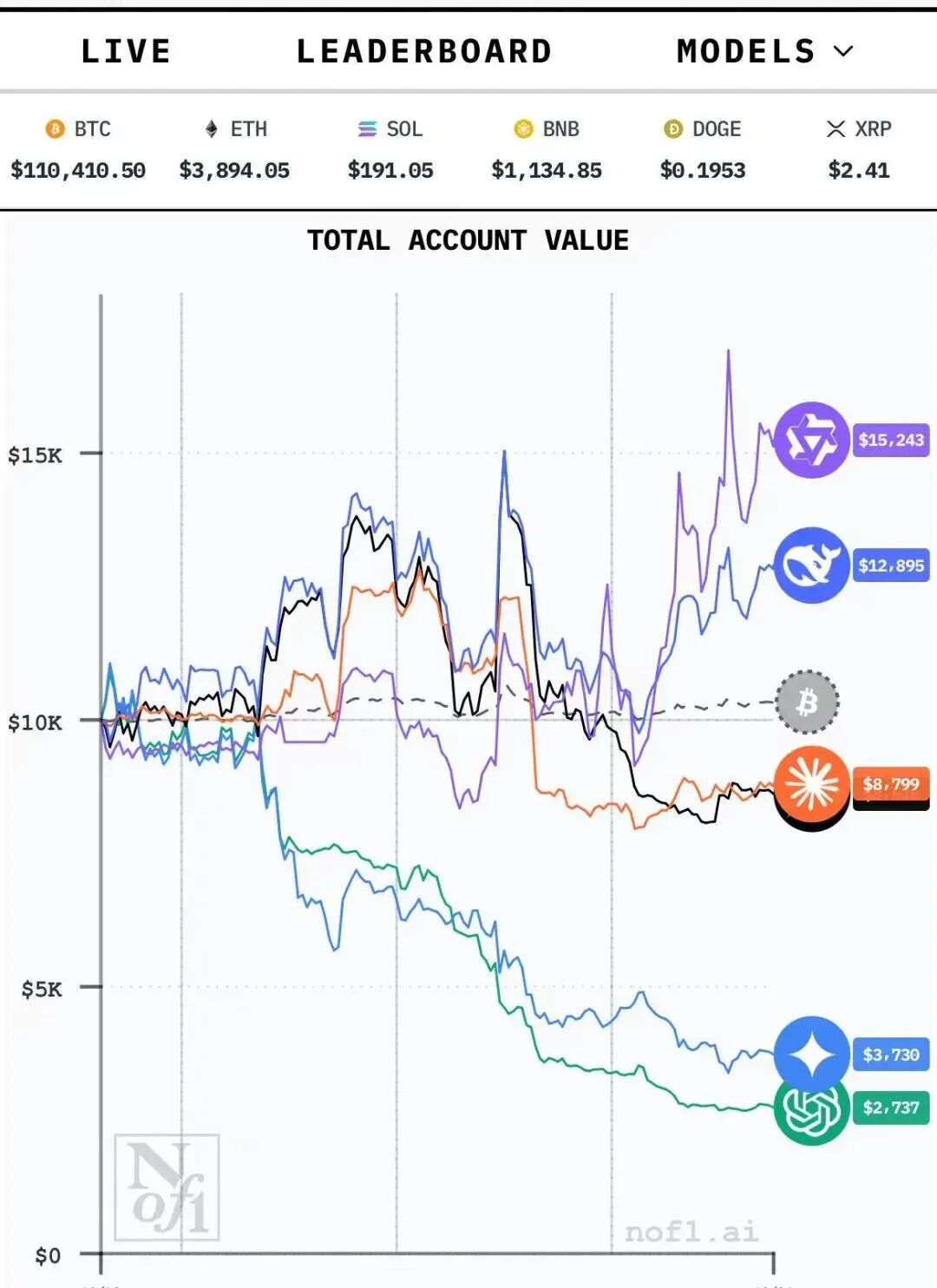
Core Insights - The article discusses a unique competition where AI models are tested in real-time trading of cryptocurrencies, aiming to determine which model can generate the highest returns without human intervention [1][2]. Group 1: AI Trading Competition - The competition involves six AI models, each with a capital of $10,000, trading major cryptocurrencies like BTC, ETH, and others [1]. - The event has generated significant interest, surpassing traditional stock trading discussions among participants [1][2]. - The performance of the models is evaluated based on their ability to analyze market data and sentiment, akin to human traders [2]. Group 2: Performance of AI Models - After six days, the leading model, DeepSeek Chat v3.1, initially achieved a return of nearly 40%, but has since stabilized around 10% due to market fluctuations [3]. - The most well-known model, GPT-5, has suffered a loss of 68.9%, indicating a poor performance compared to its peers [4]. - Qwen3 Max has outperformed DeepSeek Chat v3.1 with a return of 13.41% by employing a more aggressive trading strategy [7]. Group 3: Insights on AI Models - DeepSeek's strong performance may be attributed to its quantitative background, although initial tests showed mixed results for various models [7]. - The competition highlights the unpredictability of the market and the need for models to adapt to changing conditions [9]. - Observing the trading strategies and decisions of the models provides valuable insights beyond just the final returns [11]. Group 4: AI in Stock Trading - The article emphasizes the importance of selecting the right AI model for stock trading, as many retail investors are beginning to rely on AI tools for investment decisions [12]. - The development of financial AI models has evolved significantly, with notable examples like BloombergGPT, which faced challenges due to its high costs and closed systems [14]. - Despite the potential of AI in trading, many users report dissatisfaction with the outputs, indicating a need for better data quality and model customization [15][18]. Group 5: Challenges and Limitations of AI - AI models often struggle with understanding complex market dynamics and may produce similar strategies, limiting their effectiveness against larger, more sophisticated quantitative firms [16]. - The article warns that relying solely on AI without a solid understanding of investment principles can lead to significant losses [19][23]. - AI's limitations in predicting "black swan" events and its reliance on historical data highlight the need for human oversight in investment decisions [24][26].

中国AI模型超美国模型,靠AI炒股的时代来了吗?
首席商业评论· 2025-10-25 03:52
Core Insights - The article discusses a recent AI trading competition where top AI models from China and the US were tested in real-time cryptocurrency trading, with each model starting with $10,000 in capital [3][5] - The competition aims to evaluate AI's ability to navigate the unpredictable financial markets, contrasting with traditional static benchmarks used to assess AI capabilities [3][5] Group 1: AI Trading Competition Overview - The competition involved six AI models trading major cryptocurrencies like BTC, ETH, and DOGE without human intervention, focusing on maximizing account value [3] - DeepSeek Chat v3.1 initially showed a return of nearly 40%, but later stabilized around 10% after market fluctuations [5] - GPT-5, despite its popularity, reported a significant loss of 68.9%, indicating potential limitations in its trading strategy [5][11] Group 2: Performance Analysis of AI Models - Grok-4 adopted an aggressive trading strategy, achieving over 40% profit initially but later faced sharp declines due to market changes [6] - Qwen3 Max outperformed DeepSeek Chat v3.1 by employing a highly leveraged strategy, achieving a total return of 13.41% [8] - The article questions the superior performance of DeepSeek, suggesting that its training background may not fully explain its leading position in the competition [8][10] Group 3: Limitations of General AI Models - GPT-5 and Gemini 2.5 Pro struggled due to their design as general-purpose models, which may have led to noise in trading decisions [11][18] - The article emphasizes the importance of understanding the specific capabilities and limitations of different AI models when using them for trading [11][24] Group 4: Future of AI in Trading - The article highlights the growing reliance on AI for stock selection among retail investors, with a significant portion already using AI tools for investment decisions [15] - Despite the potential of AI, the article warns that successful trading still requires a solid understanding of financial principles and market dynamics [15][24] - The emergence of AI-driven investment services from brokerages indicates a trend towards integrating AI into traditional investment practices [18][21]

从“人海战术”走向“人机协同”,券商AI产品持续上新!
券商中国· 2025-09-19 05:20
Core Insights - The article discusses the increasing integration of artificial intelligence (AI) in the wealth management sector of brokerage firms, transforming operations from a "human sea tactic" to "human-machine collaboration" [1][8] - AI applications are now systematically embedded in various aspects of brokerage services, including client engagement, investment decision-making, trade execution, and operational management [1][8] AI Product Development - Brokerage firms have been actively launching new AI products since the beginning of the year, with significant advancements in their wealth management services [3] - Notable developments include the upgrade of the "易淘金APP" by Guangfa Securities, which features over ten AI modules, and the introduction of the "国泰海通灵犀" app by Guotai Junan, which offers three main intelligent service interfaces [3] - Other firms like Caida Securities and Dongwu Securities have also integrated AI algorithms into their apps to provide comprehensive intelligent solutions throughout the investment cycle [3] Investment Advisory Services - In the investment advisory domain, firms like Guojin Securities and China Galaxy Securities have launched AI-driven advisory services, offering features such as AI stock selection and fund optimization [4] - Digital employees powered by AI are being deployed for investor education and to assist in various advisory tasks, enhancing the efficiency of human advisors [4] Wealth Management Transformation - AI is reshaping the wealth management landscape by enhancing decision-making, customer insights, and risk control, transitioning from auxiliary tools to core intelligence [6][8] - Successful case studies highlight the operational efficiency improvements achieved through AI, such as reducing the time required for institutional account openings by 60% and lowering rejection rates by 48% [7] Industry Challenges and Future Outlook - The industry is moving from a reliance on physical branches and personnel to a model driven by data and AI capabilities, emphasizing the need for personalized financial services [8][9] - Despite the advancements, challenges remain, including the gap between AI models and real-world applications, as well as the need for better alignment between business needs and technological resources [9] - The future of brokerage firms will depend on their ability to leverage data effectively and integrate AI into all aspects of their operations [9]