
贻贝粘蛋白

Search documents
2025,投资人不爱美妆品牌了
3 6 Ke· 2025-12-02 00:56
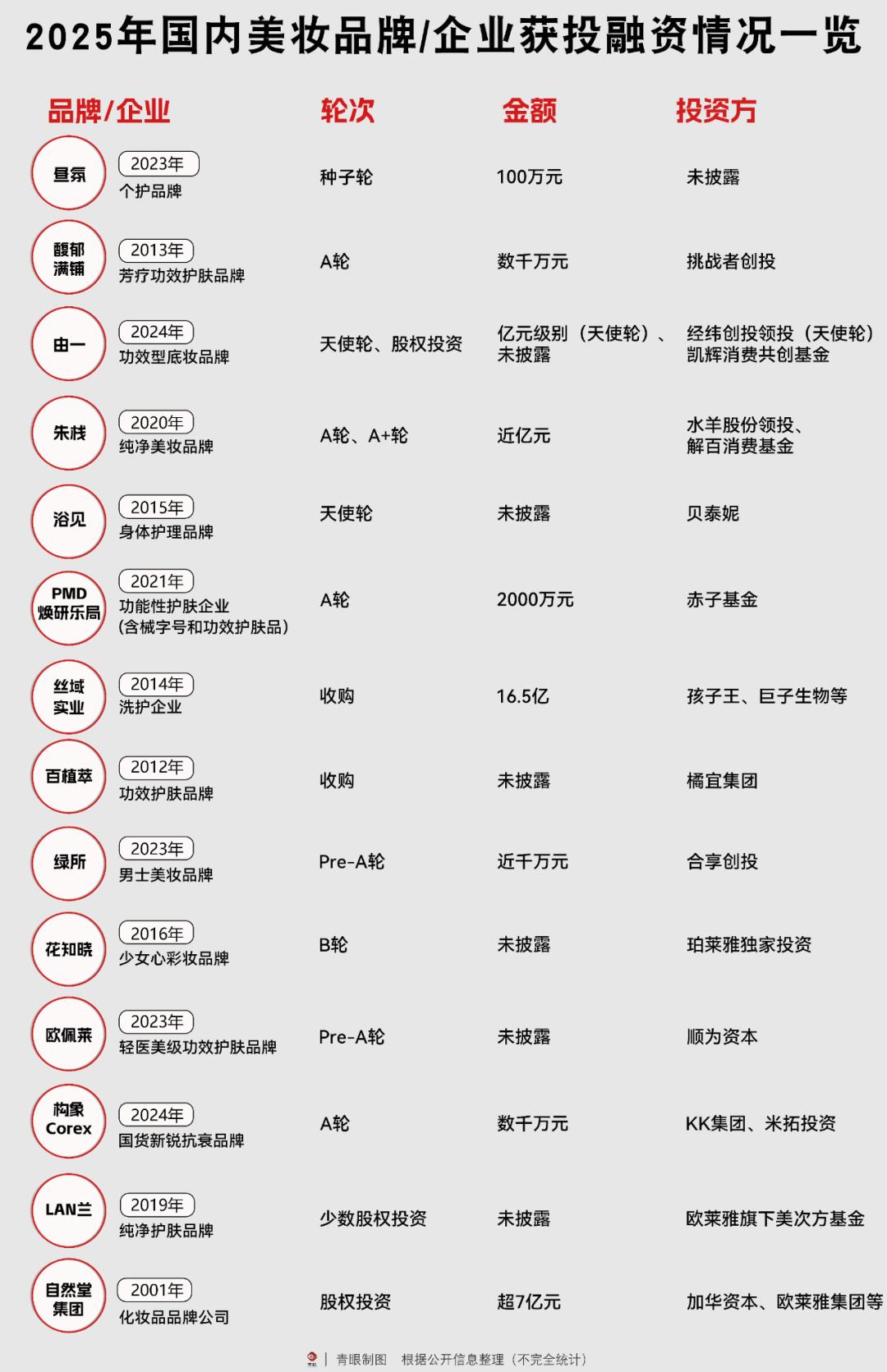
Core Insights - The investment landscape for beauty brands in China has cooled significantly, with only 14 beauty brands receiving funding from January to November 2023, representing less than 20% of total investments in the sector [1][5][22] - In contrast, upstream raw material companies have attracted over 60% of the 71 investment and acquisition events in the same period, indicating a shift in capital focus towards these suppliers [1][5][19] Investment Trends - A total of 71 investment and acquisition events occurred in the beauty sector from January to November 2023, with 43 events (over 60.6%) involving raw material companies [1][5] - The beauty brands that did receive funding primarily focused on functional skincare, with notable examples including PMD, Corex, and LAN [5][19] - The only male beauty brand to secure investment this year was GREENLAB, which completed a Pre-A round financing of nearly 10 million yuan [5][19] Funding Amounts - Among the 71 investment events, 53 companies disclosed their funding amounts, with 31 companies receiving less than 100 million yuan, accounting for 43.1% of the total [16][19] - Notably, 15 companies received over 100 million yuan in funding, maintaining the same number as the previous year [16][19] Focus on Synthetic Biology - Synthetic biology has emerged as a hot investment area, with 20 out of 43 upstream companies receiving funding in this field, representing over 46.5% of total investments [19][21] - Companies like 瑞德林 and 巨微生物 have attracted significant investments, highlighting the growing interest in innovative raw materials for cosmetics [19][20] Market Dynamics - The shift in investment focus reflects a broader trend where capital is moving from short-term brand growth strategies to long-term technological advancements in the raw material sector [22] - Industry experts suggest that the current investment climate is becoming more rational, emphasizing research capabilities and innovation potential over mere brand popularity [22]


东星医疗前三季度营收2.84亿元 收购骨科公司延伸产业链布局
Zheng Quan Shi Bao Wang· 2025-10-28 12:56
Core Insights - Dongxing Medical (301290) reported a revenue of 284 million yuan for the first three quarters of 2025, a year-on-year decline of 10.21%, with a net profit attributable to shareholders of -70 million yuan, down 263% year-on-year, primarily due to a goodwill impairment loss of approximately 100 million yuan recognized in the third quarter [1] Group 1: Business Performance - The company focuses on surgical medical devices, particularly in the field of anastomosis devices, and has two main business segments: surgical instruments represented by anastomosis devices and surgical equipment represented by operating tables and shadowless lamps [1] - In the anastomosis device sector, Dongxing Medical has emphasized the electric anastomosis device, achieving over 130% year-on-year revenue growth in 2024 [1] - The company has obtained a Class III medical device registration certificate for its self-developed fully electric laparoscopic anastomosis device, further solidifying its market position [1] Group 2: Market Trends - Industry data indicates that the anastomosis device market in China is expected to grow from 9.82 billion yuan in 2024 to 16.67 billion yuan by 2030, with electric laparoscopic anastomosis devices being a major growth driver, projected to have a compound annual growth rate of 16% during this period [1] Group 3: Strategic Initiatives - Dongxing Medical is actively expanding into synthetic biology by collaborating with research institutions such as Changzhou University and Shanghai Jiao Tong University to develop high-tech barrier materials like recombinant humanized collagen and mussel adhesive protein, aiming to launch innovative medical consumables for hemostasis and scar repair [2] - The company announced a significant advancement in its platform strategy by planning to acquire 90% of Wuhan Yijiaobao, which will allow it to enter the high-end orthopedic market and extend its industrial chain in surgical medical devices [3] - The acquisition is expected to accelerate the commercialization of synthetic biological materials and enhance the company's platform development [3]
深圳全方位打造“创新之城”(奋勇争先,决战决胜“十四五”)
Ren Min Ri Bao· 2025-08-24 22:21
Core Insights - The article highlights the rapid development of the robotics industry in Shenzhen, particularly through the innovative efforts of companies like Pashini, which has developed advanced tactile sensors and robotic hands that can delicately handle objects like strawberries [1][2]. Group 1: Company Innovations - Pashini has developed a bionic robotic hand equipped with over a thousand high-precision multi-dimensional tactile sensors, capable of sensing temperature and pressure across 15 dimensions [1]. - The company has achieved a leading position in the global market for tactile sensors, with significant output since its establishment just four years ago [1]. - Shenzhen Bay Area's innovation ecosystem allows for seamless integration of research and industry, exemplified by the rapid testing and deployment of Pashini's dual-modal robotic hand in collaboration with local tech firms [2]. Group 2: Industry Growth and Support - Shenzhen's strategic emerging industries are projected to reach a value of 1.56 trillion yuan in 2024, accounting for 42.3% of the city's GDP, marking a consistent annual growth of over 100 billion yuan [1][2]. - The city has established a robust policy framework to support the robotics industry, including a three-year action plan and various funding initiatives, resulting in over 74,000 related enterprises and a total output exceeding 200 billion yuan [2]. - Shenzhen is home to over 25,000 national high-tech enterprises, averaging 12 per square kilometer, indicating a dense concentration of innovation and technology [3]. Group 3: Research and Development Infrastructure - Shenzhen has accelerated the construction of national-level innovation platforms, focusing on synthetic biology, brain research, and materials genomics, with over 4,000 innovation carriers established [4]. - The city has built significant research facilities, including the Pengcheng Laboratory and multiple national key laboratories, to foster original innovation [4]. Group 4: Application of New Technologies - The integration of AI in healthcare is exemplified by the use of a large model developed by Tencent and Mindray in critical care settings, showcasing Shenzhen's role as a testing ground for new technologies [5]. - Shenzhen has released nearly 200 "city + AI" application scenarios, promoting the dual advancement of technological and industrial innovation [5][6].