
资产支持票据

Search documents
金隅集团(02009)注册发行银行间市场债务融资工具
智通财经网· 2026-03-30 16:15
Core Viewpoint - The company, Jinju Group, plans to enhance its financing efficiency and optimize its debt structure by applying for the qualification to issue various debt financing instruments in the interbank market, with a total issuance limit of up to 40 billion yuan [1][2] Group 1 - The company has approved a proposal to register and issue debt financing tools at the 20th meeting of the 7th Board of Directors held on March 30, 2026 [1] - The registration project includes a unified registration for various non-financial corporate debt financing instruments (DFI) [1] - The types of instruments to be issued include but are not limited to super short-term financing bills, short-term financing bills, medium-term notes, perpetual medium-term notes, targeted debt financing tools, and asset-backed notes [1] Group 2 - The total issuance scale is capped at a maximum of 40 billion yuan during the effective period of the issuance [1] - The bond terms will be determined based on the type of instruments issued, with medium-term notes and perpetual medium-term notes having terms exceeding one year, short-term financing bills not exceeding 12 months, and super short-term financing bills not exceeding 9 months [1]
资产支持票据产品报告(2026年2月):资产支持票据发行规模环比有所下降,个人消费金融类资产保持活跃
Zhong Cheng Xin Guo Ji· 2026-03-11 05:31
Group 1: Report Overview - The report is titled "Asset-Backed Notes Product Report (February 2026)", focusing on the issuance and secondary market trading of asset-backed notes [3] Group 2: Issuance Situation Overall Issuance - In February 2026, 18 asset-backed notes were issued, with a total issuance scale of 16.94 billion yuan. Compared with the previous month, the number of issuances decreased by 22, and the issuance scale dropped by 42.44%. Compared with the same period last year, the number of issuances decreased by 14, and the issuance scale dropped by 40.45% [4][5] Top Ten Issuing Institutions - In February 2026, SDIC Taikang Trust ranked first with an issuance scale of 2.752 billion yuan, accounting for 16.25%. Far East Leasing ranked second with an issuance scale of 2.1 billion yuan, accounting for 12.40%. State Power Investment Group ranked third with an issuance scale of 2.019 billion yuan, accounting for 11.92%. Meituan Sankuai Small Loan ranked fourth with an issuance scale of 2 billion yuan, accounting for 11.81%. Du Xiaoman Small Loan, Huanneng Trust, and Henghe Credit Insurance ranked fifth with an issuance scale of 1 billion yuan each, accounting for 5.90%. The total issuance scale of the top ten issuing institutions was 14.545 billion yuan, accounting for 85.86% [5] Underlying Asset Categories - The underlying asset types of the issued products mainly include personal consumer finance, subsidy funds, general financial leasing, small and micro loans, and accounts receivable. Personal consumer finance products had 6 issuances, accounting for 33.60% of the scale; subsidy fund products had 2 issuances, accounting for 17.43% of the scale; general financial leasing products had 2 issuances, accounting for 16.68% of the scale; small and micro loan products had 3 issuances, accounting for 16.53% of the scale; accounts receivable products had 3 issuances, accounting for 11.63% of the scale [8] Issuance Scale Distribution - The highest single issuance scale was 2.1 billion yuan, and the lowest was 169 million yuan. The number and scale of products with a single issuance scale between (5, 10] billion yuan were the highest, with 13 issuances, accounting for 70.55% of the scale [10] Term Distribution - The shortest term was 0.18 years, and the longest was 3.26 years. The number and scale of products with a term between (1, 2] years were the highest, with 9 issuances, accounting for 56.98% of the scale [10] Rating Distribution - According to the issuance scale of notes at each rating level, AAAsf-rated notes accounted for 91.35%, AA+sf-rated notes accounted for 2.39%, and BBB+sf-rated notes accounted for 0.32% [11] Issuance Interest Rate - The lowest issuance interest rate of one-year AAAsf-rated notes was 1.71%, the highest was 2.00%, and the interest rate center was approximately 1.84% [13] ABCP Product Issuance - In February 2026, 7 ABCP products were issued, with a total issuance scale of 6.471 billion yuan, a year-on-year decrease of 33.81%, accounting for 38.20% of the ABN issuance scale. The underlying assets mainly included subsidy funds, personal consumer finance, accounts receivable, general financial leasing, and factoring claims [17] Group 3: Secondary Market Trading Situation - In February 2026, there were 291 secondary market transactions of asset-backed notes. The number of transactions decreased by 47.47% month-on-month and 30.22% year-on-year. The transaction amount was 22.31 billion yuan, a month-on-month decrease of 52.11% and a year-on-year decrease of 39.21%. The more active underlying asset types in the secondary market were personal consumer finance, REITs, accounts receivable, small and micro loans, and subsidy funds, with transaction amount proportions of 38.98%, 12.83%, 10.91%, 10.84%, and 9.44% respectively [18]
资产支持票据产品报告(2026年1月):资产支持票据发行规模与上年同期相比小幅增长,个人消费金融类产品为市场发行绝对主力
Zhong Cheng Xin Guo Ji· 2026-02-12 11:03
Group 1: Report Overview - The report is titled "Asset - Backed Notes Product Report (January 2026)" and focuses on the asset - backed notes (ABN) market [3] Group 2: Industry Investment Rating - No industry investment rating is provided in the report Group 3: Core Viewpoints - In January 2026, the issuance scale of asset - backed notes increased slightly compared to the same period last year, with personal consumption finance products being the dominant force in the market. The secondary - market trading also showed an upward trend [3][4] Group 4: Issuance Situation - In January 2026, 40 ABN products were issued, with a total issuance scale of 29.43 billion yuan, a 4.01% increase in scale and 1 more in quantity compared to the same period last year. All were privately issued [4][5] - The top five sponsoring institutions in terms of issuance scale were CITIC Trust & Investment Co., Ltd. (4.256 billion yuan, 14.46%), Huaxin Trust Co., Ltd. (3.7 billion yuan, 12.57%), Xiamen International Trust Co., Ltd. (3 billion yuan, 10.19%), Huarong International Trust Co., Ltd. (2.764 billion yuan, 9.39%), and China Foreign Economic and Trade Trust Co., Ltd. (2.23 billion yuan, 7.58%). The top ten sponsoring institutions accounted for 81.65% of the total issuance scale [5] - The underlying asset types included personal consumption finance, micro - loans, accounts receivable, general financial leasing, and auto financial leasing. Personal consumption finance products accounted for 63.98% of the issuance scale [4][7] - The highest single - product issuance scale was 2 billion yuan, and the lowest was 70 million yuan. Products with a single - issuance scale between (5, 10] billion yuan had the largest number and scale, accounting for 69.87% [9] - The shortest product term was 0.48 years, and the longest was 4.99 years. Products with a term between (1, 2] years had the largest number and scale, accounting for 59.84% [10][11] - According to the issuance scale of notes at each level, AAAsf - rated notes accounted for 89.15%, AA + sf - rated notes accounted for 4.71%, A + sf - rated notes accounted for 0.10%, and Asf - rated notes accounted for 0.29% [11] - For one - year - around AAAsf - rated notes, the lowest issuance interest rate was 1.79%, the highest was 1.98%, and the interest - rate center was around 1.84% [4][13] - In January 2026, 12 ABCP products were issued, with a total issuance scale of 8.365 billion yuan, a 9.48% year - on - year decrease, accounting for 28.42% of the ABN issuance scale. Personal consumption finance ABCP accounted for 88.82% of the ABCP issuance scale [17] Group 5: Secondary - Market Trading Situation - In January 2026, there were 554 secondary - market transactions of asset - backed notes, a 7.78% year - on - year increase in the number of transactions, and the transaction amount was 46.585 billion yuan, a 5.12% year - on - year increase [4][18] - The more active underlying asset types in the secondary - market trading were personal consumption finance, accounts receivable, REIT - like products, micro - loans, and auto financial leasing, with transaction - amount proportions of 38.42%, 15.53%, 13.92%, 9.43%, and 4.53% respectively [18]
2025年Auto-ABS市场回顾与展望:发行规模有所回升,发行利率再创新低,资产表现依旧良好
Lian He Zi Xin· 2026-02-02 15:07
Market Overview - In 2025, the Auto-ABS market saw a recovery with a total issuance of 135 deals, an increase of 33 deals from the previous year, and an issuance scale of 255.78 billion yuan, up 21.60% year-on-year[4] - The issuance of credit ABS remained stable at 32 deals, totaling 118.54 billion yuan, a decrease of 8.58%, accounting for 46.35% of the total[4] - The issuance of exchange ABS increased significantly, with 80 deals totaling 91.60 billion yuan, up 55.98%, representing 35.81% of the total[4] Issuer Concentration and Performance - The number of issuers in 2025 was 53, with 33 being leasing companies, indicating a slight decrease in concentration[8] - Financing leasing companies issued 103 deals, an increase of 33 deals, with a total issuance of 137.24 billion yuan, up 70.11%, accounting for 53.65% of the total[10] - The average issuance size for credit ABS was 37.04 billion yuan, while for financing leasing companies, it was 13.32 billion yuan[10] Credit Ratings and Interest Rates - The majority of issued securities were rated AAAsf, with 248 securities totaling 218.11 billion yuan, accounting for 97.71% of the total[13] - The average issuance interest rate for AAAsf securities was 2.07%, down 42 basis points from the previous year, with a range from 1.60% to 4.00%[14] - The average interest rate for AA+sf securities was 3.14%, down 53 basis points, with a range from 1.98% to 4.50%[14] Asset Pool Characteristics - In 2025, 126 Auto-ABS deals had publicly available asset data, with a total issuance of 246.56 billion yuan, and 62 deals had over 10,000 underlying assets, accounting for 76.84% of the total[20] - The average weighted remaining principal balance of the underlying assets was 224,600 yuan, indicating good asset pool diversification[20] - The weighted average contract term for assets over 36 months increased to 69.13%, up 11.61 percentage points from the previous year[23] Asset Quality and Future Outlook - The cumulative default rate for underlying assets ranged from 0.00% to 6.81%, with an average of 1.29%, indicating a slight increase from the previous year[35] - The early repayment rate remained low, primarily due to low borrower incentives, with most data showing rates below 15%[38] - The market is shifting towards a structural deepening, with opportunities arising from the penetration of new energy vehicles exceeding 50%[43]
基础设施高效服务一二级债市运行 北金所1月集中簿记系统支持发债超8700亿元
Xin Hua Cai Jing· 2026-02-02 15:06
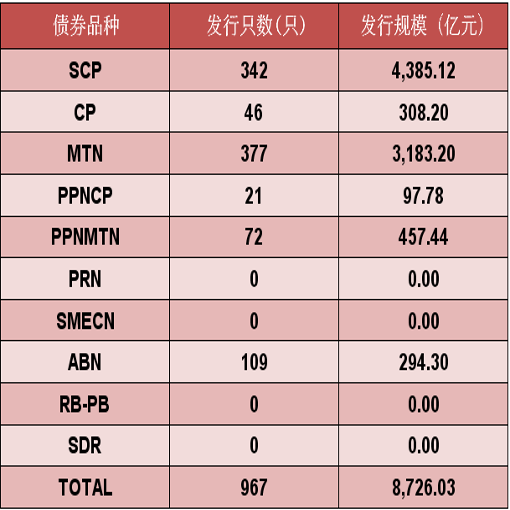
Core Viewpoint - The Beijing Financial Assets Exchange (北金所) has maintained a stable issuance scale in its centralized bookkeeping and filing system in January 2026, with an active bond trading environment indicating continued institutional interest in standardized bond issuance and trading platforms [1]. Issuance Data - In January 2026, the centralized bookkeeping system completed 967 issuances, totaling 8,726.03 billion yuan, providing a smooth channel for corporate debt financing at the beginning of the year [1][2]. - Breakdown of issuance by bond type includes: - SCP: 342 issuances, 4,385.12 billion yuan - CP: 46 issuances, 308.20 billion yuan - MTN: 377 issuances, 3,183.20 billion yuan - PPNCP: 21 issuances, 97.78 billion yuan - PPNMTN: 72 issuances, 457.44 billion yuan - ABN: 109 issuances, 294.30 billion yuan [2]. Trading Activity - In January, there were 21 trading days, with a total of 3,922 quotes made in the bond trading system, averaging about 187 quotes per day, showing an increase compared to December 2025 [3]. - The average yield levels for bonds in January showed a slight decrease compared to December, with specific bonds having notable yields, such as: - Medium-term notes with a buy yield of 1.58% and a sell yield of 2.11% - Short-term financing bonds with a buy yield of 1.31% and a sell yield of 2.22% [4]. Transaction Summary - In January 2026, a total of 15 bond transactions were completed, with cumulative transactions since November 2014 reaching 1,027, totaling 341.36 billion yuan [5]. - The breakdown of transactions includes: - 731 purchases and 296 sales by non-financial institutional qualified investors - 932 different bonds traded, including 15 short-term financing bonds and 569 medium-term notes [5]. - The data reflects a stable willingness among institutions to engage in bond issuance and trading through standardized platforms, with particular interest in certain types of credit assets [5].

山东高速股份有限公司第六届董事会第八十二次会议决议公告
Shang Hai Zheng Quan Bao· 2026-01-30 22:23
Core Viewpoint - The board of directors of Shandong Hi-Speed Company held its 82nd meeting, approving several key resolutions related to compliance management, investment tracking, and financial instruments [1][2][3][4][6][7]. Group 1: Board Meeting Resolutions - The meeting approved the 2025 Compliance Management Report with unanimous support [2]. - The board also approved the tracking of important investment projects and decisions made in 2025, again with unanimous support [2]. - The 2026 Audit Work Plan was approved unanimously [3]. - The board approved the issuance of asset-backed notes by its subsidiary, with a total amount not exceeding RMB 1 billion [4][20][22]. - The board decided to revise the Investment Management Measures and submit it for shareholder approval [4][6]. - The board approved the application for non-financial corporate debt financing tools (DFI) and will submit it for shareholder approval [7]. Group 2: Guarantee and Financing Updates - The company signed a maximum guarantee contract with CITIC Bank for RMB 200 million, with a net increase of RMB 50 million in guarantees [9][13]. - A separate guarantee contract was signed with China Everbright Bank for RMB 100 million, with similar terms [10][15]. - The total approved external guarantees amount to RMB 18.302 billion, with no overdue guarantees reported [18]. Group 3: Asset-Backed Notes Details - The asset-backed notes will be based on factoring receivables and are intended to optimize the asset structure and broaden financing channels [20][22]. - The issuance will be structured in a tiered manner, with a maximum issuance scale of RMB 1 billion [22][26]. - The company will act as a guarantor for the notes, ensuring the financial stability of the subsidiary involved [26][30].

2025年银行间市场共有超10万亿元债务融资工具发行
Xin Hua Cai Jing· 2026-01-22 23:11
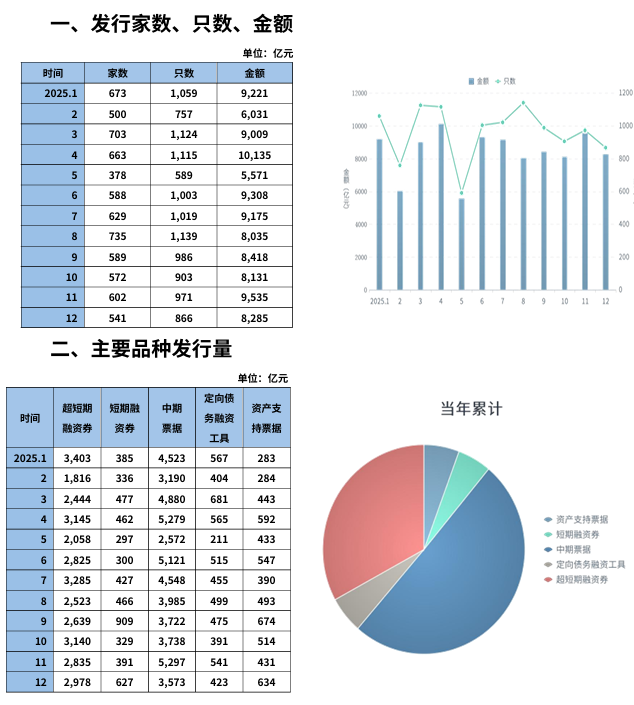
Group 1 - In December 2025, the interbank bond market issued a total of 866 debt financing instruments amounting to 828.5 billion yuan, including 297.8 billion yuan in super short-term financing, 62.7 billion yuan in short-term financing, 357.3 billion yuan in medium-term notes, 42.3 billion yuan in targeted debt financing instruments, and 63.4 billion yuan in asset-backed notes [1][2][3] - For the entire year of 2025, the interbank bond market issued a total of 11,531 debt financing instruments with a total value of 10.09 trillion yuan [1][2] Group 2 - The issuance of innovative products in December 2025 included 44.8 billion yuan in green debt financing instruments, 6.6 billion yuan in rural revitalization notes, 14.5 billion yuan in asset-backed commercial papers, 5.4 billion yuan in sustainable development-linked bonds, and 134.5 billion yuan in sci-tech notes [5] - The cumulative issuance of panda bonds reached 858.7 billion yuan by the end of December 2025, with 15.63 billion yuan issued in that year [7] Group 3 - The custody statistics for debt financing instruments showed that the total custody amount for super short-term financing bonds was 1.48 trillion yuan, short-term financing bonds at 521.3 billion yuan, medium-term notes at 1.32 trillion yuan, targeted debt financing instruments at 193.36 billion yuan, and asset-backed notes at 70.74 billion yuan [9][10] - The custody amount for innovative products included 318.8 billion yuan in panda bonds, 1.15 trillion yuan in sci-tech notes, 155 billion yuan in sustainable development-linked bonds, 585.4 billion yuan in green debt financing instruments, 123.7 billion yuan in rural revitalization notes, and 105.3 billion yuan in asset-backed commercial papers [11]
理想获100亿债务融资工具注册额度
理想TOP2· 2026-01-05 15:43
Core Viewpoint - The document outlines the approval of Li Auto's debt financing tools registration, allowing the company to issue up to 10 billion yuan in various debt instruments over a two-year period [2][3]. Group 1: Registration Details - The registered amount for Li Auto's debt financing tools is 10 billion yuan, valid for two years from the date of the notification [2]. - The joint lead underwriters for this issuance are Bank of China and China International Capital Corporation [2]. Group 2: Issuance Guidelines - Li Auto can issue various types of debt instruments, including super short-term financing bonds, short-term financing bonds, medium-term notes, perpetual notes, asset-backed notes, and green debt financing tools [3]. - Each issuance must specify the lead underwriter, product type, issuance scale, and duration [3]. Group 3: Compliance and Management - The company must adhere to the guidelines for issuing non-financial corporate debt financing tools and comply with self-regulatory management rules set by the China Interbank Market Dealers Association [3][4]. - Li Auto is required to disclose the use of raised funds according to the prospectus and must notify any changes in fund usage [3]. Group 4: Operational Conduct - The company must conduct its operations in compliance with national industrial policies and ensure healthy business development [3]. - In the event of significant events affecting debt repayment capability, Li Auto must follow investor protection mechanisms to safeguard investors' rights [3].


创新科技金融服务驱动“科技—产业—金融”良性循环|展望2026
Guo Ji Jin Rong Bao· 2025-12-31 13:36
Core Insights - The central theme of the articles emphasizes the importance of innovation-driven economic growth in 2026, particularly through the enhancement of technology financial services as a key focus of the Central Economic Work Conference [1] Group 1: Innovation in Technology Financial Services - The core objective is to establish a virtuous cycle connecting technology, industry, and finance, ensuring that financial resources are accurately matched to the development needs of hard technology enterprises throughout their lifecycle [2] - Key initiatives for 2026 include improving the intellectual property pledge financing mechanism, expanding the pilot scope of "investment-loan linkage" and "investment-insurance linkage," and fostering patient capital through the development of AIC equity investments and technology innovation bonds [2][8] Group 2: Financing Tools and Mechanisms - The articles highlight the need for innovative financing tools to support technology enterprises, including the establishment of a bond market "technology board" and the encouragement of technology companies to issue innovation bonds and asset-backed securities [4] - The focus is on making intellectual property pledge financing more accessible and effective, with efforts to standardize processes and introduce risk compensation mechanisms to alleviate banks' lending hesitance [4][6] Group 3: Patient Capital and Long-term Investment - The government aims to cultivate a "long money, long investment" ecosystem by establishing a national venture capital guiding fund with a 20-year duration, directing 70% of funds to seed and early-stage enterprises [12] - Measures to support hard technology enterprises include optimizing the listing review process, enhancing the inclusivity for unprofitable and high R&D companies, and promoting long-term capital investment [13][14] Group 4: Market Dynamics and Future Outlook - The articles suggest that the listing process for hard technology companies on the STAR Market will accelerate, with a focus on supporting enterprises with core technologies and clear commercialization paths while maintaining strict quality standards [14] - The emphasis will be on creating a favorable environment for genuine innovation while preventing "pseudo-innovation" from entering the market [14]
创新科技金融服务驱动“科技—产业—金融”良性循环
Guo Ji Jin Rong Bao· 2025-12-31 13:16
Core Insights - The central theme of the news is the emphasis on innovation-driven economic growth in 2026, particularly through the enhancement of technology financial services as a key focus of the Central Economic Work Conference [1] Group 1: Innovation in Financial Services - The core of innovative technology financial services is to establish a virtuous cycle between technology, industry, and finance, ensuring that financial resources are accurately matched to the development needs of hard technology enterprises throughout their lifecycle [2] - In 2025, significant explorations were made in technology financial services, including the launch of the National Venture Capital Guidance Fund, which has reached a scale of one trillion yuan, focusing on seed, startup, and early-stage enterprises [1][2] - The expansion of financial asset investment company (AIC) equity investment trials to 18 cities nationwide aims to guide bank capital to invest early, small, and in hard technology [1][2] Group 2: Financing Mechanisms - The establishment of a knowledge property pledge financing mechanism is crucial, with initiatives such as trial programs for "pre-compensation" loans for light asset technology enterprises to gain more financing support [2][4] - The exploration of innovative financing tools includes the promotion of knowledge property pledge financing, which has shifted from being merely feasible to being more practical, with standardized processes for patent and trademark pledges [3][5] - The introduction of a bond market "technology board" has seen nearly 100 institutions issue over 250 billion yuan in technology innovation bonds within seven months [3] Group 3: Long-term Capital Cultivation - The government is focused on cultivating "patient capital" to guide long-term investments into early and mid-stage hard technology sectors, establishing a closed-loop system for fundraising, investment, management, and exit [9] - The National Venture Capital Guidance Fund is designed with a 20-year duration, directing 70% of its funds towards seed and startup phases, alongside optimizing state-owned capital assessments [9][10] - The capital market is expected to support hard technology enterprises in their IPO processes, with measures to enhance the inclusivity of unprofitable, high-R&D companies [10][11] Group 4: Collaborative Financial Models - The "investment-loan linkage" model encourages collaboration between banks and investment institutions, integrating credit lending with equity investment to share risks and returns [6][7] - The "insurance-investment linkage" model aims to combine insurance with investment to mitigate risks associated with technology financing, enhancing banks' willingness to lend [7][8] - In 2026, the expansion of the "investment-loan linkage" and "insurance-investment linkage" trials will prioritize regions with concentrated technology enterprises and active equity investment [8]