
逻辑电路

Search documents
中芯国际赵海军:AI挤占存储产能,客户此时不宜过度砍单
经济观察报· 2026-02-11 14:12
Core Viewpoint - The current decline in terminal demand is attributed not to a loss of consumer willingness but rather to a supply chain resource mismatch caused by the explosion of AI demand [3][5]. Financial Performance - In 2025, SMIC reported a record annual revenue of $9.327 billion, a year-on-year increase of 16.2%, and a net profit of $685 million, up 39.1% [2]. - The gross margin for Q4 2025 decreased by 2.8 percentage points to 19.2%, with guidance for Q1 2026 indicating a range of 18%-20% [2][9]. Supply Chain Dynamics - The memory chip market is experiencing price volatility, leading to heightened supply chain tensions, with memory prices significantly increasing in Q1 2026 compared to Q4 2025 [3]. - AI's strong demand for storage chips, particularly HBM and high-density DDR5, is squeezing the supply available for mobile and other applications [5][6]. Capacity Utilization and Market Trends - SMIC maintained a high capacity utilization rate of 95.7% in Q4 2025, but the revenue structure showed subtle changes, with the PC and tablet segment's revenue share slightly increasing to 15.2% [5]. - The company is shifting its production capacity towards high-demand areas such as data centers and automotive sectors, as orders for mid-range mobile and PC devices decline due to storage shortages [11]. Capital Expenditure and Depreciation - SMIC's capital expenditure reached $8.1 billion in 2025, exceeding initial expectations, primarily to meet strong customer demand and adapt to external changes [9][10]. - The company anticipates a 30% year-on-year increase in total depreciation in 2026 due to rising unit depreciation costs from new factory operations [9][10]. Future Outlook - For 2026, SMIC expects revenue growth to exceed the average of comparable peers, driven by internal efficiency improvements and high capacity utilization [14]. - The company is optimistic about navigating through the high depreciation phase and entering a phase of healthy development as capacity gradually releases and market demand rebounds [14][15]. Industry Trends - The semiconductor industry is undergoing a localization shift, with significant opportunities arising from domestic design companies capturing supply chain shares [16]. - As AI technology penetrates edge devices, there will be an upgrade in specifications for mobile and PC devices, leading to increased demand for higher-value chips [16].


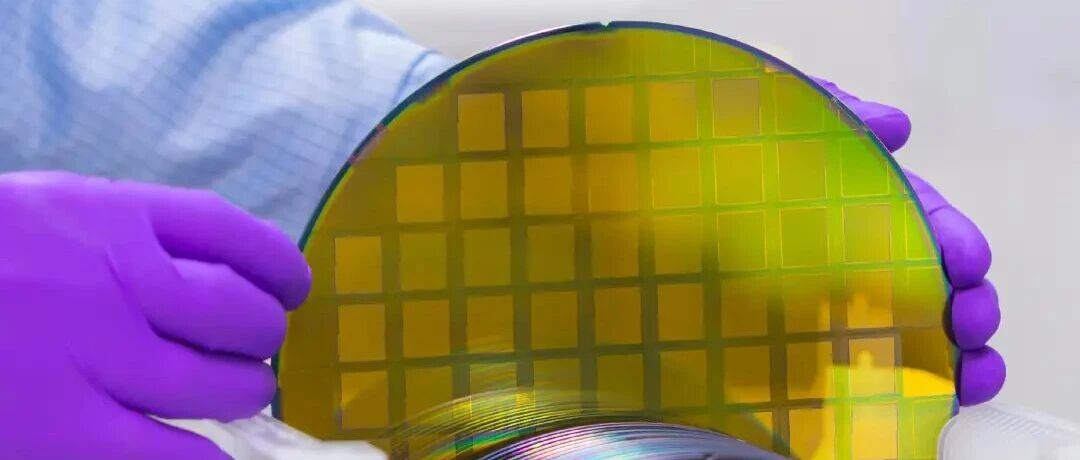
2025年全球半导体市场将达7008 亿美元,同比增长11.2%
Sou Hu Cai Jing· 2025-06-09 10:32
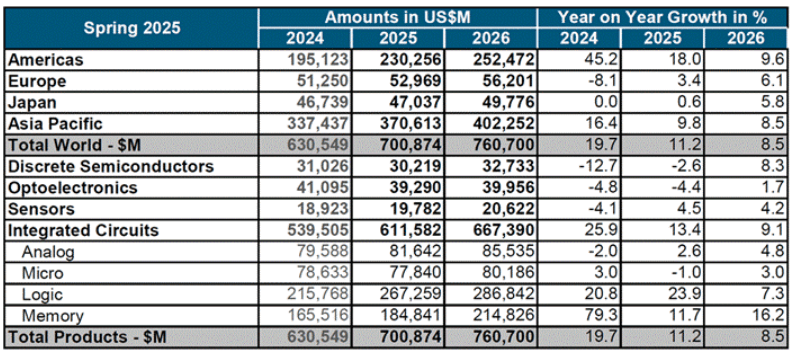
Core Viewpoint - The global semiconductor market is expected to recover by 2025, driven by demand in AI, cloud infrastructure, and advanced consumer electronics, despite Europe lagging behind the US and Asia in the AI boom [1][2]. Group 1: Market Performance - In April 2023, global semiconductor sales reached $57 billion, a month-over-month increase of 2.5% and a year-over-year increase of 22.7% compared to April 2024's $46.4 billion [1]. - By April 2025, the Americas are projected to see a year-over-year increase of 44.4%, while Asia Pacific and China are expected to grow by 23.1% and 14.4%, respectively [1]. - The total semiconductor market size for 2023 is estimated at $700.8 billion, reflecting an 11.2% year-over-year growth, which is lower than the 19.7% growth anticipated for 2024 [2]. Group 2: Regional Insights - The Americas and Asia Pacific are expected to lead growth in 2025 with projected increases of 18.0% and 9.8%, respectively, while Europe is forecasted to grow by only 6.1% due to a focus on industrial and automotive markets [3]. - Japan's semiconductor market is expected to see a modest year-over-year increase of 5.8% in 2025 [3]. Group 3: Product Segmentation - The growth in the semiconductor market is primarily driven by logic and memory segments, which are expected to achieve strong double-digit growth [4]. - Discrete semiconductors, optoelectronics, and micro ICs are projected to experience declines, attributed to ongoing trade tensions and negative economic developments affecting supply chains [5]. - The forecast for the semiconductor market in 2026 anticipates an 8.5% year-over-year growth, with memory again leading the growth, while the overall market may not exceed $1 trillion until 2032 [6].
电子行业4月月报:坚定“科技自立”与“AI+”投资主线-20250430
Yin He Zheng Quan· 2025-04-30 08:53
Investment Rating - The report assigns a rating of "Cautious Recommendation" for the semiconductor industry, indicating a potential growth of 5% to 20% relative to the benchmark index [3][32]. Core Insights - Global semiconductor sales are projected to reach $617.3 billion in 2024, marking a year-on-year growth of 19.1%. The Americas, China, and other Asia-Pacific regions are expected to see sales increases, while Japan and Europe may experience declines [6][9]. - The primary contributors to the sales growth in 2024 will be logic circuits and memory, with logic circuit sales estimated at $212.6 billion and memory sales at $165.1 billion, reflecting a significant year-on-year increase of 78.9% for memory products [9]. - Domestic wafer foundries are expanding capacity, with major players like SMIC and Hua Hong Semiconductor maintaining high capacity utilization rates [12][17]. - The semiconductor industry is expected to see a 11.2% year-on-year growth in sales by 2025, driven by consumer stimulus policies and a shift towards domestic supply chains [18]. Industry Dynamics - As of April 28, the semiconductor index underperformed the CSI 300 index by 11.15 percentage points, with a monthly decline of 14.11% compared to a 2.96% decline in the CSI 300 index [20]. - Year-to-date, the semiconductor index has increased by 51.77%, significantly outperforming the electronic index and the CSI 300 index [20]. Investment Recommendations - The report suggests focusing on domestic semiconductor companies that are self-sufficient, such as Haiguang Information and Cambrian, as well as companies in the RF and analog IC sectors like Shengbang and Naxinwei [22]. - It also highlights the potential for AI to drive demand for consumer electronics and related hardware, recommending companies like Hengxuan Technology and Ruixin Micro [22][23].