
量子2号

Search documents
集齐阿里美团字节!自变量机器人再获数亿融资,王潜直言:唱歌跳舞机器人赛道将快速出清
Jin Rong Jie· 2026-03-04 03:41
Core Insights - The company X Square Robot has raised over 3 billion yuan in total funding, with a recent financing round of several hundred million yuan completed within a month of a previous 1 billion yuan round [2][3][4] - The founder Wang Qian indicates a shift in the industry focus from performance robots to practical applications in household and industrial scenarios, aiming for positive ROI by 2026 [1][8] Funding and Investment - X Square Robot has completed 10 rounds of financing since its establishment in December 2023, with significant investments from major industry players including Meituan, Alibaba, and ByteDance [3][4] - The company’s funding history includes multiple rounds with amounts ranging from several million to 1 billion yuan, showcasing strong investor confidence [3][4] Industry Trends - The competition in the robotics industry is shifting towards developing intelligent "brains" for robots, focusing on their ability to understand and operate in complex physical environments [5][6] - Wang Qian notes that the market for performance-based robots is declining, leading to a consolidation phase where only a few top companies will survive [5][6] Commercialization Strategy - X Square Robot plans to focus on two main scenarios for commercialization in 2026: household tasks and specific industrial applications, aiming to achieve positive ROI [8][9] - The household robotics market is identified as having significant potential, with estimates suggesting that household labor constitutes about 25% of GDP when not accounted for [8] Future Outlook - The company anticipates that robots will achieve commercial viability with positive ROI within the year, while advanced models akin to GPT-3 may emerge in about a year [9] - The expected consumer price range for robots is projected to be between 10,000 to 20,000 USD, indicating a need for cost optimization in the industry [9]

深圳青年造机器人,4个月融钱20亿
2 1 Shi Ji Jing Ji Bao Dao· 2026-01-13 02:44
Core Insights - The company, founded by Wang Qian, has raised nearly 2 billion yuan in just four months, with a recent 1 billion yuan A++ round of financing involving investors like ByteDance and Sequoia China [1][2]. Company Overview - Wang Qian, the founder and CEO, graduated from Tsinghua University and has a research background in robotics and home service robots. The core team consists of technical experts and executives from the robotics and hardware sectors [3]. - The company has expanded its employee base significantly over the past two years and moved to a larger facility in the Aerospace Innovation Building [4]. Product Development - The company focuses on self-research and development of a "general embodied intelligence model," investing heavily in data collection through various devices to gather high-quality real machine data [5]. - It has launched three products: Quantum 1 and Quantum 2, which are wheeled dual-arm and general wheeled humanoid robots, and a "five-finger dexterous hand" capable of performing intricate movements [7]. Market Position and Future Outlook - According to Omdia, the humanoid robot industry is expected to enter a high-growth phase in 2025, with shipments reaching 13,000 units, although the company has not yet made it onto the list of leading players [8]. - Wang Qian believes that the next phase of competition in embodied intelligence will revolve around the construction of foundational models and the evolution of these models [6]. - The company aims to prioritize practical applications of robots, emphasizing their utility in various scenarios as it prepares for commercialization in 2026 [9].
字节、红杉中国等联合投资,自变量机器人完成10亿元A++轮融资
Sou Hu Cai Jing· 2026-01-12 10:16
Group 1 - The company, Self-Variable Robotics, has recently completed a financing round of 1 billion yuan in A++ funding, with participation from top investment institutions including ByteDance, Sequoia China, Beijing Information Industry Development Fund, Shenzhen Capital Group, Nanshan Zhanxin Investment, and Xichuang Investment [1] - This financing round marks the first investment made by Shenzhen Capital Group's AI fund since its establishment [1] - Self-Variable Robotics has previously received investments from major internet companies such as Meituan and Alibaba, making it the only embodied intelligence enterprise in China to be backed by all three of these tech giants [3] Group 2 - The company was founded in December 2023 and focuses on developing its own "general embodied intelligence model" [3] - It has launched two self-developed robotic products, Quantum 1 and Quantum 2, with Quantum 2 being a general wheeled humanoid robot [3]

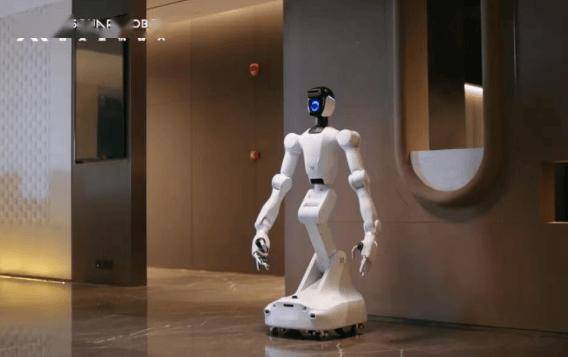
字节、红杉中国押注,自变量机器人再获10亿元融资
Nan Fang Du Shi Bao· 2026-01-12 01:54
Core Insights - The company, Self-Variable Robotics, has recently completed a 1 billion RMB A++ round of financing, with investments from major firms including ByteDance and Sequoia China [1] - Self-Variable has previously secured investments from Alibaba and Meituan, indicating strong backing from leading internet companies [1] - The company focuses on embodied intelligence models, which are distinct from large language models and aim to enable robots to handle real-time, unstructured, dynamic, and random tasks [1] Financing and Investment - The A++ round financing was led by various investment institutions and local platforms, showcasing significant interest in the embodied intelligence sector [1] - Prior to this, the company raised nearly 1 billion RMB in its A+ round, led by Alibaba Cloud, and had also received funding from Meituan in its A round [1][2] - Other companies in the embodied intelligence space, such as Galaxy General and Qianxun Intelligent, have also attracted substantial investments, indicating a growing trend in this sector [2] Technology and Development - Self-Variable has developed various data collection devices and established a model-driven data pipeline to obtain high-quality data through processes like data generation and enhancement [2] - The company initially invested less in hardware but later recognized the importance of integrating hardware and software, leading to the development of its own humanoid robot, "Quantum 2" [2] - The company claims to have achieved comprehensive self-research and deep adaptation of core components, resulting in significant cost reductions for the entire machine [2] Market Position and Valuation - The valuation of similar companies in the embodied intelligence sector has risen significantly, with Galaxy General currently valued at approximately 30 billion USD (around 211 billion RMB) [2] - Self-Variable has not disclosed its valuation following the A++ round, but the increasing interest and investment in the sector suggest a positive outlook for its market position [2]
139笔过亿融资,超600亿真金白银,砸向这些AI公司
3 6 Ke· 2025-11-10 06:59
Core Insights - The AI financing landscape in 2025 is characterized by a shift towards practical applications and revenue generation, moving away from speculative investments in concepts like AGI [1][17][18] Group 1: AI Financing Overview - From January to October 2025, China's AI sector saw 139 financing rounds exceeding 100 million RMB, totaling over 60 billion RMB [1] - Major players in the large model sector, such as 月之暗面, 智谱, and MiniMax, secured over 20 billion RMB in funding, highlighting a trend of headlined financing [3][4] - The embodied intelligence sector has emerged as the most popular area for investment, with 73 companies raising over 20 billion RMB [6] Group 2: Large Models and Multi-Modal Models - Large models have shown significant headlining financing, with 29 rounds totaling 14.2 billion RMB, averaging nearly 500 million RMB per round [3] - Multi-modal models are gaining traction, particularly in video applications, with companies like 生数科技 and 爱诗科技 achieving commercial breakthroughs [5] Group 3: Embodied Intelligence - Embodied intelligence has surpassed large models in funding, with 257 billion RMB raised across 73 financing rounds [6] - Key players like 智元机器人 and 乐聚机器人 are at the forefront, with significant orders and upcoming production milestones [7][8] Group 4: AI Infrastructure - AI infrastructure projects, particularly in AI chips, have seen diverse investments, with 8 rounds focused on AI chips and 6 on computing services [9] - Notable companies like 曦智科技 and 爱芯元智 have secured over 1 billion RMB in funding, indicating a shift towards diversified technology routes in AI chips [9][10] Group 5: AI Applications in Healthcare - Healthcare is the leading sector for AI application financing, with 6 out of 15 major funding rounds occurring in this area, representing 40% of the total [14] - Companies like 联影智能 have successfully integrated AI into medical imaging, demonstrating the commercial viability of AI in healthcare [14][16] Group 6: Future Outlook - The narrative around AI has shifted from dreams to tangible results, with a focus on revenue, orders, and production capabilities [17] - The industry is moving towards a "realism" phase, emphasizing practical applications and market-driven investments [18]
机器人公司融资疯了:各地国资大手笔打钱,有一家刚融资就停摆了?
3 6 Ke· 2025-10-22 12:05
Core Insights - The domestic robotics sector in China has seen a significant increase in financing events, with 243 investment incidents in Q3 2025, representing a 102% year-on-year growth, and a total estimated financing amount of 19.813 billion RMB, up 172% year-on-year [1][2][3] - 26 robotics startups secured over hundreds of millions in financing, accounting for 63% of the total financing in the primary market for the sector [1] - 75% of the top 20 funded robotics companies received investments from state-owned enterprises (SOEs), indicating a strong trend of government support in the industry [1][2] Financing Trends - The top three companies that received approximately 1 billion RMB each in Q3 2025 are Zhongqing Robotics, Xingmai Innovation, and Ziwang Robotics [3] - Notable investments include Mechaman Robotics receiving funding from Xiong'an Fund and other companies like Zongqing Robotics and Lingxin Qiaoshou also attracting significant investments from various SOEs [1][2][3] Investment Motivations - SOEs are investing in local robotics companies to support local industry innovation and attract established companies from other regions to set up operations locally [1] - The investment strategy reflects a dual logic of supporting local industries while also enhancing regional competitiveness through attracting external firms [1][16] Sector Focus - The majority of the top 20 funded robotics companies focus on "embodied intelligence" and "industrial robotics," showcasing a policy-driven investment direction towards core technology fields [1][16] - The "embodied intelligence" segment has emerged as a major attraction for capital, with nearly half of the top 20 companies in this category [16] Market Comparison - Chinese robotics unicorns generally have valuations between 1 billion to 3 billion USD, while US counterparts like Figure AI have reached valuations as high as 39 billion USD, highlighting a significant valuation gap [18][19] - The difference in valuation logic between Chinese and US markets is attributed to the latter's focus on high-risk, high-reward investments based on founder credibility and market expectations [19][20]
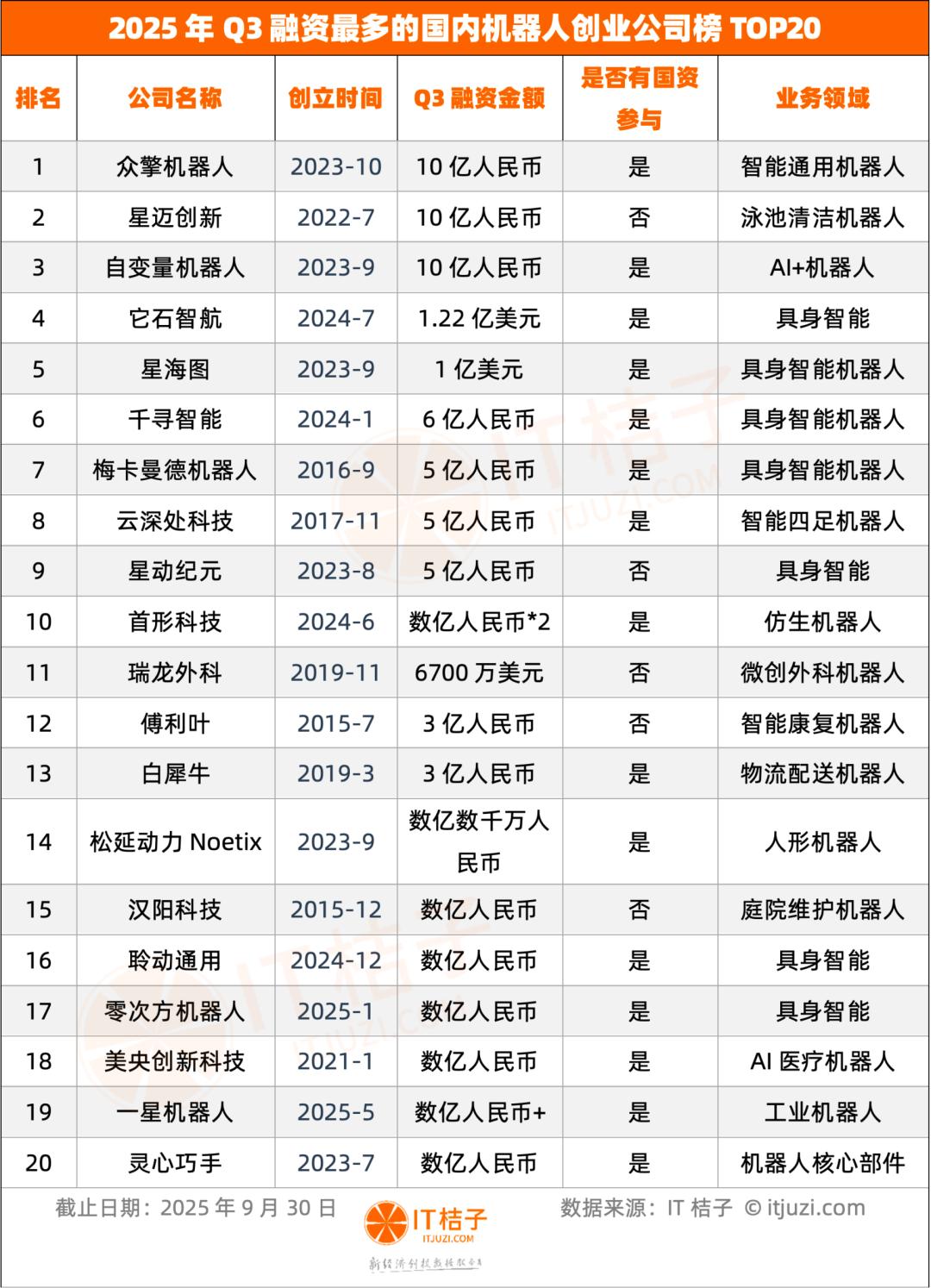
机器人公司融资疯了:各地国资大手笔打钱;有一家刚融资就停摆了?
Sou Hu Cai Jing· 2025-10-22 11:54
Core Insights - The domestic robotics sector in China has seen a significant increase in financing events, with 243 investment incidents in Q3 2025, representing a 102% year-on-year growth, and a total estimated financing amount of 19.813 billion RMB, up 172% year-on-year [1] - 26 robotics startups secured over hundreds of millions in financing, accounting for 63% of the total financing in the primary market for the sector [1] - 75% of the top 20 funded robotics companies received investments from state-owned enterprises (SOEs), indicating a strong trend of government support in the industry [1] Financing Trends - The top three companies that received the most financing in Q3 2025 are: - Zhongqing Robotics with 1 billion RMB - Xingmai Innovation with 1 billion RMB - Ziwang Robotics with 1 billion RMB [4] - Notable investments include Itstone Intelligent Navigation, which raised 1.22 million USD, and Xinghai Map, which raised over 1 billion USD [4][16] Investment Examples - Examples of SOE investments include: - Xiong'an Fund invested in the unicorn company Meikaman Robot - Hefei Binhu Jin Investment funded Zhongqing Robotics and Ziwang Robotics - Beijing Guoguan invested in Songyan Power Noetix and Yundongchu Technology [1] Sector Analysis - The active SOE investors in the robotics sector include Beijing Guoguan, Shenzhen Venture Capital, and Hefei Binhu Jin Investment, reflecting a dual strategy of supporting local industries and attracting external companies [17] - The majority of SOE investments are concentrated in "embodied intelligence," "industrial robots," and "AI + robotics," indicating a policy-driven focus on core technology areas [17] Market Dynamics - Nearly half of the top 20 funded robotics companies focus on "embodied intelligence," with most established between 2023 and 2025, suggesting a competitive landscape with emerging players [18] - The market for embodied intelligence robots is seen as having significant growth potential, although some investors express concerns about the clarity of the business model [19] Valuation Comparison - Chinese robotics unicorns have valuations typically between 1 billion to 3 billion USD, while US counterparts like Figure AI have reached valuations as high as 39 billion USD, highlighting a significant valuation gap [20][22] - The difference in valuation logic between the US and China is attributed to the US venture capital's focus on market potential and founder credibility, which is less prevalent in China [22]
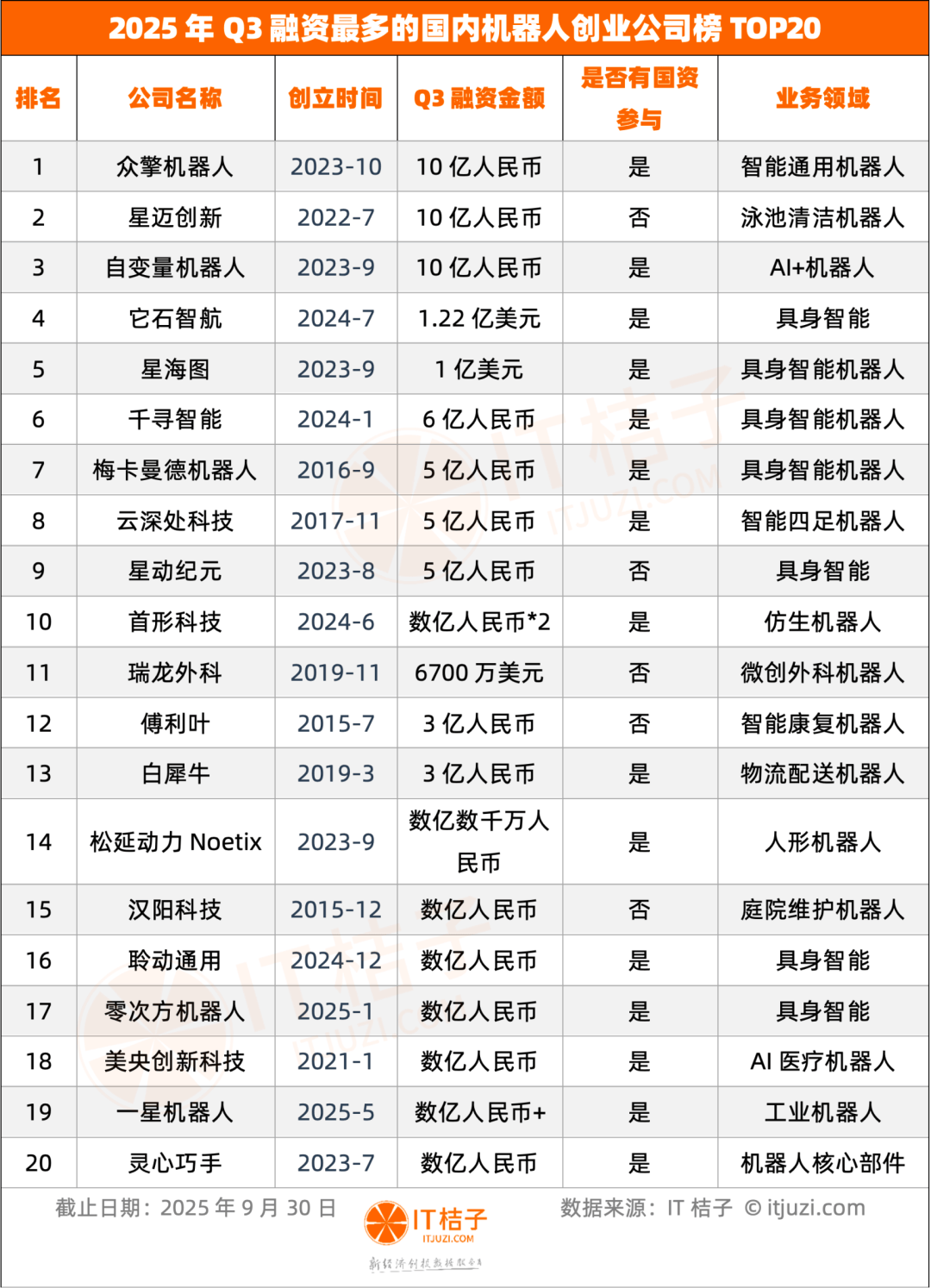
首程控股被投企业自变量机器人获近10亿元A+轮融资,并开源端到端具身智能基础大模型WALL-OSS
Ge Long Hui· 2025-09-08 02:24
Core Insights - The article highlights the successful completion of nearly 1 billion yuan in Series A+ financing for the embodied intelligence company, Zivariable Robotics, backed by major investors including Alibaba Cloud and Guokai Financial [1] Group 1: Investment Details - The financing round was led by Alibaba Cloud and Guokai Investment, with participation from Guokai Financial, Sequoia China, and existing shareholder Meituan [1] - The investment by Shoucheng Holdings in Zivariable Robotics during its Pre-A++ round in early 2025 demonstrates the firm's strategic positioning in cutting-edge technology [1] Group 2: Company Achievements - Zivariable Robotics is recognized as one of the earliest companies in China to achieve end-to-end embodied intelligence models, showcasing significant technological breakthroughs and commercialization progress [1] - The company has developed its proprietary "WALL-A" large model, which exhibits zero-shot generalization capabilities, and has open-sourced the foundational model "Wall-OSS" to promote industry ecosystem development [1] - The launch of the fully self-developed wheeled dual-arm robot "Quantum 2" represents a breakthrough in hardware and software integration, with successful collaborations established with leading service and industrial clients [1] Group 3: Strategic Implications - Shoucheng Holdings' early investment in the embodied intelligence sector is expected to yield capital returns while enhancing collaboration with industry players to drive the implementation of robotic technologies [1] - The recent financing will further accelerate Zivariable's technological iterations and scene expansion, bringing additional synergistic value to Shoucheng Holdings [1]