
铜靶材

Search documents
欧莱新材:公司自主研发高纯无氧铜锭,保障铜靶材供应链安全
Zheng Quan Ri Bao Wang· 2025-12-23 14:14
Core Viewpoint - The company emphasizes its strategic focus on high-performance sputtering target materials while expanding into upstream and downstream sectors, including high-performance metals and key materials in cutting-edge technology fields [1] Group 1: Business Strategy - The company adheres to a strategy of "relying on screens and deeply developing in frontier fields" [1] - It aims to solidify its core business in high-performance sputtering target materials while actively expanding into related sectors [1] Group 2: Product Development - The company has independently developed high-purity oxygen-free copper ingots to ensure the security of its copper target material supply chain [1] - High-purity oxygen-free copper is being applied not only in sputtering target materials but also in high-end nuclear medical particle therapy devices and superconducting materials [1] Group 3: Market Application - The company is promoting the localization of core components and materials for nuclear medical devices using high-purity oxygen-free copper [1] - The first batch of orders for high-purity oxygen-free copper products has been delivered to customers, aiding them in achieving domestic substitution of key materials [1]
研判2025!中国铜靶材行业政策、产业链、市场规模、竞争格局及前景展望:半导体产业发展提速,推动铜靶材规模增长至25.15亿元[图]
Chan Ye Xin Xi Wang· 2025-12-20 03:31
Industry Overview - The copper target industry is crucial for the vacuum coating process, primarily used in semiconductor manufacturing, flat panel displays, and solar photovoltaic applications [1][4] - The market size of China's copper target industry is projected to grow from 1.207 billion yuan in 2019 to 2.515 billion yuan in 2024, with a compound annual growth rate (CAGR) of 15.81% [1][13] - The demand for high-performance targets is increasing due to advancements in semiconductor technology and the expansion of market scale [1][12] Market Dynamics - The semiconductor industry is a key application area for copper targets, with the market size expected to grow from 2,638.573 billion yuan in 2015 to 4,734.473 billion yuan in 2024, reflecting a CAGR of 6.71% [12] - The domestic sputtering target market reached 39.5 billion yuan in 2022, with a year-on-year growth of 6.76%, and is projected to further increase to 46.7 billion yuan in 2024, growing by 8.35% [12][13] Production Methods - Copper target production methods include melting and casting, powder metallurgy, and deposition techniques, each with specific processes to ensure high purity and quality [6][8] - The purity of copper targets is critical, with requirements for ultra-high purity levels (6N or higher) to meet the demands of advanced semiconductor processes [14][16] Industry Policies - The Chinese government has implemented policies to promote technological innovation and ensure the security of the copper target industry, including the "Standard Enhancement Action Plan" for key strategic materials [9][10] - Specific performance requirements for high-purity copper targets have been established, including purity levels, density, and impurity content [9] Competitive Landscape - The copper target industry in China features a mix of foreign and domestic companies, with foreign firms like JX Nippon Mining & Metals and Honeywell leading in high-end markets [14] - Domestic companies such as Jiangfeng Electronics and Aishi Innovation are rapidly advancing through technology investments and capacity expansion, aiming to increase their market share [14][15] Future Trends - The industry is moving towards higher purity and composite functionality in copper targets to meet stringent requirements for semiconductor applications [18] - There is a growing demand for larger and more complex target shapes to accommodate advancements in semiconductor and display technologies [17] - Sustainable manufacturing practices and recycling systems are becoming essential, focusing on reducing energy consumption and enhancing material recovery [18]



稀有小金属深度路演
2025-10-09 02:00
Summary of the Conference Call on Tantalum and Niobium Metals Industry Overview - Tantalum and niobium metals are benefiting from emerging applications in high-temperature alloys, electronic components, and semiconductor chips, leading to increased product prices and enhanced profitability for companies, resulting in long-term compound growth [2][3] - The domestic tantalum and niobium industry has established a complete supply chain but initially relied on imports; recent years have seen accelerated development [2][4] - Companies like Dongfang Tantalum are improving self-sufficiency rates, reducing costs, and enhancing market competitiveness [2][7] Key Insights and Arguments - The tantalum and niobium industry is expected to maintain strong growth over the next 5-10 years, with steady price increases and significant improvements in corporate profitability, attracting more investor attention [2][8] - Enhancing the self-healing rate of wet-process plants can significantly improve gross margins, with an increase from 50% to 100% typically resulting in a 5%-10% rise in gross margins [2][9] - Tantalum capacitors experienced a decline during the 13th Five-Year Plan but are expected to benefit from growth in military and AI industries during the 14th Five-Year Plan [2][11] - Key players in the semiconductor chip supply chain include SMIC, TSMC, and NVIDIA, with expected compound growth rates of at least 20%-30% [2][16] Additional Important Points - The high-temperature alloy market is benefiting from increased overseas demand for gas turbines, with nickel-based high-temperature alloy additives gradually increasing in usage, providing stable support for the industry [2][19][20] - Tantalum and niobium materials have significant applications across various fields, including tantalum powder and wire in capacitors for AI demands, and niobium in high-temperature alloys and overseas gas turbines [2][22] - The tantalum metal industry did not see significant growth during the 13th Five-Year Plan but is expected to experience a surge in demand and new application scenarios starting in 2023, presenting important opportunities for companies that can upgrade their production capacity [2][23] - Recommended companies for investment in the tantalum metal industry include Dongfang Tantalum and Ximei Resources, which are well-positioned to capitalize on industry trends [2][24][25]
阿石创2025年中报简析:增收不增利
Zheng Quan Zhi Xing· 2025-08-29 23:42
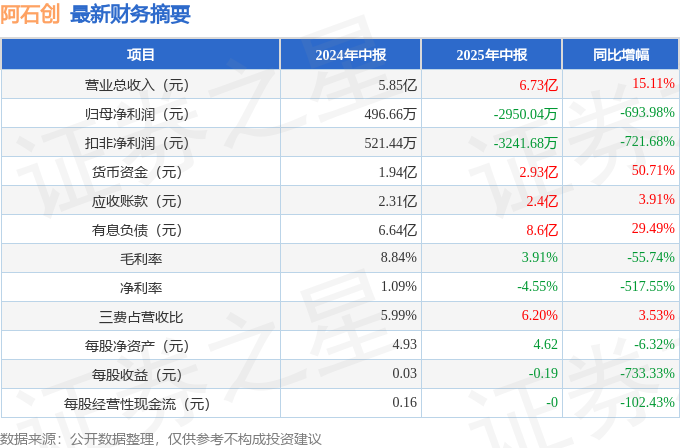
Core Viewpoint - The recent financial report of Aishi Chuang (300706) indicates a significant increase in revenue but a drastic decline in profit, highlighting challenges in maintaining profitability despite revenue growth [1] Financial Performance - As of the end of the reporting period, the company's total revenue reached 673 million yuan, a year-on-year increase of 15.11%, while the net profit attributable to shareholders was -29.5 million yuan, a year-on-year decrease of 693.98% [1] - In Q2, total revenue was 372 million yuan, up 17.75% year-on-year, but the net profit attributable to shareholders was -25.8 million yuan, down 415.61% year-on-year [1] - Key financial metrics include a gross margin of 3.91%, down 55.74% year-on-year, and a net margin of -4.55%, down 517.55% year-on-year [1] Cost Structure and Expenses - Total selling, administrative, and financial expenses amounted to 41.7 million yuan, accounting for 6.2% of revenue, an increase of 3.53% year-on-year [1] - The company's cash flow situation is concerning, with operating cash flow per share at -0.0 yuan, a decrease of 102.43% year-on-year [1] Business Model and Investment Returns - The company's business model relies heavily on capital expenditures, which raises concerns about the efficiency and necessity of these investments [3] - Historical data shows a median Return on Invested Capital (ROIC) of 5.12%, with the worst year being 2024 at -0.5%, indicating poor investment returns [3] Product and Market Position - The company is a leading supplier in the flat panel display sector, particularly in target materials like aluminum and molybdenum, with molybdenum targets holding the largest global market share [3] - Recent pressures on gross margins are attributed to new production lines and rising raw material costs, especially for precious metals [3][4] Production Capacity and Efficiency - The utilization rate of the company's target material production lines has averaged around 80%, but the front-end equipment utilization varies due to different product process requirements [6] - The overall improvement in gross margins is expected to come from new product development and changes in product supply structure, although rising raw material costs may continue to exert pressure [7] Raw Material Price Management - The company employs hedging strategies to manage price volatility for certain bulk materials, while fluctuations in precious metal prices require careful trend analysis and collaboration with upstream suppliers [8]
阿石创(300706) - 2025年7月28日-7月29日投资者关系活动记录表
2025-07-29 09:42
Group 1: Company Overview - The company specializes in materials for flat panel displays, primarily focusing on target materials and ITO products [2] - Major target materials include aluminum, molybdenum, and copper, with molybdenum holding the largest global market share [2] - Recent pressure on gross margins is attributed to new production lines, regional investments, and significant increases in raw material prices, particularly precious metals [2] Group 2: Product Development and Production - The company has made substantial investments in ITO product lines over the past two years, transitioning from wet to dry processing to reduce costs [2] - The production process has been streamlined from powder production to recycling, enhancing efficiency [2] - Semiconductor product validation is progressing smoothly, with some new products already validated and receiving trial orders [3] Group 3: Production Efficiency - The utilization rate of the target material production line has reached an average of approximately 80%, though the front-end equipment shows varying rates due to different product process requirements [3] - Plans are in place to gradually increase front-end utilization and supplement back-end equipment as production needs evolve [3] Group 4: Gross Margin and Raw Material Management - Overall gross margin improvement is linked to the introduction of new products and adjustments in product supply structure [3] - The cost structure of precious metal products is heavily influenced by raw material prices, which are currently on an upward trend, potentially reducing product gross margins [3] - The company employs hedging strategies to manage price fluctuations of raw materials, particularly for bulk materials, while precious metal price volatility is managed through careful trend analysis and upstream supplier collaboration [3]
铜价凶猛!供需紧张、关税担忧引发抢跑潮,还能涨多久?
Jie Mian Xin Wen· 2025-03-25 11:58
Core Viewpoint - Copper prices are surging due to supply tightness and concerns over U.S. tariffs, with significant price movements observed in recent weeks [1][2]. Group 1: Price Movements - As of March 25, 2024, LME copper briefly reached $10,000 per ton, marking a new high since October 2023, while COMEX copper was priced at $5.138 per pound [1][2]. - Year-to-date, COMEX copper has increased by approximately 25%, outperforming both COMEX gold and silver, which rose by 15% [1]. - The price difference between COMEX and LME copper has exceeded $1,300 per ton, indicating significant market arbitrage opportunities [2]. Group 2: Supply and Demand Dynamics - The supply of copper concentrate is tight, leading to increased processing fees and concerns about smelting capacity, particularly following maintenance announcements from major producers [3]. - A large influx of refined copper, estimated at 100,000 to 150,000 tons, is expected to arrive in the U.S. in the coming weeks, as traders redirect shipments initially intended for Asia [2]. - Domestic copper futures have also surged, with SHFE copper contracts reaching 81,900 yuan per ton, reflecting a daily increase of 1.17% [2]. Group 3: Future Demand Drivers - The ongoing recovery of China's manufacturing sector and advancements in AI technology are expected to significantly boost copper demand [4]. - The deployment of AI hardware and the upgrade of semiconductor manufacturing equipment are anticipated to increase the demand for high-precision copper products [4]. - Recent collaborations, such as the agreement between Northern Copper and Huawei, highlight the industry's focus on digital transformation and infrastructure development [3]. Group 4: Price Forecasts - Analysts predict that copper prices may stabilize around $10,200 per ton by Q4 2025, contingent on U.S. trade policies regarding copper [5]. - Morgan Stanley forecasts a significant increase in global copper demand, projecting a market shortfall of approximately 3 million tons annually by 2030 [5].