银行债券

Search documents
银行行业深度报告:如何理解存贷款增速缺口的持续收敛,以及对银行债券配置力量的影响?
Orient Securities· 2026-03-06 10:24
Investment Rating - The report maintains a "Positive" outlook for the banking sector in 2026, indicating a return to fundamental narratives supported by policy financial tools and resilient asset expansion [6][35]. Core Insights - The banking sector is expected to stabilize net interest margins and recover due to the ongoing repricing cycle of deposits, with structural risks anticipated to receive policy support [3][35]. - The report highlights two main investment lines: 1. High-quality small and medium-sized banks with solid fundamentals, including Nanjing Bank, Chongqing Rural Commercial Bank, Ningbo Bank, Shanghai Bank, and Hangzhou Bank [3][36]. 2. Large state-owned banks with stable fundamentals and defensive value, including Bank of Communications and Industrial and Commercial Bank of China [3][36]. Historical Review of Loan and Deposit Growth Gap - The report constructs a loan and deposit growth gap indicator, defined as "bank deposit growth - bank loan growth," with an upward trend indicating convergence and a downward trend indicating expansion [9][12]. - Historical analysis shows: 1. From 2016 to 2018, the gap deepened due to a faster decline in deposit growth, primarily influenced by deleveraging and regulatory impacts [14][18]. 2. Between 2019 and 2020, the gap narrowed, driven by a faster decline in loan growth due to stricter real estate regulations and the pandemic [18][19]. 3. From the second half of 2021 to 2022, the gap steeply narrowed due to dual drivers from both deposits and loans, with a significant shift in household liquidity dynamics [19][21]. 4. In 2023 to Q1 2024, the gap expanded again, primarily due to a sharper decline in deposit growth influenced by early mortgage repayments and policy-driven debt restructuring [21][24]. Understanding Recent Convergence of Loan and Deposit Growth Gap - The continuous narrowing of the loan and deposit growth gap in recent years is attributed to high-interest deposit adjustments and accelerated debt restructuring, with a projected scale of 3.2 trillion yuan in 2024 [24][26]. - The report anticipates that the gap will likely stabilize marginally but is less likely to trend towards expansion, contingent on the credit supply positioning of the household sector [31][31]. Relationship Between Loan and Deposit Growth Gap and Bank Bond Allocation - The convergence of the loan and deposit growth gap suggests relative redundancy of deposits within the banking system, which should enhance banks' bond allocation capabilities [33][34]. - Statistical analysis indicates that changes in the loan and deposit growth gap serve as a leading indicator for stable bond investment growth, particularly for large state-owned banks [33][34].






债市狂欢下的隐忧:投资者的“安全垫”快没了!
智通财经网· 2025-08-28 12:22
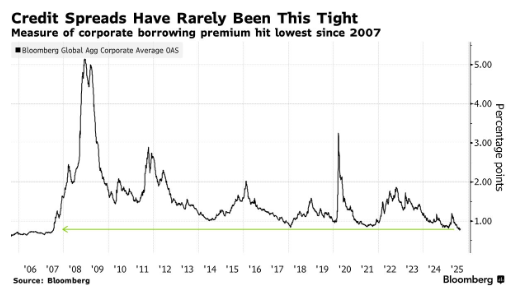
Core Viewpoint - The bond pricing mechanism is becoming distorted due to a combination of optimistic economic sentiment and an environment of "excess funds and scarce assets," leading to historically low compensation required by bond investors for taking on default risk [1][3]. Group 1: Bond Market Dynamics - The credit spread between high-risk assets and safe assets like U.S. Treasuries is narrowing globally, with the risk premium for investment-grade corporate bonds dropping to 81 basis points, close to the lowest level since 2007 [3]. - The absolute yield of bonds is attracting institutional investors such as pension funds and insurance companies, who are seeking to lock in relatively attractive returns [1][3]. - The phenomenon of "yield chasing" is evident as investors pursue higher coupon yield assets, extending their focus from corporate bonds to emerging market currencies [1][3]. Group 2: Investor Sentiment and Behavior - The "Fear of Missing Out" (FOMO) is driving investor sentiment across all asset classes, with global indices, gold, and Bitcoin reaching historical highs [5]. - Despite concerns about high valuations in the credit market, many investors are still looking for ways to enhance yields, viewing the public and liquid credit market as a relatively high-quality option [5][6]. - The issuance of bonds, such as Allianz's $12.5 billion perpetual bond, demonstrates the intense demand, with the offering receiving $12.5 billion in oversubscriptions [5]. Group 3: Emerging Market Trends - Emerging market dollar bonds have seen their risk premium drop below 260 basis points for the first time since 2013, indicating a significant shift in market dynamics [6]. - Asian investment-grade dollar bond spreads have narrowed to 60 basis points, marking a historical low and less than half of the average over the past decade [6]. - Concerns are raised about the indiscriminate buying behavior in the market, which may overlook the distinction between creditworthy issuers and those with potential risks [6][7]. Group 4: Economic Outlook and Risks - There are warnings about the fragility of the current market conditions, with predictions that the risk premium for investment-grade corporate bonds could widen to 130-140 basis points within the next 12 months [7][9]. - Recent U.S. employment data indicating economic slowdown and weakening service sector sentiment could act as triggers for a market shift [7][9].