
隔夜逆回购工具

Search documents
2025年最后一天,美联储“创纪录放水”
Hua Er Jie Jian Wen· 2026-01-01 07:44
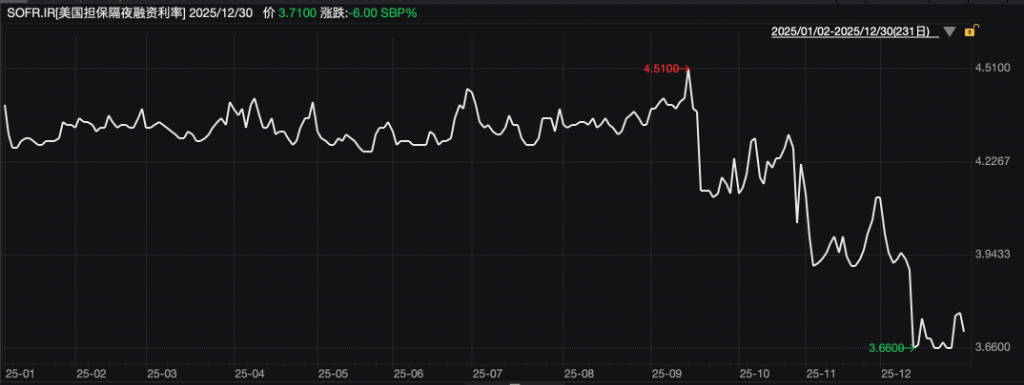
Core Viewpoint - The usage of the Federal Reserve's Standing Repo Facility (SRF) reached a record high of $74.6 billion on the last trading day of 2025, indicating a significant liquidity injection into the financial system, primarily driven by seasonal balance sheet pressures rather than structural market stress [1][2]. Group 1: SRF Usage and Market Response - The SRF provided $74.6 billion in loans, surpassing the previous record of $50.35 billion set on October 31, with collateral consisting of $31.5 billion in U.S. Treasuries and $43.1 billion in mortgage-backed securities [1]. - Market participants view the surge in borrowing as a routine response to year-end regulatory and settlement pressures, rather than a sign of a financial crisis [1][2]. - The overnight reverse repo tool absorbed $106 billion, marking the highest level since early August [1]. Group 2: Repo Market Dynamics - Seasonal patterns typically lead financial institutions to tighten cash availability at quarter-end and year-end, raising short-term borrowing costs in the repo market [2]. - The secured overnight financing rate (SOFR) recently peaked at 3.77%, reflecting increased borrowing costs, before slightly declining to 3.71% [2]. Group 3: Federal Reserve's Liquidity Management - The SRF is a key tool for the Federal Reserve to manage short-term interest rates and has effectively replaced discretionary repo operations [5]. - The Fed has signaled encouragement for eligible financial institutions to utilize the SRF during liquidity needs, with recent policy meetings discussing its operational settings [5]. - The SRF is seen as effective in alleviating year-end liquidity pressures, contributing to a more stable financing environment [5][6]. Group 4: Cryptocurrency Market Reaction - Despite discussions in the cryptocurrency market regarding the liquidity injection, Bitcoin's price remains stable, trading within a narrow range of $85,000 to $90,000, with low trading volume and volatility [1][5]. - The current market dynamics reflect a complex interplay between abundant liquidity, restrictive policy rates, regulatory uncertainties, and cautious sentiment following a turbulent year [7].

2019年恐慌一幕将重演?回购市场暗藏“流动性陷阱”!
Jin Shi Shu Ju· 2025-08-28 02:36
Core Viewpoint - The usage of the Federal Reserve's overnight reverse repurchase agreement (ON RRP) tool has significantly decreased, raising concerns about potential liquidity issues in the market, reminiscent of the 2019 crisis [2][3] Group 1: Federal Reserve's Tools and Market Impact - The ON RRP usage fell below $50 billion, a recent low compared to peaks of $2 trillion in 2022 and 2023, indicating a shift in strategy among money market funds towards short-term Treasury purchases [2] - Analysts predict that ON RRP usage may drop to zero by the end of August but could see a slight increase in September due to quarter-end financing demands [2] - The Federal Reserve established a standing repo facility post-2019 to provide liquidity to primary dealers, aiming to stabilize short-term financing rates [2][3] Group 2: Federal Reserve's Balance Sheet Management - The Federal Reserve's balance sheet remains significantly below pre-crisis levels, currently around $6.6 trillion, down from nearly $9 trillion at the pandemic peak [3] - Dallas Fed President Lorie Logan indicated that banks may turn to the standing repo facility for liquidity if they face funding pressures next month, suggesting a potential further reduction in reserves [3] - Recent trends show that repo rates have averaged about 8 basis points lower than reserve rates, indicating room for further reserve reductions [3] Group 3: Market Conditions and Future Projections - The Federal Reserve is expected to continue reducing its balance sheet by the end of the year unless a significant market shock occurs [5] - Current market conditions are characterized by low volatility, with no immediate concerns prompting investor anxiety [5] - The impact of the Federal Reserve's balance sheet adjustments is often overlooked, despite its significant influence on market dynamics [4]