雪佛兰Silverado EV

Search documents
美国巨头败退新能源:电动血裁1750人,氢燃料也放弃了
3 6 Ke· 2025-10-30 11:04
Core Insights - General Motors (GM) reported better-than-expected Q3 earnings, with a revenue of $48.6 billion and a net profit of $1.3 billion, leading to a stock price surge of over 14% [6][8] - Despite the positive financial results, GM announced significant layoffs affecting over 1,200 employees in electric vehicle (EV) and battery production, alongside a reduction in EV output [3][4] Financial Performance - Q3 revenue was $48.6 billion, approximately flat year-over-year, exceeding market expectations by nearly $1.2 billion [6] - Net profit reached $1.3 billion, with adjusted EBIT of $3.4 billion, both surpassing market forecasts [6] - GM raised its full-year guidance for adjusted EBIT to $12-13 billion, up from previous estimates of $10-12.5 billion [8] Electric Vehicle Progress - GM's EV deliveries in North America surged by 45% year-over-year, achieving a market share of 16.5%, second only to Tesla [8] - The company has seen continuous growth in its EV segment in China for ten consecutive quarters, achieving profitability for four straight quarters [8] Layoff and Production Cuts - GM plans to cut EV and battery production in the U.S., impacting approximately 1,200 jobs at the Detroit EV plant and 550 jobs at the Ohio battery plant [4] - Starting January, GM will suspend cell production at two battery plants for six months, affecting around 1,550 employees [4] - The Detroit EV plant will shift from a two-shift to a single-shift operation, reducing capacity by about 50% [4] Market Challenges - CEO Mary Barra cited two main reasons for the layoffs: the slowing adoption of EVs in the U.S. and changes in regulatory and federal incentive policies, including the cancellation of a $7,500 EV purchase subsidy [10][12] - GM's forecast indicates a potential decline in U.S. EV sales compared to Q3 levels [10] Strategic Shift - GM is shifting its focus from a rigid 2035 full electrification goal to a more flexible approach based on market demand [12] - The company has recognized that only about 40% of its EV products are currently profitable [12] - GM is also reducing excess capacity and exploring cost-cutting measures, including a $1.6 billion charge for EV business restructuring in the latest quarter [13] Hydrogen Fuel Cell Developments - GM has decided to halt the next-generation hydrogen fuel cell development project and shelve a $55 million factory plan, indicating a retreat from its long-term hydrogen strategy [13][15] - The company will continue to operate its joint venture with Honda for existing hydrogen fuel cell production [16] Industry Context - The broader U.S. automotive industry is experiencing "electric anxiety," with several automakers, including Nissan and Stellantis, postponing or canceling EV plans due to market uncertainties [17] - Analysts predict a potential reduction in EV job positions and production levels returning to previous years, despite a general consensus on the increasing penetration of EVs in the market [17]



电动皮卡为啥在美国不吃香了?
Zhong Guo Qi Che Bao Wang· 2025-10-21 05:49
Core Insights - The electric pickup truck market in the U.S. is experiencing a significant downturn, leading major automakers like Stellantis and General Motors to cut back on electric pickup projects and shift focus to traditional fuel models [2][3][4] Group 1: Company Actions - Stellantis has officially terminated the development of its Ram 1500 electric pickup due to a slowdown in demand for full-size electric pickups in North America, opting instead to focus on a range-extended version set for production in 2026 [2][3] - General Motors plans to invest approximately $4 billion in three U.S. factories to expand production of popular fuel models while reducing electric vehicle production plans, including the conversion of a factory from electric to fuel pickup production [3][4] - Tesla has removed the rear-wheel drive version of the Cybertruck from its website, indicating poor sales performance despite initial high demand, with actual annual sales falling significantly short of expectations [3][6] Group 2: Market Trends - The overall demand for electric vehicles in the U.S. is declining, exacerbated by the expiration of federal electric vehicle tax credits, which has led to a drop in consumer interest in purchasing electric vehicles [8][10] - A survey indicated that only 16% of respondents are likely to purchase a pure electric vehicle, marking a new low since 2019, while 63% expressed they are unlikely to consider electric vehicles [8][10] - The end of federal subsidies has resulted in a record high of over 438,000 electric vehicle sales in Q3 2025, but a significant drop in sales is expected in subsequent quarters due to the lack of incentives [8][10] Group 3: Consumer Preferences - Traditional pickup truck users prioritize reliability, functionality, and cost-effectiveness, which electric pickups currently struggle to meet due to limitations in towing capacity and range [11][12] - The pricing of electric pickups is generally higher than traditional models, making them less appealing to cost-conscious consumers, with examples showing significant price differences between electric and gasoline models [12][13] - Electric pickups are perceived as less practical for traditional uses, with issues such as inadequate towing capabilities and range anxiety due to insufficient charging infrastructure in rural areas [12][13] Group 4: Future Outlook - Despite current challenges, the electric pickup market may have long-term growth potential as technology improves and infrastructure develops, alongside the introduction of more competitively priced models by automakers [13]


特斯拉Cybertruck入门版停售,所以电动皮卡是“伪命题”吗?
3 6 Ke· 2025-09-18 11:56
Core Insights - Tesla's Cybertruck rear-wheel drive version has been removed from the market, indicating a significant setback for the model that was launched less than six months ago [1][4]. Group 1: Product Performance and Market Response - The Cybertruck was first unveiled in November 2019, with deliveries starting in December 2023, but it has only achieved annual sales of 20,000 units despite over 1 million pre-orders [4][11]. - The rear-wheel drive version was priced approximately $10,000 lower than the all-wheel drive version, but the expected market response was disappointing, leading to its discontinuation [4][6]. - Key features such as the electric tailgate, rear power outlet, and active air suspension were removed in the rear-wheel drive version, significantly reducing its utility as a pickup truck [8][9]. Group 2: Competitive Landscape - Other electric pickups in the U.S. market, such as the Ford F-150 Lightning and Chevrolet Silverado EV, retain essential features while lowering costs through reduced battery capacity and range [9][12]. - In the first quarter of this year, the Ford F-150 Lightning sold 7,913 units, surpassing the 7,126 units sold by the Tesla Cybertruck, making it the best-selling electric pickup in the U.S. [11]. Group 3: Consumer Expectations and Market Trends - Consumers prioritize practicality in pickup trucks, and the Cybertruck's lack of essential features has led to negative perceptions [11][13]. - The electric pickup market is still in its infancy, with traditional fuel pickups dominating sales in both the U.S. and China, where electric pickups sold only 1,718 units in August compared to nearly 290,000 traditional pickups [13][15]. - The future of electric pickups depends on consumer acceptance of their quality and performance, as current models face skepticism regarding their safety and utility [20][21].
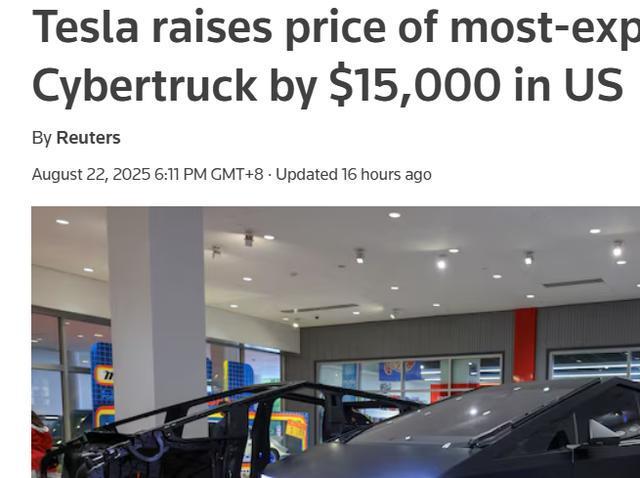
特斯拉Cybertruck“逆势”提价:是自信还是冒险?
Huan Qiu Wang Zi Xun· 2025-08-23 04:41
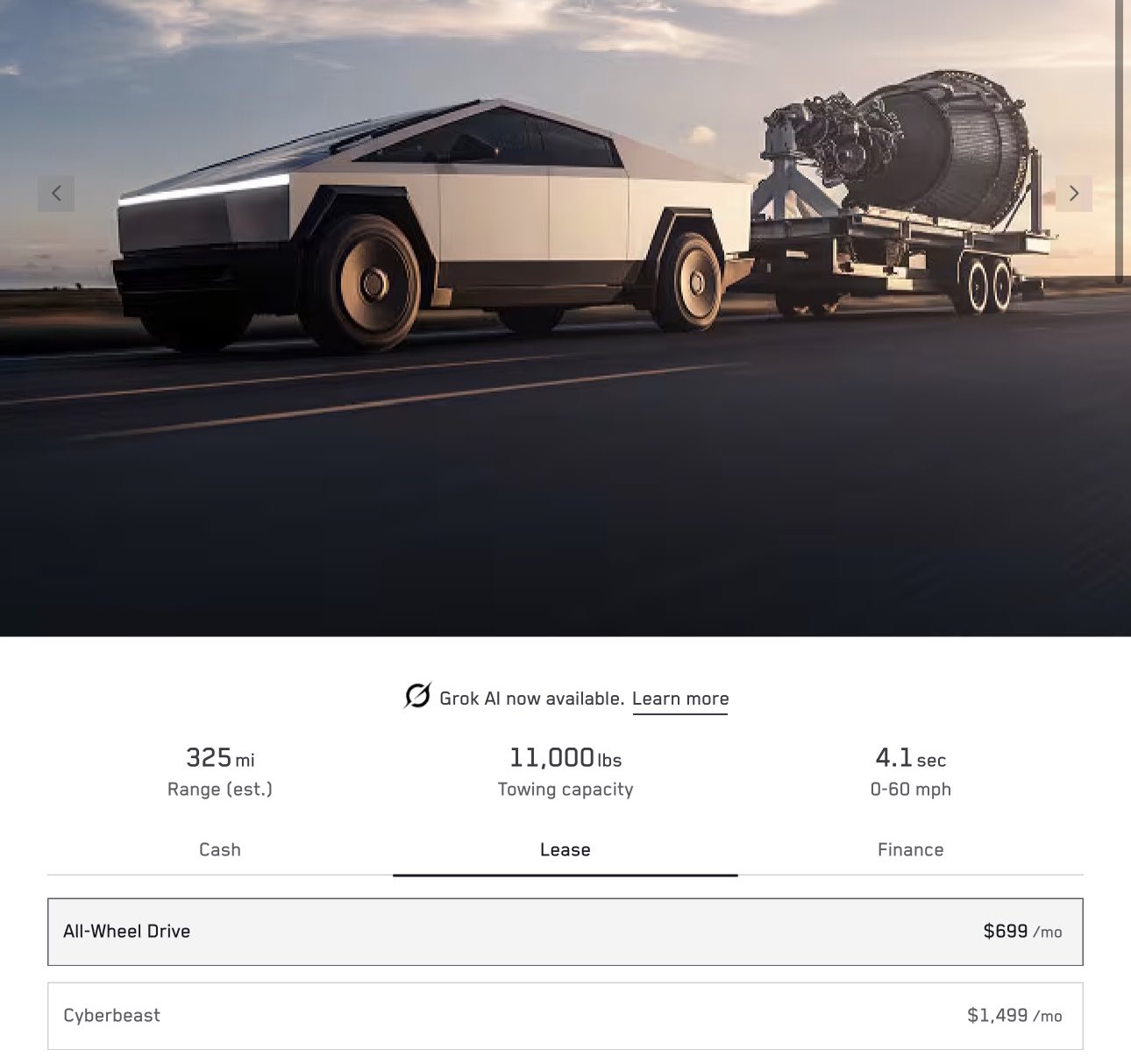
Core Insights - Tesla has raised the price of its fastest version of the Cybertruck by $15,000 despite lower-than-expected sales and multiple recalls [1][4] - The new price for the Cyberbeast model is now $114,990, which includes a "luxury package" with supervised full self-driving capabilities and free access to the Supercharger network [4] - The pricing trajectory of the Cybertruck has significantly deviated from initial expectations, with the base model's price rising to $60,990 from an originally proposed starting price of around $40,000 in 2019, representing an increase of over 50% [4] Market Competition - The automotive market is becoming increasingly competitive, with rivals like the Ford F-150 Lightning and Chevrolet Silverado EV offering lower starting prices for certain configurations, putting pressure on the Cybertruck [4] - In response to market conditions, Tesla has implemented significant discounts of around $10,000 on some Cybertruck inventory to attract more consumers [4] Production Capacity and Challenges - Elon Musk has expressed confidence in Tesla's ability to produce over 125,000 Cybertrucks annually, with potential capacity reaching approximately 250,000 units by 2025 [5] - However, the company faces challenges in ramping up production, compounded by multiple recalls and quality issues that have led to a decline in demand for the Cybertruck [5]