饮用天然矿泉水

Search documents
2025年预亏超2亿元 “常温乳酸菌第一股”均瑶健康为何失灵了?
Xin Lang Cai Jing· 2026-02-09 11:34
Core Viewpoint - Junyao Health, known as the "first stock of ambient lactic acid bacteria" in A-shares, is facing significant financial challenges, with a projected net loss of between -216 million to -144 million yuan for 2025, marking a year-on-year decrease of 395.14% to 642.71% [2][15][25] Financial Performance - The company expects a substantial decline in net profit for 2025, with a projected loss of -233 million to -155 million yuan, representing a year-on-year decrease of 167.33% to 301.00% [2][15] - Since its listing in 2020, Junyao Health has experienced revenue growth, but net profit has consistently declined, showcasing a typical "increased revenue without increased profit" pattern, culminating in significant losses in 2025 [2][15][25] - Junyao Health's net profit has decreased for five consecutive years, with a reported revenue of 1.458 billion yuan in 2024, down 10.77% year-on-year, and a net profit of -29.12 million yuan, a decline of 150.57% [4][17] Factors Contributing to Losses - The anticipated losses for 2025 are attributed to several factors, including a challenging consumer environment leading to reduced market share in the dairy beverage sector, increased sales and marketing expenses, and higher research and development costs [4][17] - Significant impairment provisions for inventory and receivables, totaling an impact of 80 million to 140 million yuan, are identified as core drivers of the profit decline [4][17] - The company has previously reported substantial impairment losses, including 36.43 million yuan for goodwill and 12.76 million yuan for inventory write-downs in 2024, which have severely affected profitability [5][18] Market and Product Strategy - Junyao Health has attempted a "second entrepreneurship" strategy since 2021, focusing on upstream integration, new product launches, and diversification to mitigate reliance on single products [21] - Despite launching numerous new products since 2023, including those targeting specific consumer needs, the market response has been lukewarm, failing to generate significant sales volume or new growth points [10][23] - The company's marketing expenditures have surged, with sales expenses increasing by 30.27% to 245 million yuan in 2024 and a further 70.65% increase in the first half of 2025, which has further eroded profits [11][24] Stock Performance - Junyao Health's stock price has been on a downward trend since 2022, reaching a historical low of 4.18 yuan per share in 2024, and as of January 30, 2026, the stock price was 6.94 yuan, significantly lower than its initial offering price of 13.43 yuan [6][20] Future Outlook - Despite the current challenges, the dairy beverage industry still presents growth opportunities, with trends towards functionality, premiumization, and diversification [25][26] - Junyao Health possesses advantages in strain research and development, brand accumulation, and channel distribution, which could support a turnaround if strategic adjustments are made [25] - The company needs to focus on core business strengths, optimize product structure, and enhance cost control to gradually reverse the declining performance trend [25][26]


瓶装水该如何选
Xin Lang Cai Jing· 2026-01-30 00:01
Group 1 - The article discusses the various types of bottled water available in the market, categorizing them into three main types: natural mineral water, purified water, and other types of drinking water [3][4] - Natural mineral water is sourced from deep underground and is protected from pollution, containing certain minerals and trace elements [3] - Purified water is derived from public water systems and undergoes processes like distillation and reverse osmosis, resulting in minimal mineral content [3] Group 2 - Other types of drinking water can be further divided into natural spring water, natural water, and other drinking water, with each having specific characteristics regarding mineral content and processing [3][4] - The article emphasizes the importance of checking labels for "mineral water" and the source location to ensure authenticity, as well as verifying the execution standards (GB 8537) for nutritional content [4]
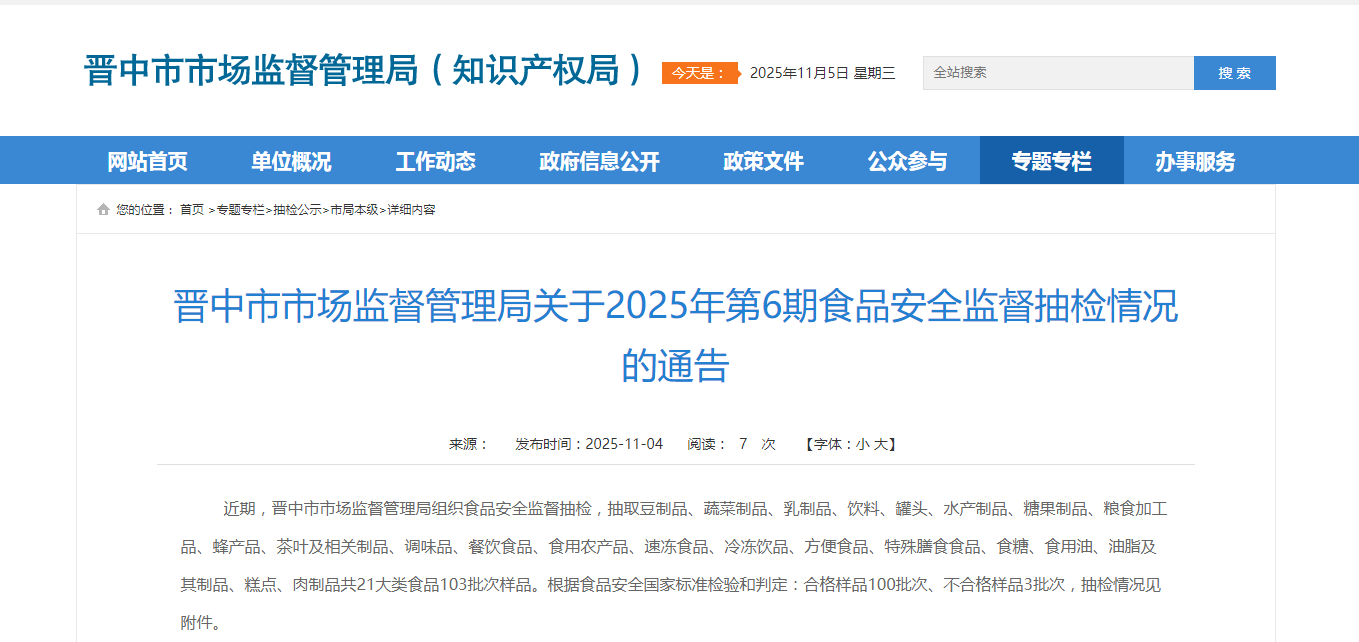
山西省晋中市市场监督管理局关于2025年第6期食品安全监督抽检情况的通告
Zhong Guo Zhi Liang Xin Wen Wang· 2025-11-05 06:37
Core Points - The Jinzhong Market Supervision Administration conducted a food safety inspection, sampling 103 batches of various food products, with 100 passing and 3 failing the safety standards [3] - The inspection covered 21 categories of food, including dairy products, beverages, canned goods, and frozen foods [3] - The local market supervision departments were urged to handle the non-compliant products according to relevant laws and regulations [3] Summary by Category Food Safety Inspection - A total of 103 samples were collected from 21 categories of food products [3] - 100 samples were found to be compliant, while 3 samples were deemed non-compliant [3] Non-compliant Products - The local authorities are responsible for addressing the non-compliant products identified during the inspection [3] - Consumers are encouraged to report any non-compliant food products they encounter in the market by calling 12315 [3]
2025年中国包装饮用水行业市场规模、进入壁垒及投资战略研究
Sou Hu Cai Jing· 2025-08-25 07:07
Core Viewpoint - The report titled "2025-2031 China Bottled Water Industry Development Monitoring and Investment Outlook" by Huajing Industry Research Institute provides a comprehensive analysis of the bottled water industry in China, highlighting market trends, competitive landscape, and investment opportunities [1][29]. Group 1: Industry Overview - Bottled drinking water is defined as water packaged in bottles or barrels for sale, categorized into three types: natural mineral water, purified water, and other types of drinking water [6][8]. - The global bottled water market has shown growth, with a market size of approximately $347.47 billion in 2023, reflecting a year-on-year increase of 11.24% [2][15]. - In China, the bottled water market reached approximately 159.97 billion yuan in 2023, with a compound annual growth rate (CAGR) of 2.74% from 2018 to 2023 [2][20]. Group 2: Market Dynamics - The growth of the bottled water market is driven by increased disposable income and changing consumer habits, particularly in urban areas [2][20]. - The average price of bottled water in China in 2023 was 1,649.5 yuan per ton, a 0.52% increase from 2022 [2][20]. - The top five players in the Chinese bottled water market accounted for 58.6% of the market share in 2023, with Nongfu Spring and China Resources Beverage leading in market shares of 23.6% and 18.4%, respectively [2][22]. Group 3: Regulatory Environment - Recent policies in China aim to promote the development of the bottled water industry, ensuring drinking water safety and encouraging green development [9][11]. Group 4: Industry Structure - The bottled water industry supply chain includes upstream activities such as water source exploration and treatment, midstream production, and downstream distribution through both online and offline channels [13][14].

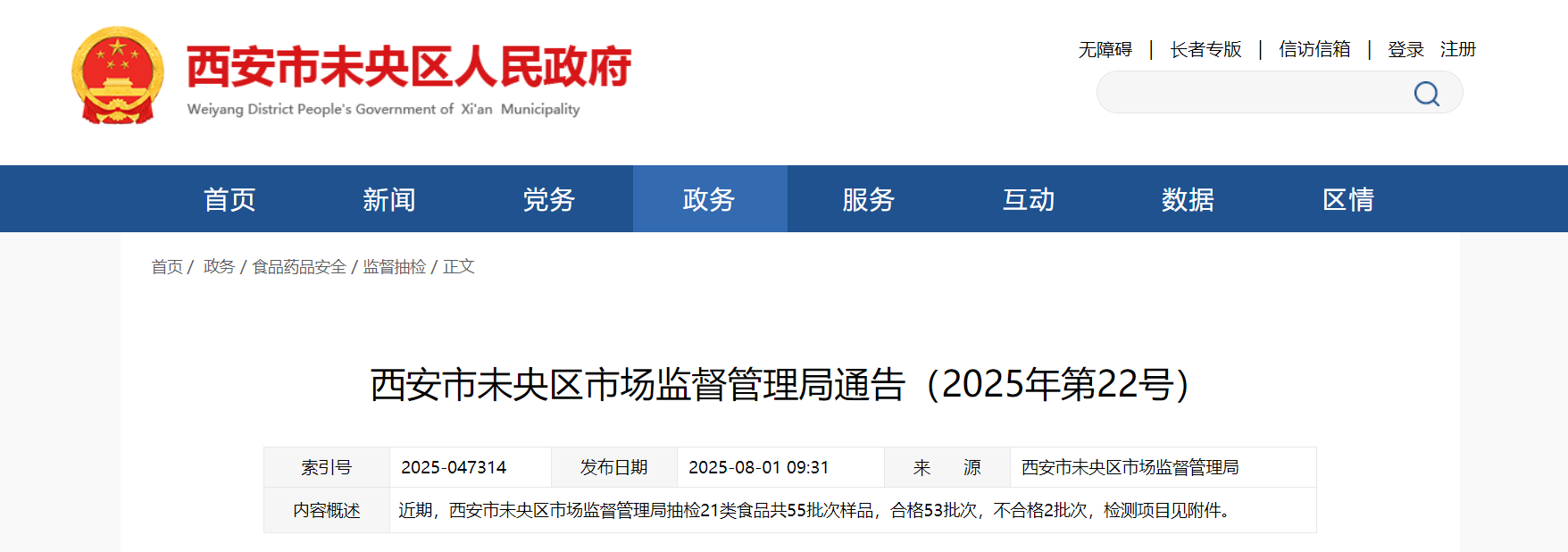
西安市未央区市场监督管理局通告(2025年第22号)
Zhong Guo Zhi Liang Xin Wen Wang· 2025-08-05 03:34
Group 1 - The Xi'an Weiyang District Market Supervision Administration conducted a food safety inspection, sampling 55 batches of various food products, with 53 passing and 2 failing the safety standards [2][3][7] - The inspection covered 21 categories of food, including starch products, condiments, canned goods, alcoholic beverages, and dairy products [2][3] - The inspection was based on multiple national food safety standards, including limits for contaminants and food additives [3][7] Group 2 - The two non-compliant products were found to contain pesticide residues exceeding the allowable limits, specifically for the substances thiamethoxam and sodium dehydroacetate [8] - The inspection results indicate a high compliance rate of 96.36% among the sampled products, reflecting the overall food safety in the region [2][7] - The inspection was part of ongoing efforts to ensure food safety and protect consumer health in the Xi'an area [2][3]