
高效太阳能电池

Search documents
光伏重磅重组!TCL中环,收购一道新能源
DT新材料· 2026-03-31 16:05
Core Viewpoint - TCL Zhonghuan is acquiring a 59.14% stake in Yidao New Energy Technology Co., Ltd. for a total cash consideration of 1.258 billion yuan, which will enhance its control over the solar energy sector and further the integration process within the photovoltaic industry [1][2]. Group 1: Acquisition Details - The acquisition involves a cash payment of 258 million yuan for an 8.06% stake and an additional 1 billion yuan for a capital increase to obtain 55.56% of Yidao New Energy [1]. - Yidao New Energy specializes in the research, manufacturing, and sales of high-efficiency solar cells and photovoltaic modules, with a registered capital of 529 million yuan [1]. Group 2: Industry Positioning - TCL Zhonghuan maintains the leading market share in the high-efficiency photovoltaic silicon wafer sector, creating a vertically integrated supply chain from silicon wafers to batteries and modules [2]. - The company aims to accelerate breakthroughs in back-contact (BC) battery components, which is a key operational strategy to leverage Yidao's technology and production advantages [2]. Group 3: Technological Advancements - The photovoltaic battery technology is transitioning from P-type to N-type to achieve higher efficiency and lower costs, with BC technology being a significant focus due to its efficiency benefits [2]. - Yidao New Energy has a strong position in the N-type battery sector, with a projected production capacity of 40 GW for both high-efficiency batteries and modules by 2025 [3]. Group 4: Valuation Insights - The acquisition is notable for its pricing, with a pre-investment valuation of 800 million yuan, significantly lower than Yidao's peak post-investment valuation of nearly 8 billion yuan in July 2023, indicating a 90% reduction in valuation [3].


拓日新能: 控股股东拟减持不超3%股份
Zhong Guo Zheng Quan Bao· 2026-02-27 05:45
Core Viewpoint - The controlling shareholder of Tuori New Energy, Shenzhen Aoxin Investment Development Co., Ltd., plans to reduce its stake in the company by up to 42.249 million shares, representing no more than 3% of the total share capital after deducting repurchased shares, to support the company's funding needs [1] Group 1: Shareholder Actions - Aoxin Investment intends to reduce its holdings through centralized bidding and block trading within three months after the announcement [1] - The reduction is estimated to have a market value of approximately 289 million yuan based on the closing price of 6.83 yuan per share on February 25 [1] - Aoxin Investment currently holds about 398 million shares, accounting for 28.23% of the total share capital after deducting repurchased shares [1] Group 2: Company Financial Outlook - Tuori New Energy expects a net loss attributable to shareholders of 138 million to 218 million yuan for 2025, compared to a profit of 10.788 million yuan in the previous year [1] - The company anticipates a non-recurring net profit loss of 130 million to 210 million yuan, compared to a profit of 3.3821 million yuan in the previous year [1] - Basic earnings per share are projected to be between -0.0977 yuan and -0.1543 yuan [1] Group 3: Business Operations - Tuori New Energy is engaged in the research and production of high-efficiency solar cells, photovoltaic modules, photovoltaic glass, photovoltaic films, photovoltaic brackets, photovoltaic junction boxes, and various portable solar consumer products [1] - The company also designs, constructs, and operates distributed and ground photovoltaic power stations [1]

TCL中环:拟投一道新能源,推进一体化战略
Sou Hu Cai Jing· 2026-01-16 15:41
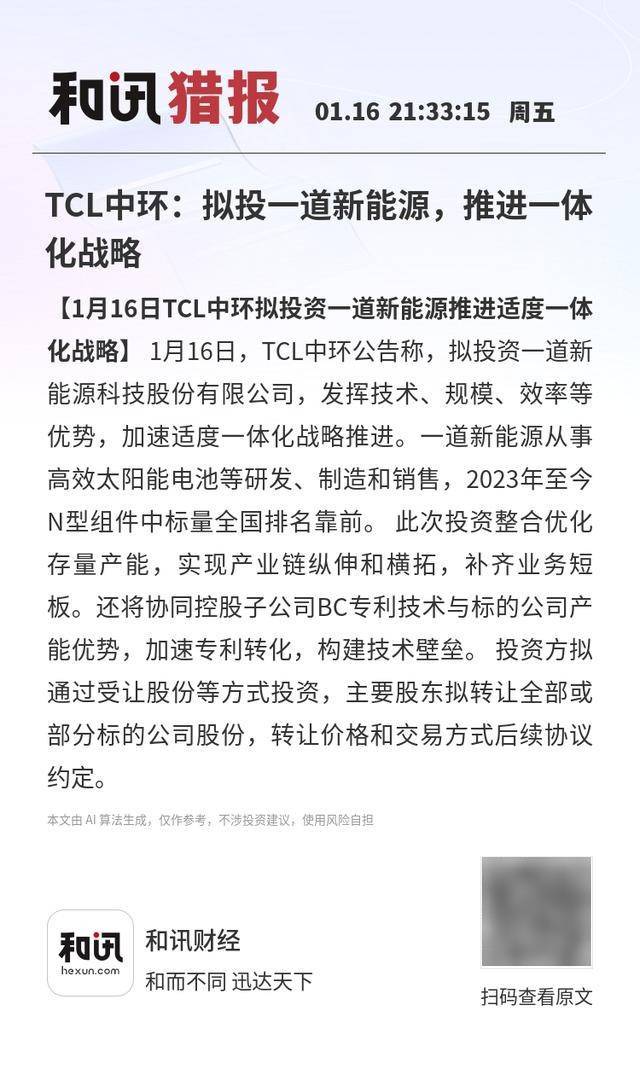
Group 1 - The core viewpoint of the article is that TCL Zhonghuan plans to invest in Yida New Energy Technology Co., Ltd. to accelerate its moderately integrated strategy by leveraging advantages in technology, scale, and efficiency [1] - Yida New Energy is engaged in the research, manufacturing, and sales of high-efficiency solar cells, and has ranked among the top in the national bidding volume for N-type modules in 2023 [1] - The investment aims to optimize existing production capacity, extend the industrial chain, and address business shortcomings, while also enhancing the collaboration with the subsidiary BC for patent technology and production capacity advantages [1] Group 2 - The investment will be executed through share transfer, with major shareholders planning to transfer all or part of the shares of the target company, with the transfer price and transaction method to be agreed upon later [1]
TCL中环拟投资一道新能源 加速公司适度一体化战略推进
Zhi Tong Cai Jing· 2026-01-16 14:41
Core Viewpoint - TCL Zhonghuan plans to invest in Yidao New Energy Technology Co., Ltd. to leverage its technological, scale, and efficiency advantages, accelerating the company's moderate integration strategy [1] Group 1: Investment Details - The investment aims to optimize existing production capacity and achieve vertical and horizontal expansion of the company's industrial chain [1] - Yidao New Energy specializes in the R&D, manufacturing, and sales of high-efficiency solar cells, photovoltaic modules, and system applications, ranking high in N-type module bidding volume in 2023 [1] Group 2: Strategic Goals - The investment will enhance the synergy between TCL Zhonghuan's BC patent technology and Yidao's BC battery module processing and production capacity, accelerating the conversion of patent technology and building a complete technological barrier [1] - The global layout and multi-scenario applications are key strategies for capacity reduction, with the investment expected to create synergies in products, brands, and channels, providing comprehensive solutions to customers [1] Group 3: Operational Improvements - Both parties will gradually implement the clearance of inefficient production capacity during and after the transaction, aiming to establish a new technology and application industrial ecosystem [1] - The plan includes improving operational conditions through empowerment and collaboration, contributing to the healthy development of the industry [1]
TCL中环(002129.SZ)拟投资一道新能源 加速公司适度一体化战略推进
智通财经网· 2026-01-16 14:41
Core Viewpoint - TCL Zhonghuan plans to invest in Yidao New Energy Technology Co., Ltd. to leverage its technological, scale, and efficiency advantages, accelerating the company's moderate integration strategy [1] Group 1: Investment Rationale - Yidao New Energy specializes in the R&D, manufacturing, and sales of high-efficiency solar cells, photovoltaic modules, and system applications, ranking among the top in the country for N-type module bids in 2023 [1] - The investment aims to optimize existing production capacity, achieving vertical and horizontal expansion of the company's industrial chain, and quickly addressing business shortcomings [1] Group 2: Strategic Benefits - The investment will synergize the company's BC patent technology with Yidao's BC battery module processing and production capacity advantages, accelerating patent technology conversion and building a complete technological barrier [1] - Global layout and multi-scenario applications are key strategies for capacity reduction, with the investment expected to enhance product, brand, and channel synergies, providing customers with more comprehensive products and solutions [1] Group 3: Operational Improvements - Both parties will gradually implement the clearance of inefficient production capacity during and after the transaction, constructing an industrial ecosystem for new technologies and applications [1] - The plan includes improving operational conditions through empowerment and collaboration, contributing to the healthy development of the industry [1]
光伏龙头大动作!TCL中环拟投资一道新能源,后者曾IPO未果
Bei Jing Shang Bao· 2026-01-16 14:20
Group 1 - TCL Zhonghuan announced an investment in Yida New Energy Technology Co., Ltd., which specializes in the research, manufacturing, and sales of high-efficiency solar cells and photovoltaic modules [1] - Yida New Energy has ranked high in the national bidding for N-type modules in 2023 and has accumulated years of R&D reserves in various application scenarios and BC battery technology [1] - The transaction aims to gradually eliminate inefficient production capacity and build a new technology and application ecosystem, with plans to improve operational conditions through empowerment and collaboration [1] Group 2 - TCL Zhonghuan released a profit forecast for 2025, expecting a net loss attributable to shareholders between 8.2 billion to 9.6 billion yuan, compared to a loss of 9.818 billion yuan in the previous year [2] - The company anticipates a non-recurring net profit loss between 8.6 billion to 9.8 billion yuan for the same period [2]
TCL中环:拟投资一道新能源,加速突破BC电池等新技术和产品能力
Xin Lang Cai Jing· 2026-01-16 13:55
Core Viewpoint - TCL Zhonghuan announced plans to invest in Yidao New Energy Technology Co., Ltd. to leverage its technological, scale, and efficiency advantages, accelerating the company's moderate integration strategy [1] Group 1: Company Overview - Yidao New Energy Technology Co., Ltd. specializes in the research, manufacturing, and sales of high-efficiency solar cells, photovoltaic modules, and system applications [1] - The company has ranked among the top in the national bidding volume for N-type modules in 2023, indicating strong market presence [1] Group 2: Strategic Implications - The investment aims to enhance TCL Zhonghuan's competitive edge in the renewable energy sector by utilizing Yidao's accumulated technological reserves in various application scenarios and BC battery technology [1]

TCL中环:拟投资一道新能源,后者从事高效太阳能电池、光伏组件及系统应用的研发等业务
Ge Long Hui A P P· 2026-01-16 13:46
Core Viewpoint - TCL Zhonghuan announced an investment in Yida New Energy Technology Co., Ltd. to leverage its technological, scale, and efficiency advantages, accelerating the company's moderate integration strategy [1] Group 1: Investment Details - The investment aims to optimize existing production capacity and achieve vertical and horizontal expansion of the company's industrial chain [1] - Yida New Energy specializes in the research, manufacturing, and sales of high-efficiency solar cells, photovoltaic modules, and system applications, ranking among the top in the country for N-type module bids in 2023 [1] Group 2: Strategic Objectives - The investment will synergize with the patented technology of the company's controlling subsidiary and the production capacity advantages of Yida New Energy's BC battery module process, accelerating the conversion of patented technology and building a complete technological barrier [1] - The investment will be executed through share acquisition, voting rights delegation, and capital increase, with the main shareholders planning to transfer all or part of their shares in Yida New Energy [1]

TCL中环:公司拟投资一道新能源公司
Zheng Quan Shi Bao Wang· 2026-01-16 13:37
Core Viewpoint - The global photovoltaic market is experiencing a supply-demand imbalance, with the industry remaining at the bottom of the cycle. The domestic new energy electricity market entry policy has led to adjustments in project revenue models, indicating a profound transformation in the photovoltaic industry [1] Group 1: Company Strategy - TCL Zhonghuan plans to invest in Yida New Energy Technology Co., Ltd. to leverage its technological, scale, and efficiency advantages, accelerating the company's moderate integration strategy [1] - Yida New Energy specializes in the research, manufacturing, and sales of high-efficiency solar cells, photovoltaic modules, and system applications, ranking high in the national bidding volume for N-type modules in 2023 [1] Group 2: Industry Trends - The photovoltaic industry is facing significant changes due to the new energy electricity market policies and ongoing supply-demand imbalances [1] - The company is considering various factors such as industry chain ecological positions, technological layouts, product applications, and customer compositions in its strategic decisions [1]
TCL中环:拟投资一道新能源科技股份有限公司
Guo Ji Jin Rong Bao· 2026-01-16 13:22
Core Viewpoint - The company plans to invest in Yida New Energy Technology Co., Ltd. to leverage its technological, scale, and efficiency advantages, accelerating the implementation of its moderate integration strategy [1] Group 1: Company Strategy - The investment aims to enhance the company's strategic positioning in the renewable energy sector [1] - Yida New Energy specializes in the research, manufacturing, and sales of high-efficiency solar cells, photovoltaic modules, and system applications [1] Group 2: Market Position - As of 2023, Yida New Energy ranks among the top in the national bidding volume for N-type modules [1] - The company has accumulated years of technological reserves in various application scenarios and BC battery technology [1]