高校专业

Search documents
高等教育学龄人口2032年达到峰值,多所高校专业调整
Di Yi Cai Jing· 2025-11-17 10:54
Core Insights - The number of vocational undergraduate institutions in China has reached 87, reflecting a growing trend in vocational education [1][5] - Changes in population structure are driving a transformation in the allocation of educational resources, with primary school enrollment peaking in 2023 and higher education age population expected to peak in 2032 [2] - The Ministry of Education is focusing on reforming higher education classification and regional structure to align with national strategic needs, particularly in emerging fields like AI and renewable energy [3][4] Group 1: Educational Trends - The current population development in China shows new characteristics, with primary school enrollment peaking in 2023, and secondary education expected to peak in the coming years [2] - The "14th Five-Year Plan" emphasizes the need for educational resource allocation mechanisms that adapt to population changes [2] - There is a significant increase in the establishment of new colleges and programs focused on high-demand fields, indicating a shift towards meeting market needs [3][4] Group 2: Vocational Education - Vocational undergraduate institutions are gaining popularity, with some institutions achieving admission scores comparable to top-tier universities [5] - The rise in vocational education is attributed to the competitive nature of programs and favorable employment prospects, leading to higher admission scores [5] - There is a growing trend of university graduates returning to vocational schools, highlighting the need for higher education institutions to adapt their programs to market demands [6]
高校加快学科专业调整 有985高校停招24个本科专业
Di Yi Cai Jing· 2025-11-04 11:38
Group 1 - The rapid development of emerging industries necessitates adjustments in higher education programs to align with the needs of industrial transformation and upgrading [1] - A number of "Double First-Class" universities in China have announced the establishment of new colleges focusing on cutting-edge technologies and emerging industries, particularly in fields such as artificial intelligence, future technologies, and quantum science [1] - The establishment of the first Artificial Intelligence and Robotics College at Northwest A&F University marks a significant milestone for agricultural and forestry universities in China [1] Group 2 - New research-oriented universities are increasingly becoming popular among high-scoring students, with some new institutions achieving admission scores comparable to or exceeding those of established 985 universities [2] - Traditional universities are encouraged to adapt to economic and social development needs by adding new programs while also considering the reduction or elimination of programs that do not align with their institutional focus [2] Group 3 - An increasing number of universities, including those classified as 985, are discontinuing or suspending certain programs, reflecting a trend towards program optimization [3] - East China Normal University plans to add one new program in data science while discontinuing 24 programs, indicating a shift in focus towards more relevant fields [3] - Shandong University has announced the suspension of 27 programs and the introduction of two new programs, further illustrating the trend of program adjustments in response to market demands [3]
高校专业大逃杀
投资界· 2025-05-12 09:17
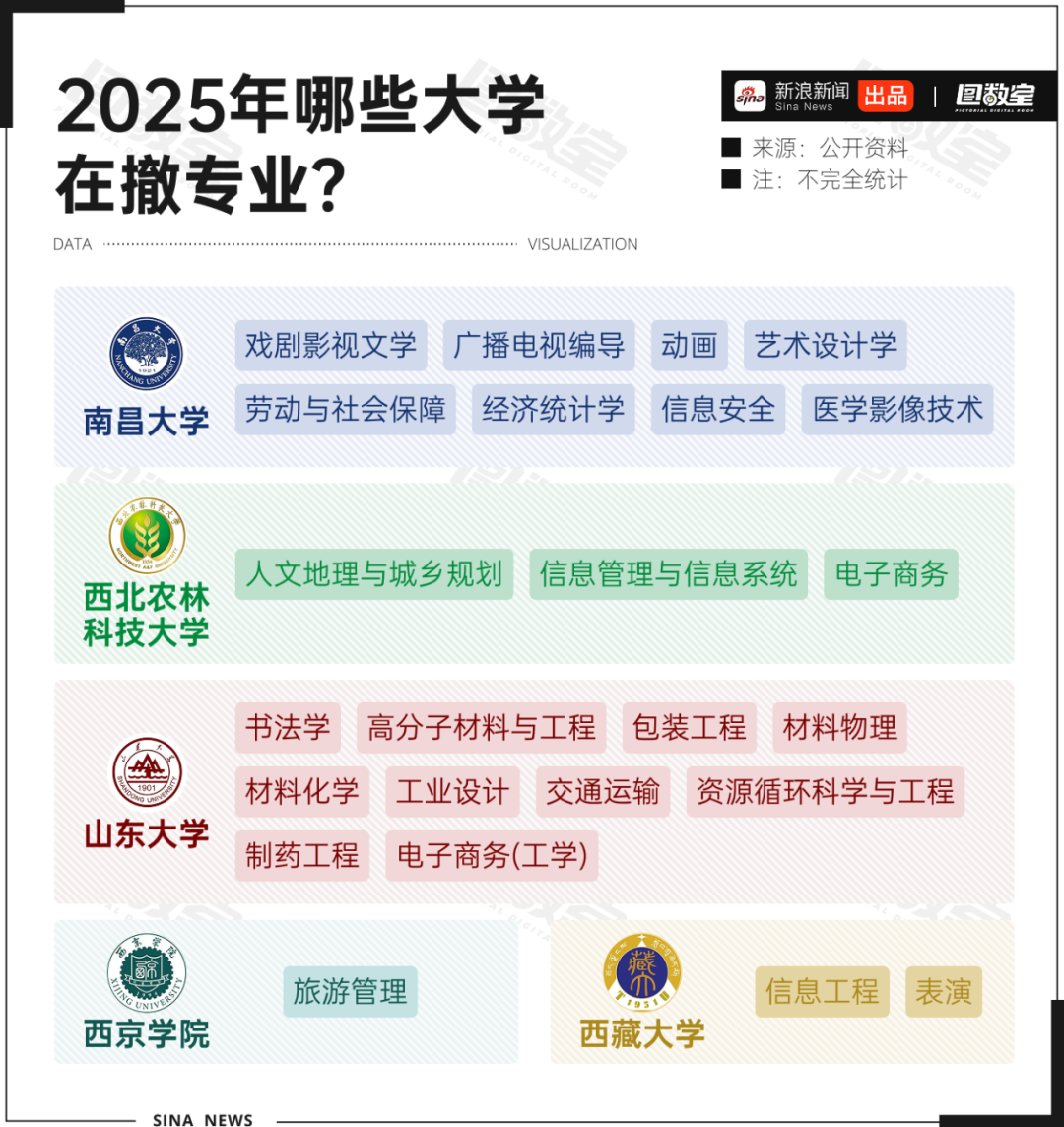
Core Viewpoint - A significant restructuring of university majors is occurring in China, with 1,428 programs being eliminated in 2024, marking a historical high. This trend reflects the shift away from outdated programs towards emerging fields like artificial intelligence and digital theater [4][14]. Group 1: Major Eliminations - Notable universities such as Nanchang University and Shandong University have announced the removal of multiple programs, indicating a broader trend of "professional retreat" across Chinese higher education [5][6]. - The eliminated programs include those with low employment rates, such as industrial design and public administration, which have seen job placement rates below 60% for five consecutive years [4][7]. - The trend of program elimination is not isolated; it represents a large-scale adjustment in higher education, with institutions like Tibet University leading in the number of programs cut [9][10]. Group 2: Reasons for Program Cuts - The removal of traditional engineering and management programs reflects the pain of industrial upgrades, as seen in fields like metallurgy and public administration, which are struggling with outdated curricula and low job demand [7][18]. - Programs with vague professional positioning, such as information management and information systems, are also facing cuts due to insufficient depth in skill training, leading to weaker job market competitiveness [18][20]. Group 3: New Program Additions - In response to market demands and technological advancements, the Ministry of Education has introduced 29 new programs, including those focused on artificial intelligence, carbon neutrality, and marine science [22][23]. - The majority of new programs are concentrated in cutting-edge technology fields, with artificial intelligence leading the way with an average of 83 new programs added annually [26]. Group 4: Historical Context and Future Outlook - The fluctuation of popular majors over the decades is closely tied to economic conditions, with past trends showing that fields like accounting and international trade surged during specific economic booms [28][30][32]. - The future of university programs may resemble a "dynamic menu," requiring institutions to adapt quickly to societal needs, emphasizing the importance of aligning personal skills with market demands [37].


1428个专业被撤,中国高校上演“专业大逃杀”
Hu Xiu· 2025-05-09 08:30
Core Points - A significant wave of program cancellations is occurring in Chinese universities, with 1,428 programs being cut in 2024, marking a historical high. This includes programs with employment rates below 60% for five consecutive years, as well as once-popular disciplines [1][16][19] - The trend shows a stark contrast between the retreat of traditional programs and the rapid growth of fields like artificial intelligence and digital theater, indicating a dynamic shift in higher education [2][30] Group 1: Program Cancellations - Notable universities like Nanchang University and Shandong University have announced the cancellation of multiple programs, with Nanchang University planning to cut eight programs and Shandong University ten [3][4] - The canceled programs can be categorized into "sunset industry" programs and "theoretical" programs, reflecting the need for universities to adapt to industry demands [6][11] - Programs such as industrial design and public administration are being phased out due to low employment rates and outdated curricula [7][8] Group 2: New Program Additions - In contrast to the cancellations, 1,839 new programs have been added in 2024, focusing on emerging fields that align with national strategies and market demands [16][29] - New programs include areas like carbon neutrality, marine science, and artificial intelligence, showcasing a proactive approach to meet future workforce needs [29] Group 3: Employment Trends - The cancellation of programs often stems from low enrollment and poor job prospects, with specific guidelines indicating that programs with low employment rates for consecutive years are subject to removal [23][24] - Certain fields, such as education and history, are also facing challenges due to limited job growth, while niche programs struggle with insufficient national demand [25][27] Group 4: Historical Context - The fluctuation of popular and unpopular programs over the decades is closely tied to economic conditions, with past trends showing that fields like accounting and international trade surged during specific economic phases [34][43] - The evolution of program offerings reflects a broader need for educational institutions to remain agile and responsive to changing societal and market needs [44]