高速网络互联设备

Search documents
中美芯片战,中国大反击
虎嗅APP· 2025-09-16 14:05
Core Viewpoint - The article discusses China's recent countermeasures in the ongoing chip war with the United States, highlighting three specific actions taken against American semiconductor companies, particularly Nvidia, in response to U.S. export controls and anti-competitive practices [4][5][6]. Group 1: China's Countermeasures - On September 13, China initiated an anti-dumping investigation into American-made analog chips [4]. - On the same day, China launched an anti-discrimination investigation against U.S. measures affecting the integrated circuit sector [4]. - On September 15, China determined that Nvidia violated antitrust laws, leading to further investigations [4][9]. Group 2: Nvidia's Antitrust Issues - Nvidia recently received U.S. government approval to sell H20 chips to China but faced scrutiny from the Chinese government for alleged antitrust violations [8][9]. - The investigation relates to Nvidia's 2019 acquisition of Mellanox Technologies, which was approved under specific conditions to prevent anti-competitive practices [11][14]. - Nvidia's supply of H20 chips to China has been criticized for not adhering to fair and non-discriminatory principles, as the performance of these chips is significantly lower than their counterparts available in other markets [16][17]. Group 3: Impact on the Semiconductor Industry - The anti-dumping investigation targets analog chips, with significant price discrepancies noted, such as a dumping margin of 340.10% for certain products [24][25][26]. - Major U.S. companies like Texas Instruments, ADI, Broadcom, and ON Semiconductor are implicated, with their combined revenue in China exceeding $10 billion, indicating potential significant financial repercussions [33]. - Following the announcement of these investigations, Chinese semiconductor stocks surged, while U.S. counterparts like Texas Instruments experienced declines [33]. Group 4: Broader Trade Implications - The article suggests that the ongoing trade tensions involve not only direct actions like anti-dumping and antitrust investigations but also broader issues of discrimination in trade practices [35][36]. - The ultimate goal for China is to enhance its self-sufficiency in semiconductor manufacturing, reducing reliance on foreign technology [37][38].


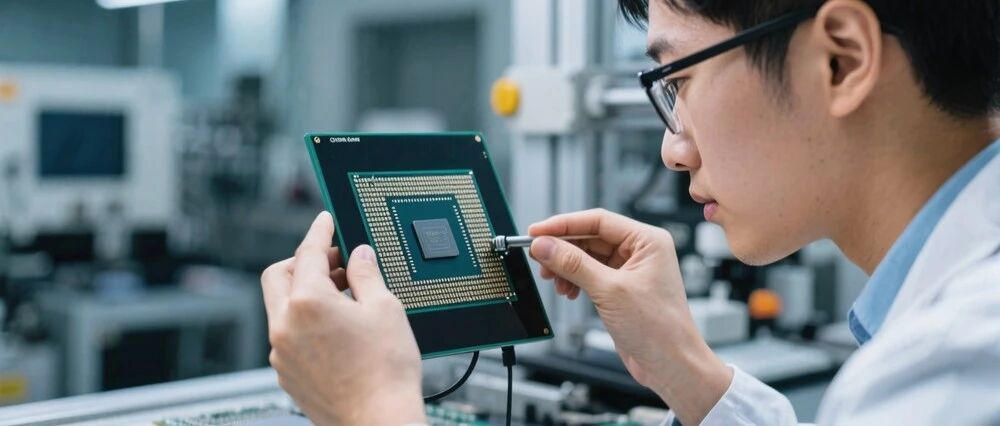
中美芯片战:中国大反击,上了 3 个反制手段,直戳美国痛处
3 6 Ke· 2025-09-16 01:19
Group 1 - China has initiated anti-dumping investigations against American semiconductor chips, marking a significant response in the ongoing chip war with the U.S. [1] - The investigations were triggered by the U.S. Department of Commerce's recent addition of 32 entities to the export control "entity list," including 23 from China involved in chip business [1][2] - The Chinese government has also launched an anti-discrimination investigation against U.S. measures in the integrated circuit sector [1] Group 2 - Nvidia is under investigation by China's State Administration for Market Regulation (SAMR) for violating antitrust laws, particularly related to its acquisition of Mellanox Technologies in 2019 [4][7] - The acquisition raised concerns due to Nvidia's dominant market share in GPU accelerators and Mellanox's significant presence in high-speed networking equipment [9][10] - Nvidia's H20 chip, which is being sold to China, has significantly reduced performance compared to its H200 counterpart, raising fairness concerns in supply [14] Group 3 - The anti-dumping investigation targets American analog chips, with reported dumping margins of 340% for certain products [22][30] - The investigation period is set from January 1, 2024, to December 31, 2024, with the domestic industry claiming significant harm due to price suppression by U.S. companies [23][30] - The outcome of the anti-dumping investigation could lead to substantial penalties for U.S. companies like Texas Instruments and Broadcom, which collectively earn over $10 billion in China [31][32] Group 4 - The Chinese government is also conducting an anti-discrimination investigation against U.S. trade practices, which may result in tariffs or restrictions on U.S. products [32] - The ultimate countermeasure for China may involve enhancing its self-reliance in semiconductor manufacturing capabilities [33][34]
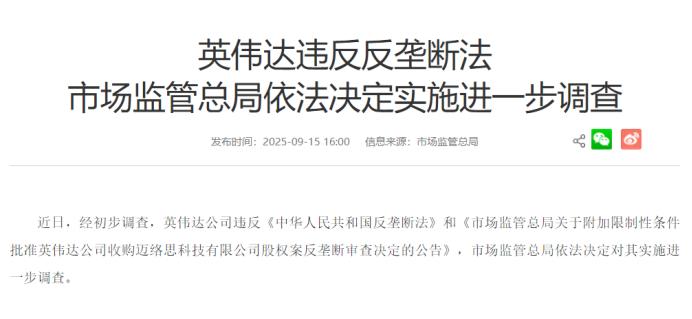
英伟达69亿美元收购案遭反垄断调查,或面临最高85亿美元罚款
Sou Hu Cai Jing· 2025-09-15 15:51
Core Viewpoint - The National Market Regulation Administration of China has initiated further investigations into NVIDIA for allegedly violating the Anti-Monopoly Law and conditions set during the approval of its acquisition of Mellanox Technologies, indicating a serious breach of regulatory compliance [2][4][6]. Group 1: Investigation Background - NVIDIA is under investigation for a $6.9 billion acquisition of Mellanox Technologies, which was finalized in March 2019 at a price of $125 per share [7]. - The acquisition allowed NVIDIA to integrate Mellanox's technology, enhancing its capabilities in AI computing and networking, which has been pivotal in its recent market success [8]. Group 2: Regulatory Conditions - The acquisition was approved with specific conditions aimed at preventing anti-competitive practices, including a prohibition on forced bundling and ensuring fair supply to the Chinese market [9][10]. - The conditions were set to remain in effect for six years, after which NVIDIA could apply for their removal, contingent on market conditions [10]. Group 3: Potential Penalties - NVIDIA could face fines up to $8.5 billion if found in violation of the Anti-Monopoly Law, based on a percentage of its revenue in China [11][12]. - The regulatory scrutiny is part of a broader trend, as multiple semiconductor companies have faced similar investigations, indicating a tightening of market regulations in the industry [12]. Group 4: Market Impact - NVIDIA's stock fell nearly 3% following the announcement of the investigation, reflecting investor concerns over potential regulatory repercussions [6]. - The company has also faced challenges related to U.S. export restrictions, which have impacted its revenue from the Chinese market, further complicating its operational landscape [11][14].
英伟达突发!中国出手 股价直线跳水!
Zhong Guo Ji Jin Bao· 2025-09-15 09:20
Core Viewpoint - Nvidia is under further investigation by China's State Administration for Market Regulation (SAMR) for allegedly violating the Anti-Monopoly Law of the People's Republic of China and the conditions set for its acquisition of Mellanox Technologies [1][3]. Group 1: Investigation Details - The investigation is related to Nvidia's $6.9 billion acquisition of Mellanox, which was approved in April 2020 with specific conditions aimed at addressing competition concerns [3]. - Nvidia had committed to supply its GPU accelerators and Mellanox's high-speed networking equipment to the Chinese market based on fair, reasonable, and non-discriminatory principles [3]. - Recent actions by Nvidia to halt the supply of several GPU accelerator products to China, citing U.S. government export controls, have raised significant dissatisfaction among Chinese enterprises [3]. Group 2: Market Reaction - Following the announcement of the investigation, Nvidia's stock dropped approximately 2% in pre-market trading, which also negatively impacted Nasdaq futures [4].
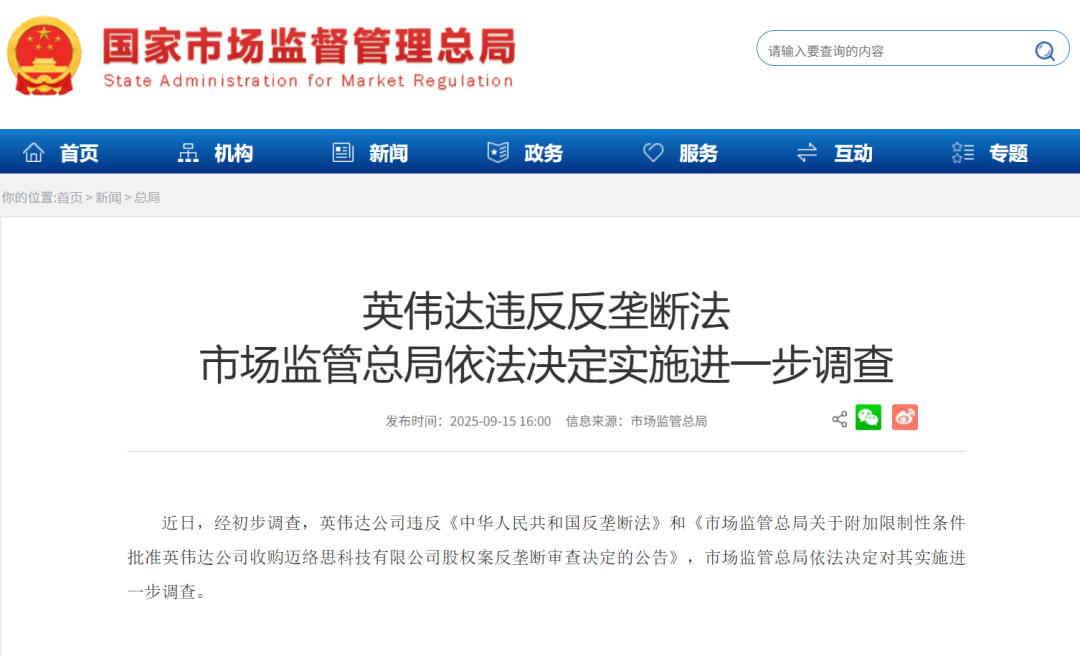
英伟达突发!刚刚,中国出手,直线跳水!
中国基金报· 2025-09-15 08:42
Core Viewpoint - Nvidia is under further investigation by China's State Administration for Market Regulation (SAMR) for allegedly violating the Anti-Monopoly Law of the People's Republic of China and the conditions set for its acquisition of Mellanox Technologies [2][4]. Group 1: Investigation Details - The investigation is related to Nvidia's $6.9 billion acquisition of Mellanox, which was approved in April 2020 with specific conditions aimed at addressing competition concerns [4]. - Nvidia had committed to supply its GPU accelerators and Mellanox's high-speed networking equipment to the Chinese market on fair, reasonable, and non-discriminatory terms [4]. - Recently, Nvidia has halted the supply of several GPU accelerator products to China, citing U.S. government export controls, which has led to dissatisfaction among Chinese enterprises [4]. Group 2: Market Reaction - Following the announcement of the investigation, Nvidia's stock dropped approximately 2% in pre-market trading, which also negatively impacted Nasdaq futures [5]. Group 3: Broader Context - Concurrently, discussions are taking place between the U.S. and China in Madrid regarding unilateral tariffs, export control abuses, and other economic issues [7]. - China's Ministry of Foreign Affairs has criticized U.S. actions as unilateral bullying and economic coercion, asserting that such measures threaten global supply chain stability [8].