高镍三元锂电池

Search documents
人形机器人催生固态电池新需求
Zheng Quan Ri Bao· 2026-02-03 16:41
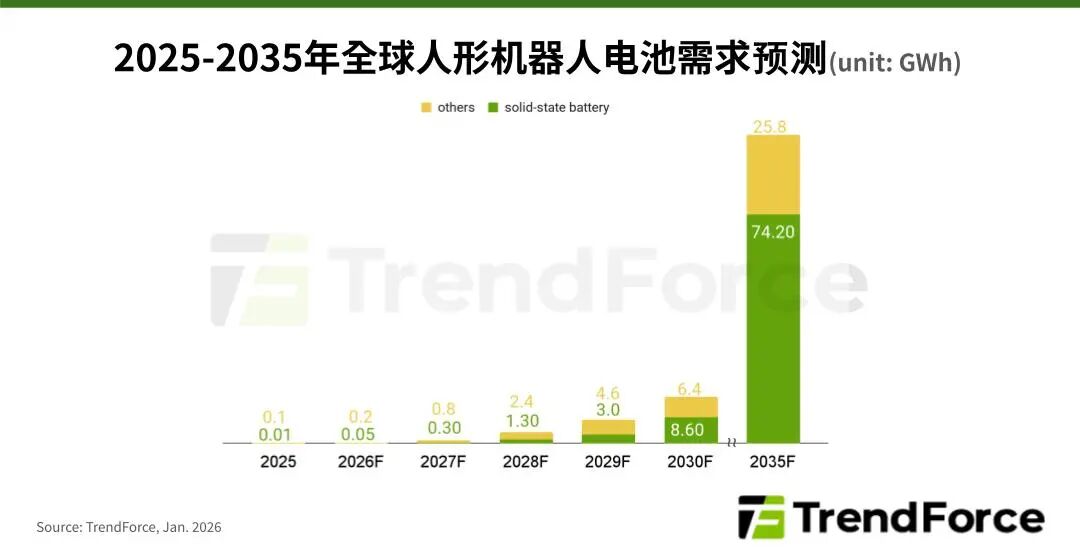
Core Insights - The global humanoid robot shipment is expected to exceed 50,000 units by 2026, with an annual growth rate of over 700% [1] - The humanoid robot industry is projected to transition from "0-1" to "1-10" by 2025, driven by "technology convergence," and will move towards "10-100" scale production by 2026, focusing on "mass production and commercialization acceleration" [1] Group 1: Industry Trends - The bottleneck in the power systems for humanoid robots is becoming a focal point, with traditional lithium batteries facing limitations in energy density, safety, and size [1] - High-nickel ternary lithium batteries (NMC/NCA) are currently the mainstream choice for robot batteries, but most products have a limited endurance of 2 to 4 hours, with battery capacities typically below 2 kWh [1] - For example, the Unitree H1 has a battery capacity of 0.864 kWh with a static endurance of less than four hours, while the Tesla Optimus Gen2, equipped with a 2.3 kWh high-nickel ternary battery system, can only sustain about two hours of dynamic endurance [1] Group 2: Solid-State Battery Development - Solid-state batteries are seen as a key technology to unlock large-scale commercial applications for humanoid robots, addressing the shortcomings of current liquid lithium-ion batteries [2] - Solid-state batteries offer high energy density, safety, and space advantages, making them highly desirable for humanoid robots, which are recognized as one of the first fields for high-value applications of solid-state battery commercialization [2] - Some companies are accelerating breakthroughs in solid-state battery technology, with the first humanoid robot featuring a solid-state battery expected to be mass-produced by the end of 2026 [3] - Leading battery companies, such as CATL, are also advancing in the solid-state battery sector, with small-scale production anticipated by 2027 [3] - The demand for solid-state batteries from humanoid robots is projected to exceed 74 GWh by 2035, representing a growth of over a thousand times compared to 2026 [4]


集邦咨询:预计人形机器人对固态电池的需求有望于2035年超74GWh
智通财经网· 2026-01-28 09:09
Core Insights - The development of humanoid robots is expected to reach a commercialization milestone by 2026, increasing the importance of batteries as an "energy supply" [1] - Solid-state lithium batteries are projected to become the mainstream solution due to their high energy density, with demand from humanoid robots expected to exceed 74 GWh by 2035, growing over a thousand times from 2026 [1] Group 1: Humanoid Robot Battery Market - Global humanoid robot shipments are forecasted to surpass 50,000 units in 2026, representing an annual growth of over 700% [4] - High-nickel ternary lithium batteries (NMC/NCA) are currently the mainstream choice for robot batteries due to their relatively high energy density, while lithium iron phosphate batteries (LFP) are used for lower endurance applications [4] - Most humanoid robots currently have a battery capacity below 2 kWh, with typical endurance ranging from 2 to 4 hours, such as Unitree's H1 with 0.864 kWh and Tesla's Optimus Gen2 with 2.3 kWh [4] Group 2: Challenges and Opportunities - The development of humanoid robot batteries faces two main challenges: the rapid iteration of core technologies affecting battery customization and the current focus on finding scalable commercial applications rather than improving endurance [5] - Despite these challenges, the demand for high energy density, high discharge rate, and high safety batteries in humanoid robots presents an opportunity for solid-state batteries to demonstrate their advantages [5] - Breakthroughs in solid-state battery technology and cost reductions are expected to help humanoid robots overcome power limitations [5]


研报 | 人形机器人迈向商用化,固态电池技术将成为突破动力瓶颈的关键
TrendForce集邦· 2026-01-28 09:01
Core Insights - The article highlights the increasing importance of solid-state batteries as humanoid robots approach commercialization in 2026, with a projected demand for solid-state batteries exceeding 74 GWh by 2035, representing a growth of over 1,000 times from 2026 levels [2][5]. Group 1: Current Battery Technology - Currently, humanoid robots primarily use liquid lithium batteries, with most models having a battery capacity below 2 kWh and a runtime of 2 to 4 hours [6][8]. - High-nickel ternary lithium batteries (NMC/NCA) are the mainstream choice for robot batteries due to their relatively high energy density, while lithium iron phosphate batteries (LFP) are used for lower endurance applications [6]. Group 2: Future Developments - To achieve a runtime of 5 to 8 hours, strategies such as battery swapping technology are being explored, allowing for continuous operation without rebooting [7]. - The adoption of high energy density battery technology, such as solid-state batteries, is expected to significantly enhance the runtime of humanoid robots to over 4 hours [7]. Group 3: Challenges in Battery Development - The development of humanoid robot batteries faces two main challenges: the rapid iteration of core technologies affecting battery customization and the current focus on finding scalable commercial applications rather than improving battery life [8]. - Despite these challenges, the demand for high energy density, high discharge rate, and high safety batteries presents an opportunity for solid-state batteries to demonstrate their advantages [8].