
鸿蒙OS6

Search documents
国产手机海外角逐
2 1 Shi Ji Jing Ji Bao Dao· 2026-01-21 23:11
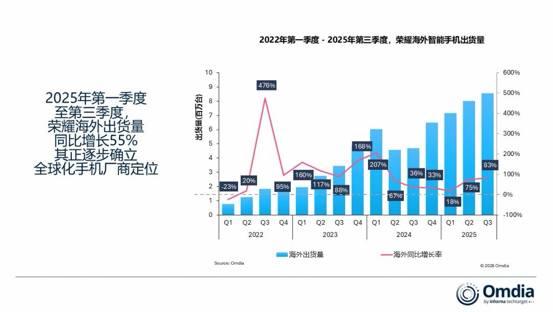
Core Insights - The global smartphone market is projected to grow in 2025, with an expected shipment volume of 1.26 billion units, reflecting a year-on-year increase of 1.9% [1] - Chinese smartphone manufacturers have established a significant presence in the global market, capturing approximately 60% of global shipments, with brands like OPPO, vivo, Xiaomi, and Honor leading the way [1] - Honor is expected to see rapid growth in overseas shipments, with a projected year-on-year increase of about 55% in the first three quarters of 2025 [1][2] Industry Trends - Chinese companies are adopting two main strategies for overseas markets: full AI integration and brand premiumization, with a focus on "Glocal" strategies that combine global thinking with local actions [2] - Honor's international business has undergone a structural transformation, with overseas shipments rising from less than 10% of total shipments in early 2021 to nearly 50% by the third quarter of 2025 [2] - The competition in emerging overseas markets is intense, particularly in the entry-level segment priced below $200, which remains a primary focus for many manufacturers despite profit pressures [2] Market Positioning - Increasingly, Chinese smartphone manufacturers are shifting towards the mid-to-high-end market to balance scale and profitability, with Honor targeting the $300-$500 price range, which accounted for approximately 23% of its overseas shipments in the first three quarters of 2025 [3] - The high-end market, particularly in Europe, is becoming a battleground for Chinese manufacturers, who are transitioning from a scale competition to a capability competition, emphasizing high-end product offerings [4] Product Innovation - To penetrate the high-end market, product capability is essential, with manufacturers upgrading their high-end product lines, such as Honor's Magic8 series and Huawei's Mate80Pro [5] - Honor is set to showcase its ROBOT PHONE, a unique product that integrates AI capabilities, at the 2026 International Consumer Electronics Show (CES) [5] AI Integration - Since 2025, there have been significant advancements in AI capabilities for consumer applications, with Honor achieving breakthroughs in on-device AI technologies that enhance real-time processing and user experience [6] - Huawei's strengths lie in its foundational system capabilities, with HarmonyOS 6 enabling multi-device AI computing, enhancing the processing of complex tasks [6] Future Outlook - The market is expected to continue evolving, with two prominent trends: premiumization and globalization, driven by improvements in AI capabilities and a focus on high-end user experiences [6] - Globalization is a core theme for Chinese companies, emphasizing the need to not only expand internationally but also to enhance their global presence and competitiveness [6]
中国手机厂商加码海外高端市场 荣耀结构性转变
2 1 Shi Ji Jing Ji Bao Dao· 2026-01-21 03:55
Core Insights - The global smartphone market is projected to grow in 2025, with an expected shipment volume of 1.26 billion units, reflecting a year-on-year increase of 1.9% [1] - Chinese smartphone manufacturers are increasingly focusing on both domestic and overseas markets, with significant growth in international shipments, particularly for Honor [1][3] Industry Overview - The smartphone industry is experiencing a recovery phase, but it still faces long-term challenges [1] - Chinese manufacturers hold approximately 60% of the global smartphone shipment share, with brands like OPPO, vivo, Xiaomi, and Honor leading the market [1] - Honor's overseas smartphone shipments are expected to grow by about 55% year-on-year in the first three quarters of 2025, marking significant international expansion [1][3] Strategic Shifts - Chinese companies are adopting two main strategies for overseas markets: full AI integration and brand premiumization [3] - Honor's international business has undergone a structural transformation, with overseas shipments rising from less than 10% of total shipments in early 2021 to nearly 50% by the third quarter of 2025 [3] - The competition is shifting from a focus on scale to a focus on stability and capability, with high-end positioning becoming essential for profit restructuring and brand recognition [6][9] Market Positioning - Honor is targeting the mid-to-high-end market segment, with 23% of its overseas shipments in the $300–500 price range during the first three quarters of 2025 [4] - Europe is a critical battleground for high-end consumer electronics, and Honor aims to solidify its position in key Western European markets [6] - Latin America and the Middle East and Africa are emerging as core regions for Honor's overseas shipment growth [6] Product Development - Product strength is crucial for penetrating the high-end market, with manufacturers enhancing their high-end offerings [7] - Honor has introduced innovative products like the Magic8 series and the ROBOT PHONE, which integrates AI capabilities and advanced imaging [7][8] - The AI capabilities of Chinese manufacturers are becoming a competitive advantage, with advancements in localized AI applications enhancing user experience [8][9] Future Outlook - The trends of high-end positioning and globalization are expected to continue shaping the market landscape [8][9] - Honor's "Alpha Strategy," launched in March 2025, signifies its transition from a smartphone manufacturer to a leading AI terminal ecosystem company, with global shipments projected to exceed 71 million units [9] - The new management team faces the challenge of balancing scale expansion, AI capability implementation, and profitability to maintain a leading position in the competitive landscape [9]

开源证券:AI终端开启2026年新周期 聚焦苹果华为及光学PCB等环节
Xin Lang Cai Jing· 2026-01-13 06:28
Core Viewpoint - The report from Kaiyuan Securities highlights that the AI terminal market is set to enter a new cycle in 2026, with a focus on key players like Apple and Huawei, as well as advancements in optical PCB technology [1][5]. Group 1: Industry Performance - The consumer electronics and components industry is expected to see significant performance improvements in 2025, with the PCB sector leading in growth [1][5]. - The overall electronic sector is projected to perform strongly, driven by rapid iterations and bulk shipments of AI products, alongside new product launches and government subsidies boosting demand in the consumer electronics sector [1][5]. - Traditional categories such as smartphones, PCs, and tablets are maintaining stable growth, while AI glasses and AI servers are experiencing rapid growth trends [1][5]. Group 2: AI Terminal Focus - Key investment lines for 2026 include Apple's ecosystem, Huawei's HarmonyOS, AI glasses, and OpenAI's hardware [2][6]. - Apple is positioned as a leader in the global consumer electronics supply chain, with plans to launch new products including the iPhone 17E, foldable iPhone, and AI glasses in 2026, entering a three-year innovation cycle [2][6]. - Huawei is expected to continue releasing new foldable devices in 2025, with its HarmonyOS 6 significantly enhancing user experience through AI capabilities, and increasing domestic component sourcing likely to boost sales [2][6]. - The AI glasses market is anticipated to grow significantly, with companies like Meta driving sales, positioning AI glasses as potential high-volume products [2][6]. - OpenAI's entry into terminal hardware is expected to create popular native AI hardware products from the perspective of AI model manufacturers [2][6]. Group 3: Component Upgrades - Focus areas for component upgrades include optical systems, batteries and fast charging, thermal management, and structural components [3][7]. - Enhanced optical hardware modules are crucial for AI terminals, with ongoing upgrades in mobile optical performance from both Apple and Android manufacturers [3][7]. - The demand for battery life is increasing due to enhanced AI terminal performance, leading to the adoption of new battery technologies such as steel shell batteries and solid-state batteries [3][7]. - Thermal management challenges are intensifying, with Apple expected to implement VC heat spreaders in more models, while Android manufacturers are exploring liquid cooling and micro-fan solutions [3][7]. - Upgrades in display technology are focusing on durability and lightweight designs, with advanced manufacturing techniques like 3D printing and liquid metal processes expected to penetrate more consumer electronics components [3][7]. Group 4: Resonance of AI Computing and Components - The synergy between AI computing and AI terminals is expected to drive an upward cycle for PCBs and passive components [4][8]. - As SoC performance improves and internal integration in smartphones increases, PCBs are evolving towards higher density and precision, with a greater use of flexible printed circuits in foldable devices [4][8]. - The iteration of AI chips is continuously raising the specifications and demand for PCBs, with corresponding upgrades in upstream materials [4][8]. - The increase in power consumption of AI servers is prompting a shift in data center power supply architectures towards high voltage direct current (HVDC) and solid-state transformer (SST) systems, leading to a rise in the use and specifications of various passive components [4][8].

开源证券:AI终端开启产业链升级新周期 重点关注高景气方向和增量环节
智通财经网· 2026-01-08 01:47
AI终端:2026年把握苹果、华为鸿蒙、AI眼镜、OpenAI硬件4条投资主线 (1)苹果产业链:苹果在全球消费电子产业链占据龙头地位,2025年开始,iPhone系列进入新的升级周 期,苹果计划2026年推出iPhone17E、折叠屏iPhone和AI眼镜等新品,且会对AI功能持续升级,果链有 望进入3年创新周期。(2)华为鸿蒙产业链:华为是具备全栈式研发创新能力的终端品牌厂商,2025年持 续在折叠屏设备领域推出新品,鸿蒙OS6支持多种AI智能体,大幅提升用户体验。未来随着上游芯片和 零部件国产化率提升,华为终端销量有望不断增长。(3)AI眼镜产业链:随着以Meta为代表的AI眼镜产 品销量持续攀升,国内外厂商积极入局,AI眼镜有望成为下一款千万级至亿级销量的终端产品。 (4)OpenAI终端硬件产业链:OpenAI高调入局终端硬件,从AI大模型厂商的视角出发,有望打造出爆款 原生AI硬件。 零组件:重点关注光学、电池及快充、散热、结构件及工艺等环节升级趋势 智通财经APP获悉,开源证券发布研报称,从消费电子行业数据上看,2025年手机/PC/平板等传统品类 增长保持平稳,而AI眼镜/AI服务器等品类呈现 ...