6G超宽带光电融合集成系统

Search documents
中国第二个“5万亿城市”诞生,为什么是北京?
Sou Hu Cai Jing· 2025-10-10 01:16
Core Points - Beijing is set to become China's second city to surpass a GDP of 5 trillion yuan by 2025, achieving this milestone 2 to 3 years ahead of expert predictions [2][3] - The city's GDP reached 4.98 trillion yuan in 2024, with an average growth rate of 5.2% over the past five years, indicating a strong economic performance [2][4] Economic Structure - Beijing's economy is supported by key industries such as information services, finance, and manufacturing, with the information services sector contributing significantly to GDP growth [4][5] - The city has a leading position in energy consumption, water usage, and carbon emissions metrics, showcasing its advanced economic development [4] Industrial Growth - The manufacturing sector in Beijing has seen rapid growth, particularly in new energy vehicles, with production increasing by 1100% [5] - The city is also home to a significant number of AI companies, with 50% of the nation's AI enterprises located in Beijing, solidifying its status as the "AI capital" of China [8][9] Innovation and R&D - Beijing has a high R&D investment intensity of around 6%, placing it among the top global innovation cities [9] - The city has established a robust ecosystem for technology and innovation, with a notable number of unicorns and specialized small giant enterprises [8][9] Future Prospects - Shenzhen and Chongqing are potential candidates for joining the 5 trillion yuan club next, with Shenzhen leading in digital economy growth and innovation [12][15] - The economic performance of these cities will depend on their ability to innovate and upgrade their industrial structures [15][16]

解码北京经济的韧性和潜力
Bei Jing Shang Bao· 2025-09-15 16:14
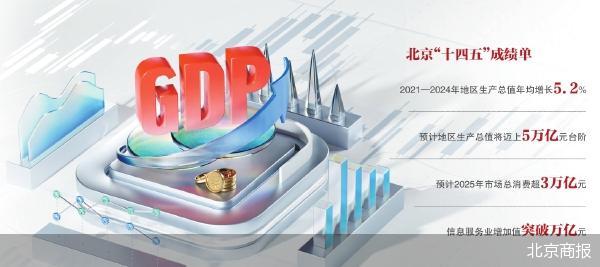
Core Insights - Beijing's economy is making solid progress towards high-quality development, with a focus on new technologies and industries, as highlighted in the recent press conference on the achievements during the 14th Five-Year Plan period [1] Economic Growth and Structure - The total economic output of Beijing is expected to exceed 5 trillion yuan, with a significant increase in the value added by the information service industry, which has surpassed 1 trillion yuan, making it the city's largest pillar industry [3][7] - The GDP is projected to grow by an average of 5.2% annually from 2021 to 2024, with a total economic increment of approximately 1.4 trillion yuan during the 14th Five-Year Plan [3] - By 2024, the per capita GDP is expected to reach $32,000, and labor productivity is projected at 444,000 yuan per person, leading among all provinces and cities [3] Technological Innovation - Beijing is home to over 2,400 artificial intelligence companies, accounting for about half of the national total, establishing itself as the "capital of artificial intelligence" [5][7] - The city has integrated education and technology talent initiatives to enhance the overall efficiency of its innovation system, with significant investments in research and development [6][7] - The commercial space industry is also growing, with a notable presence of core R&D units and unicorn companies [6] Consumer Market Dynamics - The consumer market in Beijing is expected to exceed 3 trillion yuan by 2025, driven by new consumption trends such as pop culture, events, and concerts [8] - Service consumption has seen an average annual growth of over 7.5% in the past four years, becoming a key driver of overall consumption [8] - Investment in high-tech industries has increased significantly, with the proportion of high-tech industry investment rising from 9.5% in 2020 to 22.6% in 2024 [8] Rural Development and Urban Integration - Beijing is advancing urban-rural integration, with initiatives to enhance rural tourism and local economies, leading to a 20% increase in collective income for demonstration villages [9] - The city is also focusing on sustainable practices and the "Two Mountains" concept, promoting both technological innovation and smart agriculture [9] Future Outlook - The dual drivers of technological and consumption innovation are expected to continue supporting Beijing's high-quality development, with a focus on artificial intelligence, digital economy, and new consumption models [9]
GDP迈上5万亿台阶 解码北京经济的韧性和潜力
Bei Jing Shang Bao· 2025-09-15 12:10
Core Insights - Beijing's economy is making solid progress towards high-quality development during the 14th Five-Year Plan period, with a projected GDP exceeding 5 trillion yuan [1][5][9] - The information service industry has become the largest pillar industry in Beijing, with its added value surpassing 1 trillion yuan, maintaining the top position nationwide [1][5][9] - Consumption has seen new highlights, with service consumption growing at an average annual rate of over 7.5% in the past four years, becoming a major driver of economic growth [1][10][11] Economic Growth and Structure - The GDP is expected to achieve a significant increase of approximately 1.4 trillion yuan over five years, with an average annual growth rate of 5.2% from 2021 to 2024 [5][9] - By 2024, the per capita GDP is projected to reach $32,000, with labor productivity at 444,000 yuan per person, leading among all provinces and cities [5][9] - The financial sector's asset scale exceeds 220 trillion yuan, accounting for about half of the national total, while the manufacturing sector is optimizing towards high-end industries [5][8] Technological Innovation - Beijing is recognized as the "Artificial Intelligence Capital," with over 2,400 AI companies, accounting for about half of the national total [7][9] - The city has established a robust innovation ecosystem, with significant investments in R&D, maintaining an intensity of around 6% of GDP [7][9] - The integration of new technologies has led to the development of various innovative products, including robots and advanced manufacturing technologies [8][9] Consumption Trends - The market total consumption is expected to exceed 3 trillion yuan by 2025, with fixed asset investment surpassing 1 trillion yuan [10][11] - The "first store economy" is leading nationwide, with nearly 2,000 large-scale events held in 2024, averaging five events per day [10][11] - Over 70% of residents engage in short-distance vacations annually, indicating a growing trend in leisure and tourism [10][11] Urban-Rural Integration - Beijing is advancing urban-rural integration, enhancing rural service industries and increasing collective income by over 20% in demonstration areas [11][12] - The rural tourism revenue is projected to exceed 3.5 billion yuan in 2024, reflecting the successful implementation of rural revitalization strategies [11][12] - The dual drive of technological and consumption innovation is optimizing the economic structure and enhancing development momentum [11][12]