
ADC类药物

Search documents
过去三年 投资创新药“真的非常爽” | 海斌访谈
Di Yi Cai Jing· 2025-11-06 14:27
Core Insights - The biopharmaceutical industry in China is experiencing a recovery, with significant increases in stock indices and market valuations, indicating a positive shift after a challenging period [1][2][3]. Industry Overview - The Hang Seng Biotechnology Index has risen by 80% this year, while the Shanghai Stock Exchange's STAR Market Biopharmaceutical Index has increased by 40% [2]. - Despite some companies not returning to their 2021 market highs, recent valuations have reached new highs for 2025 [2]. - The year 2023 is viewed as a turning point for the Hong Kong biotechnology index, with investors seeing nearly double returns from investments made this year [2]. Investment Climate - The capital market's recovery has improved the financing environment for biopharmaceutical companies that have recently emerged from a downturn [2]. - Investment firms that remained active during the downturn are now reaping the benefits, as the valuation of innovative drugs has become more favorable [3]. Global Partnerships and Transactions - The number of overseas licensing deals for Chinese innovative drugs has significantly increased, with total amounts exceeding $100 billion and upfront payments surpassing $5 billion [4]. - Major global pharmaceutical companies are actively seeking assets in China, with significant transactions reported with companies like Takeda, Merck, and AstraZeneca [4]. Patent Cliff Concerns - The urgency among multinational pharmaceutical companies to acquire new products is driven by the impending patent cliff, which is expected to begin in 2026 and last for about ten years [5]. - It is estimated that over $100 billion in revenue from existing drugs will be at risk due to patent expirations, prompting the need for new product development [5]. Clinical Development Advantages - China offers significant advantages in clinical trial costs and efficiency, with costs for patient enrollment being approximately one-third of those in the U.S. and enrollment speeds being four to five times faster [6][7]. - The improvement in clinical standards and resources in China has positioned it as a leading location for high-quality clinical trials [6]. Future Outlook - Chinese biopharmaceutical companies are moving towards global collaboration rather than merely licensing out their innovations, as seen in the strategic partnership between Innovent Biologics and Takeda [8]. - The ongoing reforms in drug approval processes and the development of a robust talent pool are expected to lead to the emergence of Chinese multinational pharmaceutical companies in the future [8][9].
过去三年,投资创新药“真的非常爽” | 海斌访谈
Di Yi Cai Jing· 2025-11-06 14:19
Core Insights - The biopharmaceutical industry in China is experiencing a resurgence, with significant increases in stock indices and market valuations, indicating a recovery from previous downturns [1][3][4] Group 1: Market Performance - The Hang Seng Biotechnology Index has risen by 80% this year, while the Shanghai Stock Exchange's Sci-Tech Innovation Board Biomedicine Index has increased by 40% [3] - Notable companies like BeiGene have reached three-year highs in market capitalization [1] - Investment returns have nearly doubled for those who invested in the Hong Kong Biotechnology Index in 2023 [3] Group 2: Investment Climate - The capital market's recovery has improved the financing environment for biopharmaceutical companies that recently emerged from a downturn [3] - Venture capitalists are now more optimistic, as the previous valuation declines and lack of exit channels have eased [3][4] Group 3: Global Interest and Collaborations - Chinese pharmaceutical companies have engaged in overseas business development (BD) deals exceeding $100 billion this year, with upfront payments surpassing $5 billion [4] - Major global pharmaceutical companies, including Takeda and Merck, are actively seeking assets in China due to impending patent cliffs [5] - The upcoming patent cliff, expected to start in 2026, could affect over $100 billion in revenue for multinational companies, creating a demand for new products [5] Group 4: Clinical Development and Cost Efficiency - China's clinical trial costs are significantly lower than those in the U.S., with an average cost of $25,000 per patient compared to $70,000 in the U.S. [8] - The speed of patient enrollment in clinical trials is also faster in China, with centers enrolling approximately 0.5 patients per month compared to 0.1 in the U.S. [8] Group 5: Future Outlook - Chinese biopharmaceutical companies are moving towards global collaboration models, as seen in the $11.4 billion strategic partnership between Innovent Biologics and Takeda [9] - The expectation is that more Chinese companies will evolve into global biopharmaceutical firms over the next decade, with a projected increase in the proportion of new drugs approved by the FDA coming from China [9][10]


生物制品分段生产需求迫切,上海完善创新药械“出海”政策链
Di Yi Cai Jing· 2025-10-16 03:37
Core Viewpoint - The article discusses the regulatory challenges and policy support for the biopharmaceutical industry in Shanghai, particularly focusing on the cross-province and cross-border segmented production of biological products, which is essential for integrating into the global supply chain [2][4]. Regulatory Challenges - High regulatory costs and data sharing risks are significant constraints on the segmented production of biological products across provinces and borders [2]. - The State Council issued a directive in January to explore segmented production models and support cross-border segmented production [2]. Policy Support - Shanghai has been actively promoting cross-province and cross-border segmented production since May, including the production of injectable drugs and ADCs [2]. - The Shanghai Municipal Drug Administration has outlined key conditions for contracted production, including a minimum of three years of commercial production experience and adherence to a unified quality management system [2]. Innovation and Approval - In the first half of 2025, 34 domestic innovative medical devices were approved, with Shanghai accounting for 21%, highlighting the city's significant role in the innovation landscape [3]. - The review process for innovative medical devices has been streamlined, reducing technical review timelines from 45 to 40 working days [3]. Support for Overseas Expansion - Policies have been introduced in the Pudong New Area to support biopharmaceutical companies in expanding overseas, including public service policies and talent incentives [4]. - The Pudong Trade Promotion Council has organized over 230 overseas exhibition projects, with more than 30 focused on biotechnology and medical devices, facilitating global market access for Shanghai's biopharmaceutical companies [5].
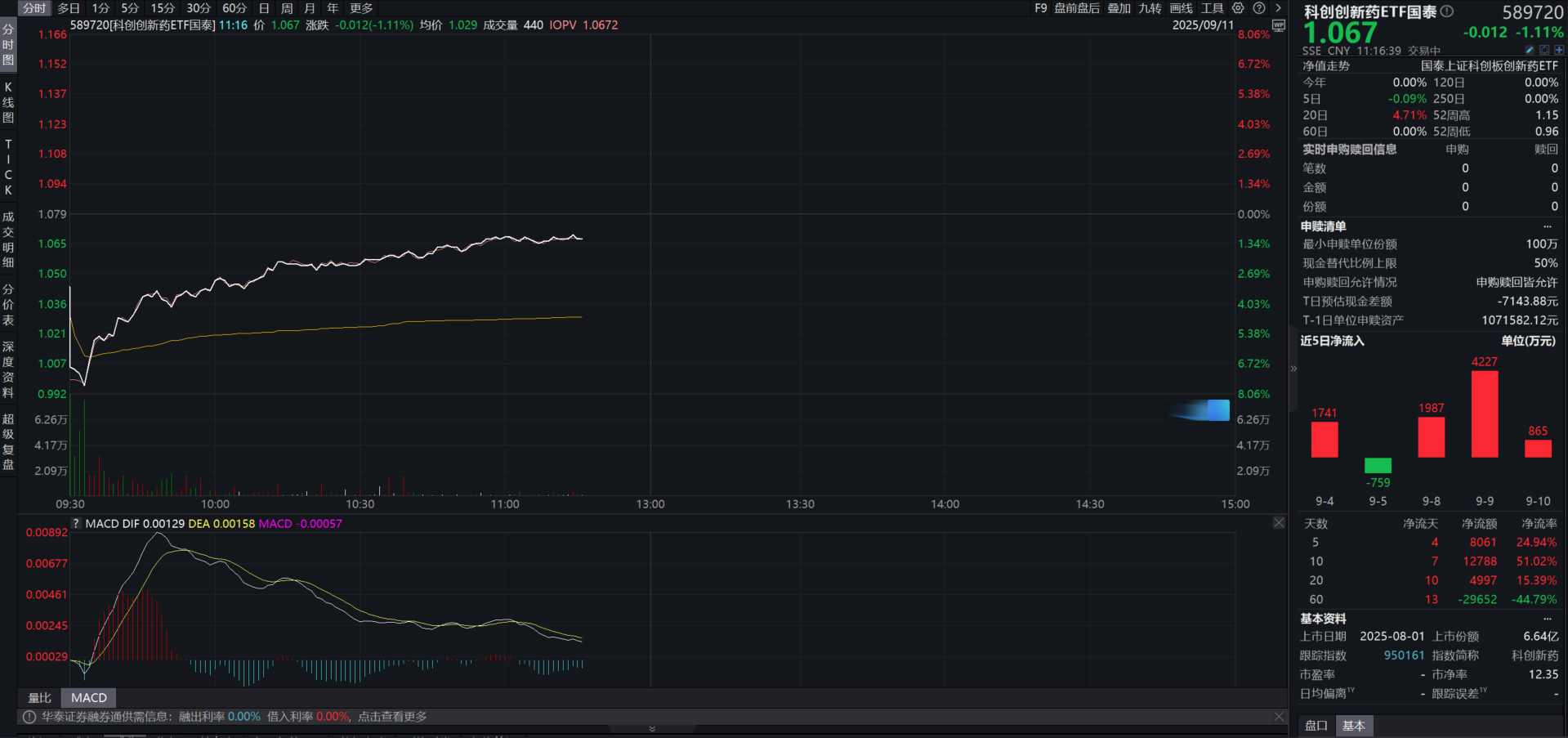
特朗普政府或加强对中国药品限制?机构:虚张声势!把握科创创新药ETF(589720)回调布局良机
Mei Ri Jing Ji Xin Wen· 2025-09-11 05:39
Core Viewpoint - The Chinese innovative pharmaceutical sector is rapidly enhancing its global competitiveness, with significant advancements in drug development and commercialization strategies, positioning itself to lead in the global market [3][5][6]. Group 1: Market Performance - The Science and Technology Innovation Drug ETF (589720) experienced a market correction at the opening but showed signs of recovery, indicating market confidence [1]. - The ETF has seen a net inflow for three consecutive days, with over 120 million yuan in net inflows over the past ten days, suggesting that the recent correction may present a good opportunity for investment [4]. Group 2: Competitive Advantages - Chinese innovative drugs have established differentiated, high-cost performance, and globalized competitive advantages, with core capabilities evolving from drug design to international compliance [5][6]. - The drug development strategy has shifted from "me-too" to "me-better" and "first-in-class," focusing on unique therapeutic areas such as hematological malignancies and solid tumors, leading to significant breakthroughs [5]. - The cost of developing similar targeted drugs in China is approximately one-third of the international level, supported by a large clinical resource base and the ongoing release of engineering talent in the biopharmaceutical sector [5]. Group 3: Globalization and Compliance - Leading Chinese pharmaceutical companies have developed the capability to conduct clinical trials in accordance with ICH standards, facilitating easier entry into international markets [6]. - The transition from "catching up" to "keeping pace" and even "leading" in certain areas has been achieved, with some domestic products demonstrating superior efficacy in head-to-head clinical trials compared to international counterparts [6]. Group 4: Future Outlook - The innovative drug industry is expected to benefit from continuous breakthroughs in international expansion, policy incentives, and steady improvements in R&D capabilities, indicating a promising growth trajectory [7]. - The Science and Technology Innovation Drug ETF (589720) has outperformed major Hong Kong pharmaceutical indices since the "924 market" began, with significant growth potential anticipated in the upcoming market rebound [7].
双抗和ADC药物为晚期肿瘤患者带来曙光
Qi Lu Wan Bao· 2025-08-14 21:28
Core Insights - Traditional chemotherapy has been the main weapon against cancer, but advancements in targeted therapies and immunotherapies have provided new hope for patients. However, many still face challenges such as drug resistance and treatment bottlenecks. The emergence of bispecific antibodies and antibody-drug conjugates (ADCs) offers renewed optimism for late-stage cancer patients [1][2][3] Group 1: Patient Experiences - A 62-year-old patient diagnosed with late-stage lung cancer experienced significant relief from symptoms after using targeted therapy, but faced disease progression and treatment failure with subsequent therapies. After switching to a bispecific antibody, the patient saw a reduction in pleural effusion and improvement in overall health after just two doses [1] - A 46-year-old patient with late-stage gastric cancer underwent multiple lines of treatment without success until an ADC was introduced. This therapy not only halted gastrointestinal bleeding but also significantly reduced the size of liver metastases after three cycles of treatment, demonstrating the effectiveness of targeted drug delivery [2] Group 2: Treatment Mechanisms - Bispecific antibodies work by activating the immune system while simultaneously inhibiting tumor blood supply, thus broadening the treatment targets and enhancing efficacy against various cancer types [1] - ADCs combine targeted therapy with chemotherapy, allowing for precise delivery of cytotoxic agents directly to cancer cells, resulting in minimal damage to normal cells and improved treatment outcomes [2][3] Group 3: Clinical Considerations - While bispecific antibodies and ADCs represent significant advancements in cancer treatment, they are not suitable for all late-stage cancer patients. A thorough assessment of the patient's health status, tumor type, stage, and genetic factors is essential for developing an appropriate treatment plan [3]
中信建投 医药每周谈:CXO行业投资观点
2025-07-14 00:36
Summary of CXO Industry Conference Call Industry Overview - The CXO industry is experiencing a recovery in revenue and profit growth in Q1 2025, although some companies are under pressure due to high base effects from Q1 2024. A continued recovery trend is expected in Q2 2025. [1][4] - Representative companies reported a revenue growth of 14%, with net profit attributable to shareholders and adjusted net profit increasing by 118% and 28.1% respectively. Gross margins have stabilized, and net margins have improved, with various expense ratios declining year-on-year. [1][4] Investment Trends - Global biopharmaceutical investment saw slight growth in 2024, with a larger increase in chemical pharmaceuticals, while biopharmaceuticals remained flat. In Q2 2025, global biopharmaceutical investment is expected to decline slightly, mirroring trends in the domestic market where both chemical and biopharmaceuticals are experiencing minor declines. [1][5] Order Trends - Domestic CXO companies faced pressure on orders in 2024, but overseas orders have shown a good recovery. In Q1 2025, domestic-focused CXO companies began to see order recovery, with Kangde reporting an order backlog of 52.3 billion yuan, a 47% year-on-year increase, and the Taizi division's orders growing by 106%. [1][6] Market Opportunities - The GLP-1 peptide drug market is benefiting from treatment effectiveness and is expected to maintain high growth rates, driving the development of peptide CDMO. The global peptide CDMO market is projected to reach $20 billion by 2032, with the domestic market potentially exceeding $4 billion. Kangde's Taizi business revenue grew by 188% year-on-year, with capacity expansion underway. [1][7] ADC CDMO Development - ADC drug production, characterized by high complexity and outsourcing, is driving ADC CDMO business growth. WuXi AppTec reported a revenue of 4 billion yuan in 2024, a 91% increase, with net profit rising by 277%. The backlog of unfulfilled orders approached $1 billion, a 71% year-on-year increase. [1][8] Performance of Overseas CROs - Overseas CROs are showing mixed performance, with Charles River experiencing a revenue decline but a net book-to-bill ratio above one, while Lonza reported strong Q1 2025 results. Sangamo expects a revenue increase of 20% to 25% for the year. [1][9] Regulatory Impact - The proposed U.S. biomanufacturing safety bill raised concerns about Chinese CXO dominance in global drug supply, significantly impacting the CXO industry. However, the bill was ultimately shelved, reflecting the importance and irreplaceability of the domestic CXO supply chain. [1][12][13] Tariff Policies - The U.S. announced a 10% basic tariff on all countries, with higher tariffs on those with significant trade deficits, but pharmaceuticals remain exempt. The CXO industry primarily exports R&D services to the U.S., which are tariff-free, limiting the overall impact on the industry. [1][14] Geopolitical Factors - Geopolitical factors are becoming normalized, but domestic CTO companies are building global competitiveness through supply chain integrity and cost advantages. Companies like Kangde and WuXi Biologics are actively planning overseas capacity to maintain their leading positions. [1][15][16] Company-Specific Performance - WuXi AppTec's H1 2025 revenue is projected at 20.8 billion yuan, a 21% increase, with adjusted net profit of 6.3 billion yuan, a 44% increase. The company’s integrated CRDMO model and global layout are key drivers of its performance, with expectations for continued growth in H2 2025. [1][17] - Tigermed is benefiting from supply-side consolidation in the clinical CRO sector, with new order numbers and amounts increasing by approximately 20% year-on-year in Q1 2025. [1][18][19]
