AirScape

Search documents
华为哈勃押注,成立仅半年融资三连跳,这家公司凭什么成为“世界模型黑马”?
Sou Hu Cai Jing· 2026-01-20 11:29
Core Insights - Manifold AI, founded by Dr. Wu Wei, aims to redefine embodied intelligence through a world model that allows robots to predict physical interactions rather than just perceive the environment [1][4][14] - The company has completed over 300 million yuan in funding within just seven months of its establishment, indicating strong investor interest in the "physical AI" sector [5][11] Funding and Growth - Manifold AI was established in May 2025 and has rapidly completed three rounds of financing, including a seed round led by Inno Fund, followed by two angel rounds totaling over 300 million yuan [4][5] - The latest funding round included prominent investors such as Meihua Venture Capital, Junlian Capital, and Huawei Hubble, highlighting the strategic importance of the company's technology [1][6] Technology and Innovation - The company is developing a unique approach called World Model Action (WMA), which allows AI to not only see but also simulate physical interactions based on first-person perspective videos [7][10] - Manifold AI's models, including DriveScape, RoboScape, and AirScape, are designed for various applications such as autonomous driving and robotics, all built on the foundational WorldScape model [10][12] Market Position and Future Goals - The company aims to have its robots equipped with the "Manifold Brain" in 10% of the market, focusing on product-driven development while also commercializing sub-domain models [11][12] - The long-term vision includes transitioning world models from experimental phases to practical applications in warehouses, factories, and homes within the next three years [13][14] Industry Context - The growing interest in world models is attributed to their potential to provide AI systems with the long-missing "physical intuition," which is essential for real-world intelligent behavior [14][15] - The entry of strategic investors like Huawei signals a strong alignment between Manifold AI's technology and the future of industrial digitalization and robotics [6][10]


华为哈勃押注,成立仅半年融资三连跳,这家公司凭什么成为“世界模型黑马”?
机器人大讲堂· 2026-01-20 09:11
Core Viewpoint - Manifold AI, founded by a former key member of SenseTime, aims to redefine embodied intelligence through its World Model technology, enabling robots to not only perceive but also predict physical interactions in their environment [1][4][12]. Group 1: Financing and Growth - Manifold AI has completed over 300 million yuan in financing within just seven months of its establishment, showcasing a rapid fundraising pace that reflects strong market interest in "Physical AI" [2][7]. - The company has successfully raised funds in three rounds: a seed round led by Inno Angel Fund, followed by two angel rounds, each exceeding 100 million yuan [4][7]. - The latest funding round included notable investors such as Meihua Venture Capital, Junlian Capital, and Huawei Hubble, indicating a strong backing from the industry [1][9]. Group 2: Technology Development - Manifold AI's technology focuses on World Model Action (WMA), which allows robots to predict physical state changes based on first-person perspective videos, moving beyond traditional visual-language models (VLM) [12][14]. - The company's WorldScape model enables robots to simulate and interact with their environment autonomously, marking a shift from mere execution of pre-set codes to possessing "brain-like" capabilities [14][15]. - Manifold AI is developing multiple specialized models, including DriveScape for autonomous driving, RoboScape for physical interaction, and AirScape for drones, all built on the foundational WorldScape model [15]. Group 3: Future Aspirations - The company aims to equip over 10% of robots in the market with its "Manifold Brain," pushing the boundaries of Physical AI agents [19][20]. - The long-term vision includes transitioning World Models from experimental stages to practical applications in warehouses, factories, and homes within the next three years [20][21]. - The strategy emphasizes creating a universal embodied world model while simultaneously commercializing sub-domain models to generate revenue and support further development [20].

商道创投网·会员动态|流形空间·完成超亿元天使+轮融资
Sou Hu Cai Jing· 2026-01-13 16:19
Group 1 - Manifold AI recently completed a Series A+ funding round exceeding 100 million yuan, led by Junlian Capital and Tongchuang Weiye, with participation from Hubble Investment and other institutions [2] - The company, founded in May 2025, focuses on developing general spatial world models, with its core product WorldScape utilizing vast amounts of first-person perspective video data for pre-training [3] - The AirScape sub-model has achieved significant progress in the low-altitude economy, enabling drones to autonomously navigate complex environments [3] Group 2 - The funding will primarily be used for technology research and product iteration, aiming to optimize the performance and application scenarios of the WorldScape model [4] - The investment was attracted by the company's technological strength and market potential, particularly the innovative nature of the WorldScape model in the spatial intelligence field [5] - The financing is seen as a significant event in the spatial intelligence sector, with government policies supporting the development of AI and robotics, pushing technology from the lab to the market [6]

锦秋被投企业Manifold AI流形空间完成超亿元天使+轮融资,国产世界模型让机器人大脑超进化|Jinqiu Spotlight
锦秋集· 2026-01-10 06:13
Core Insights - Manifold AI has completed over 100 million yuan in angel+ round financing, with Jinqiu Capital continuing to invest. The funding will be used for the iteration of its world model and the application of embodied intelligence [4] - The company has developed a universal spatial world model called WorldScape, which matches the quality and real-time capabilities of leading global models [6] - Manifold AI is the first team globally to deploy a comprehensive outdoor, indoor, and aerial embodied world model, significantly enhancing data efficiency and model performance [9] Financing and Investment - The latest funding round was led by Junlian Capital, with participation from Meihua Venture Capital, Huawei Hubble, and existing investors including Inno Fund and Jinqiu Capital [4] - Manifold AI has raised several hundred million yuan in total funding over the past six months [4] Technological Advancements - WorldScape enables single-image generation of interactive spaces, providing a foundation for physical AI applications [8] - The company utilizes a vast amount of physical video data for pre-training, enhancing WorldScape's operational interaction capabilities [8] - Manifold AI's approach replaces traditional VLM models with its world model, resulting in superior performance in real-world applications [10] Future Prospects - The integration of NVIDIA Jetson Thor for deploying embodied world models is a significant step towards scaling operations [14] - The involvement of Huawei Hubble is expected to facilitate the integration of domestic chips and robotic brains, laying the groundwork for large-scale implementation [14]

流形空间CEO武伟:当AI开始“理解世界”,世界模型崛起并重塑智能边界|「锦秋会」分享
锦秋集· 2025-11-05 14:01
Core Insights - The article discusses the evolution of AI towards "world models," which enable AI to simulate and understand the world rather than just generate content. This shift is seen as a critical leap towards "general intelligence" [4][5][9]. Group 1: Definition and Importance of World Models - World models are defined as generative models that can simulate all scenarios, allowing AI to predict and make better decisions through internal simulations rather than relying solely on experience-based learning [15][18]. - The need for world models arises from their ability to construct agent models for better decision-making and to serve as environment models for offline reinforcement learning, enhancing generalization capabilities [18][22]. Group 2: Development and Applications - The development of world models has been rapid, with significant advancements since the 2018 paper "World Models," leading to the emergence of structured models capable of video generation [24][52]. - Key applications of world models include their use in autonomous driving, robotics, and drone technology, where they provide a foundational layer for general intelligence [9][75]. Group 3: Technical Approaches - Various technical approaches to world models are discussed, including explicit physical modeling and the use of generative models that focus on creating environments for reinforcement learning [29][40]. - The article highlights the importance of data collection, representation learning, and architecture improvements to enhance the capabilities of world models [69][71]. Group 4: Future Directions - Future improvements in world models are expected to focus on richer multimodal data collection, stronger representation learning, and the ability to adapt to various tasks and environments [69][70][73]. - The company claims to be the only team globally to have developed a "universal world model" that can be applied across different domains, including ground and aerial intelligent agents [75][81].

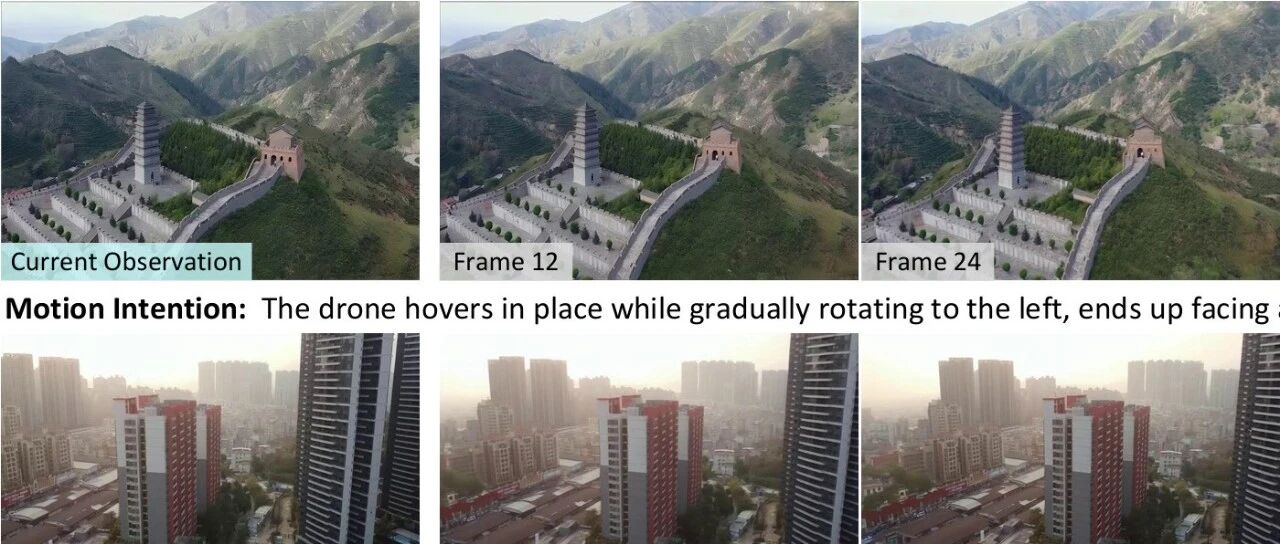
清华团队提出AirScape:动作意图可控的低空世界模型,全面开源!
具身智能之心· 2025-11-05 09:00
Core Viewpoint - The article discusses the development of AirScape, a generative world model designed for aerial embodied intelligence, which aims to predict future visual observations based on motion intentions [5][17]. Group 1: Background and Importance - Human spatial awareness includes anticipating visual changes resulting from movement, which is crucial for decision-making in spatial tasks [2]. - Predictive reasoning and imagination are foundational issues in embodied intelligence, focusing on how observations change with movement intentions [3]. Group 2: Challenges in Current Research - Existing world model research primarily targets humanoid robots and autonomous driving, often limited to two-dimensional operations [4]. - Key challenges include the lack of low-altitude datasets, differences in distribution between video foundation models and world models, and the complexity of generating diverse and realistic scenarios for aerial agents [8]. Group 3: AirScape Development - AirScape is designed specifically for six degrees of freedom (6DoF) aerial agents, capable of predicting future sequences of observations based on current low-altitude visual inputs and motion intentions [6][11]. - A dataset comprising 11,000 video clips paired with corresponding action intentions has been created to support the training and testing of the low-altitude world model [7]. Group 4: Training Methodology - AirScape employs a two-phase training approach: the first phase focuses on learning intention controllability using the 11k video-intention pairs, while the second phase emphasizes learning spatio-temporal constraints [11][14]. - The introduction of a self-play training mechanism allows the model to generate synthetic data, which is evaluated by a spatio-temporal discriminator to ensure adherence to physical constraints [14]. Group 5: Experimental Results - AirScape demonstrates significant improvements in intention alignment and video quality metrics, with over 50% enhancement in the Intention Alignment Rate (IAR) and 15.47% and 32.73% improvements in FID and FVD metrics, respectively [21][18]. - Qualitative results indicate that AirScape can effectively predict future observations based on different motion intentions, addressing issues such as limited action amplitude and object distortion [15]. Group 6: Future Goals - Future objectives for AirScape include enhancing real-time performance, achieving a lightweight design, and improving applicability in assisting real-world aerial agent decision-making [19].