Arene操作系统

Search documents
丰田汽车(TM.US)战略转型:RAV4将采用全混合动力,关税风险成最大变数
智通财经网· 2025-05-21 07:05
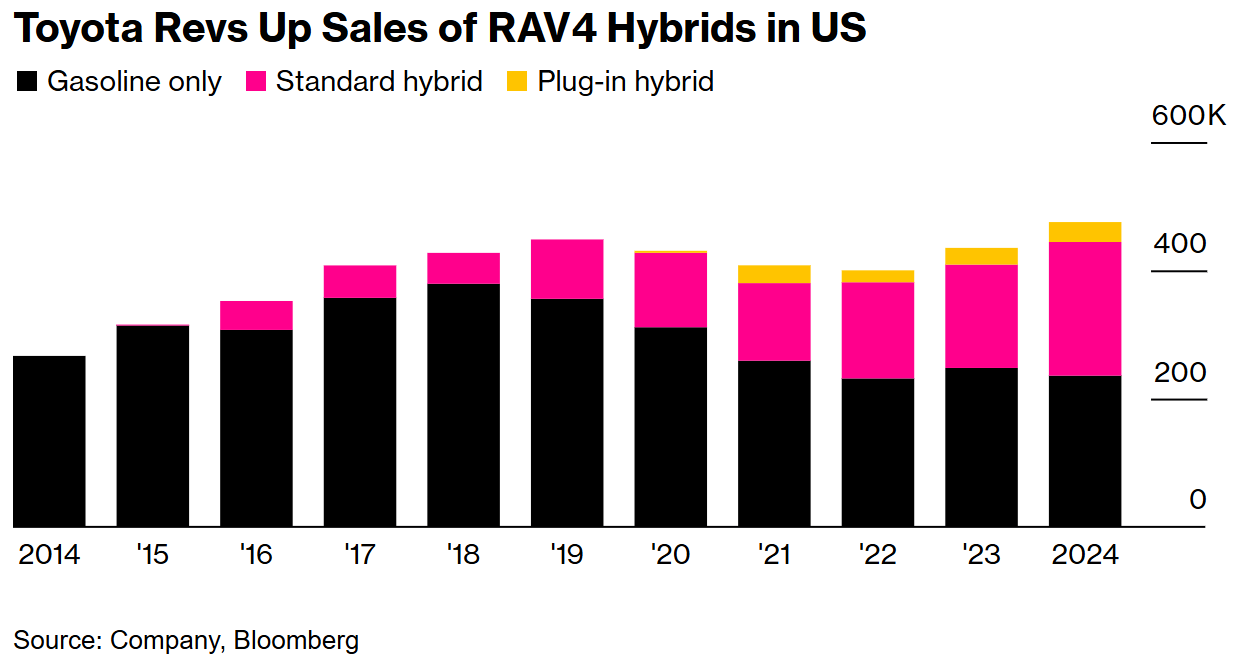
Group 1 - Toyota has announced the discontinuation of the gasoline version of its best-selling RAV4 in the U.S. market, with the new generation only offering hybrid and plug-in hybrid versions, marking a significant step in its electrification strategy [1][4] - The current RAV4 hybrid model is a top seller among dealers, with a starting price of $32,300, only $3,000 more than the gasoline version, indicating strong consumer demand for hybrid vehicles [1] - In Q1 of this year, the sales share of electrified models from Toyota and Lexus in the U.S. reached 53%, a significant increase from 37% in the same period last year, highlighting the growing demand for hybrid vehicles [1] Group 2 - The new RAV4 will be the first model to feature the Arene operating system developed by Woven by Toyota, integrating advanced driver assistance and smart cockpit functions [4] - The RAV4's electrification will directly impact competitors like Honda CR-V and Nissan Rogue, which rely on overseas production, as Toyota maintains a diversified production strategy [4] - Despite the shift towards electrification, Toyota will continue to utilize its current 2.5L engine platform in other models, indicating a balanced approach to technology [4] Group 3 - Analysts view Toyota's strategic adjustment as a response to the surge in hybrid demand and a proactive measure against trade policy uncertainties, providing a new model for industry transformation [5] - Currently, 80% of Toyota's models available in the U.S. offer electric options, and the addition of a third pure electric vehicle model next year aims to address previous criticisms regarding its pace of electrification [5]


丰田支持日产,市场竞争的“三国杀”越来越有看头了?
Zhong Guo Qi Che Bao Wang· 2025-05-20 03:33
Core Insights - Nissan, previously in talks with Honda, has attracted interest from Toyota for potential collaboration after negotiations with Honda stalled [2][3] - Toyota's approach aims to support Nissan by providing technological advancements in electrification and smart systems, while integrating Nissan into its global supply chain [6][8] Group 1: Toyota's Proposal - A Toyota executive reached out to Nissan, offering assistance, although the outcome remains uncertain as both companies have not publicly commented on the matter [3] - Toyota has a history of investing in other Japanese automakers and forming loose alliances, holding stakes in Subaru, Mazda, Suzuki, and Isuzu, as well as a majority stake in Hino Motors [3] Group 2: Nissan's Challenges - Following the breakdown of talks with Honda, Nissan is under pressure to find new partnerships and has recently appointed a new CEO, Ivan Espinosa [5] - Nissan announced plans to cut 20,000 jobs and close 7 out of 17 factories globally, aiming to collaborate with Mitsubishi and Renault for new product development [5] Group 3: Market Dynamics - The failed merger discussions between Nissan and Honda were primarily hindered by disagreements over management control and shareholding structures [4] - Despite the collapse of the merger, Nissan, Honda, and Mitsubishi continue to collaborate in key areas such as electric vehicle technology and supply chain management [7] Group 4: Industry Evolution - The potential collaboration between Toyota and Nissan signifies a shift in the Japanese automotive industry towards more integrated partnerships, focusing on technology sharing and supply chain cooperation [8] - The evolving landscape suggests that Japanese automakers must unite to navigate challenges in electrification and smart technology, enhancing their global competitiveness [8]