Atlas 960

Search documents
国产AI芯片:推理赛道起飞,谁能再破寒武纪神话?
Nan Fang Du Shi Bao· 2026-01-07 23:14
Core Insights - The domestic AI chip industry is experiencing a significant transformation in 2025, driven by the launch of DeepSeek, which has accelerated the demand for AI computing power and domestic alternatives [2][3] - Major domestic companies like Cambrian, Moore Threads, and Muxi are making headlines with their stock performances and upcoming IPOs, indicating a capital market boom for domestic AI chips [2][5] - The market is witnessing a shift in focus from training to inference, with a projected market size for AI inference chips in China expected to grow from 162.6 billion yuan in 2024 to 310.6 billion yuan in 2025 [3][4] Trend 1: Domestic AI Chip Opportunities - The launch of DeepSeek has ignited enthusiasm for domestic AI chips, particularly in the inference sector, as companies like Huawei and Cambrian quickly adapt to support this new model [2][3] - The inference chip market is expected to see explosive growth, with significant contributions from companies focusing on inference applications, such as Huawei, Cambrian, and Muxi [3][4] Trend 2: IPO Surge of Domestic AI Chip Manufacturers - 2025 marks a pivotal year for domestic AI chip manufacturers, with several companies successfully listing on the stock market, including Moore Threads and Muxi, which saw substantial initial stock price increases [5][6] - Despite the IPO successes, the market share of domestic chip manufacturers remains low, with major players like Nvidia and AMD dominating the market [6][7] Trend 3: Nvidia's Market Dynamics - Nvidia has faced challenges in the Chinese market, including export restrictions and security concerns, which have opened opportunities for domestic chip manufacturers [9][10] - The approval of Nvidia's H200 chip for sale in China could impact the domestic market, as it offers competitive performance, although concerns about dependency on foreign technology persist [10][11] Trend 4: Advanced Process Limitations - Domestic AI chip manufacturers are constrained by limitations in advanced process technologies, with most using 7nm or 14nm processes compared to Nvidia's 4nm technology [12][13] - Companies are exploring alternative solutions, such as switching to domestic supply chains and developing "super nodes" to enhance performance despite process limitations [13][14] Outlook: Future Opportunities for Domestic AI Chips - The domestic AI chip market is expected to exceed 300 billion yuan by 2026, driven by the rapid development of intelligent computing centers and increasing AI demands from internet companies [15][16] - The industry is anticipated to split into two main directions: self-developed ASICs by CSPs and local suppliers, with a focus on lower-spec AI inference chips presenting significant growth opportunities [16]



华为徐直军,罕见公开华为AI算力版图,新超节点已超越英伟达
2 1 Shi Ji Jing Ji Bao Dao· 2025-09-18 10:48
Core Insights - Huawei's Vice Chairman Xu Zhijun unveiled the company's AI computing power roadmap at the HC 2025 conference, detailing the evolution of the Ascend chip series over the next three years, with a focus on doubling computing power annually [3][4] Group 1: AI Computing Power Development - The Ascend 950 series will launch in Q1 2026, followed by the Ascend 960 in 2027 and the Ascend 970 in 2028, with significant advancements in low-precision data formats, vector computing power, interconnect bandwidth, and self-developed HBM [3][4] - The Atlas 950 and Atlas 960 supernode products were introduced, with the Atlas 950 featuring 8192 cards and an FP8 computing power of 8E FLOPS, set to launch in Q4 2026, significantly surpassing NVIDIA's concurrent offerings [3][4] Group 2: Expansion into General Computing - Huawei is extending its supernode concept to general computing with the TaiShan 950 supernode, which aims to outperform traditional databases and high-end servers by achieving a 2.9x performance boost without requiring database modifications [4] - The self-developed "UnifiedBus" interconnect protocol will be open-sourced from version 2.0, promoting a truly open supernode ecosystem [4] Group 3: Market Reaction and Collaborations - Following the announcements, Huawei's computing power concept stocks surged, with companies like Fenghuo Communication hitting the daily limit, and others like Xingtuxinke and Xinghuan Technology seeing significant gains [6][9] - Companies in the Huawei ecosystem, such as Fenghuo Communication and Xingtuxinke, are actively collaborating with Huawei on various AI solutions and have received certifications for their compatibility with Huawei's Ascend platform [9] Group 4: Industry Outlook - Analysts from Zhongyin Securities noted a rising industry sentiment, with domestic computing power expected to see significant growth, driven by high utilization rates in wafer manufacturing and semiconductor equipment orders [10]

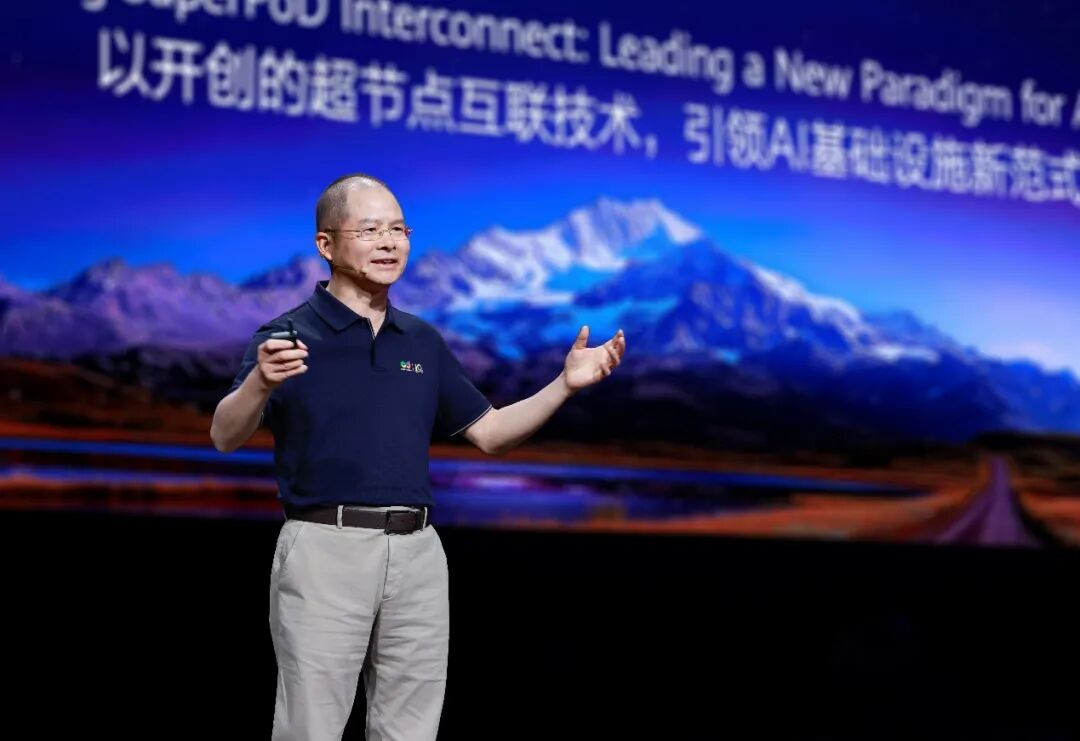
华为徐直军,罕见公开华为AI算力版图,新超节点已超越英伟达
21世纪经济报道· 2025-09-18 10:12
Core Viewpoint - Huawei unveiled its AI computing roadmap at the HC 2025 conference, emphasizing a commitment to doubling computing power annually through the development of its Ascend chip series and a comprehensive AI infrastructure strategy [3][4]. Group 1: AI Computing Strategy - Huawei's Vice Chairman Xu Zhijun detailed the three-year iteration plan for the Ascend chips, with the Ascend 950 series launching in Q1 2026, followed by the Ascend 960 in 2027, and the Ascend 970 in 2028, aiming for a doubling of computing power each year [3]. - The Atlas 950 and Atlas 960 supernode products were introduced, with the Atlas 950 featuring 8192 cards and achieving FP8 computing power of 8E FLOPS, and the Atlas 960 set to support 15488 cards, further enhancing performance [3][4]. Group 2: Infrastructure and Ecosystem - Huawei's TaiShan 950 supernode, based on the new Kunpeng 950 processor, aims to outperform traditional databases and high-end servers with a 2.9x performance improvement without requiring database modifications [4]. - The self-developed "UnifiedBus" interconnect protocol facilitates high-reliability computing collaboration across large-scale systems and will be open-sourced from version 2.0 to foster an open supernode ecosystem [4]. Group 3: Market Reaction and Collaborations - Following the announcements, Huawei's computing concept stocks surged, with Fenghuo Communication hitting the daily limit, and other companies like Xingtuxinke and Xinghuan Technology also seeing significant gains [5][6]. - Companies such as Fenghuo Communication and Xingtuxinke are actively collaborating with Huawei's Ascend ecosystem, enhancing their capabilities in AI and computing solutions [6][7]. Group 4: Industry Outlook - Analysts from Zhongyin Securities noted that Huawei's dual breakthroughs in computing and software are paving the way for a new era in domestic AI, with significant growth potential in the domestic computing chain [7]. - The semiconductor sector is experiencing increased utilization rates and strong orders, indicating a favorable environment for domestic computing chip growth driven by AI demand [7].