B10 SUV

Search documents
零跑:“领跑” 势头遇阻,如何血路突围?
3 6 Ke· 2025-11-19 00:19
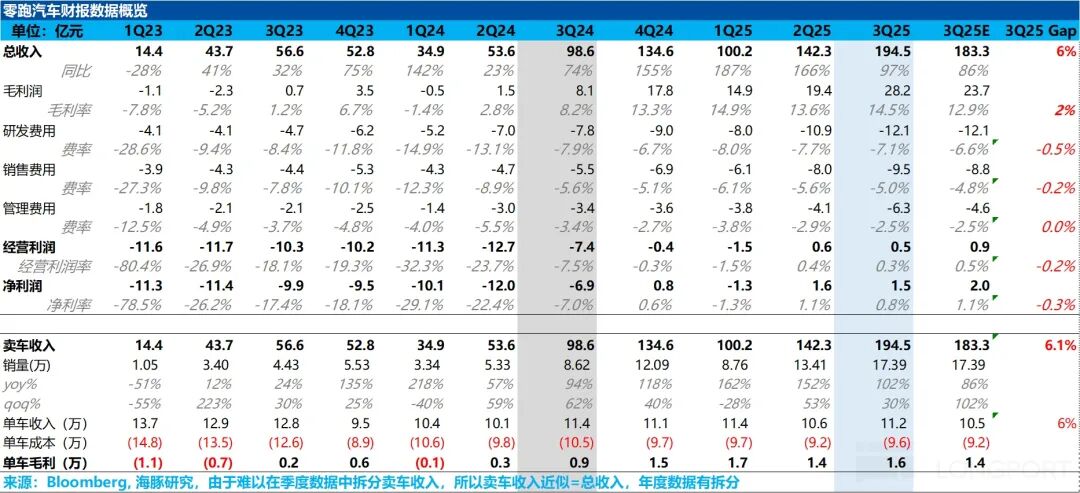
Core Viewpoint - Leap Motor's Q3 2025 financial report shows mixed results, with revenue exceeding expectations but net profit declining due to increased expenses [1][4]. Revenue Performance - Total revenue for Q3 reached 19.45 billion, significantly surpassing market expectations of 18.33 billion, primarily due to the recognition of 2.5 billion in carbon credit income and a rebound in vehicle selling prices [1][4]. - The average selling price of vehicles increased to 112,000, up by 6,000 from the previous quarter, contrary to market expectations of a decline [1][4]. Profitability Metrics - The vehicle gross margin rose by 0.9 percentage points to 14.5%, exceeding the market expectation of 12.9%, driven by higher selling prices, carbon credit income, and economies of scale [1][4]. - Despite the positive gross margin, net profit fell to 150 million, below the market expectation of 200 million, due to increased operating expenses [2][4]. Expense Analysis - R&D expenses increased to 1.2 billion, reflecting ongoing investments in smart technology and channel expansion [1][2]. - Selling expenses rose to 950 million, exceeding market expectations, as the company expanded its retail channels and increased marketing efforts [2][4]. Future Outlook - For Q4 and 2026, the company aims for a gross margin of 14%-15% and a net profit of 500-1,000 million for the full year 2025, with projected sales of 580,000 to 650,000 vehicles [5][6]. - The company is implementing promotional strategies to boost sales, including cash subsidies on various models, and anticipates Q4 sales to reach 218,000 vehicles, a 25% increase from the previous quarter [6][4]. Competitive Positioning - Leap Motor's strategy focuses on high vertical integration and self-sourcing, aiming to enhance cost advantages and offer high-value models to price-sensitive consumers [9]. - The partnership with Stellantis is expected to strengthen Leap Motor's overseas expansion, leveraging Stellantis's brand and distribution channels in Europe [9].

靠平价车“小赚”3000万,零跑汽车下一关要卖够百万辆|钛度车库
Tai Mei Ti A P P· 2025-08-19 13:18
Core Insights - Leap Motor has reported a strong half-year performance for 2025, achieving revenue of 24.25 billion yuan and a net profit of 33 million yuan, becoming the second new force in China's automotive industry to achieve profitability after Li Auto [2] - The company's profitability is based on a strategy of offering affordable models with an average price of around 100,000 yuan, challenging the notion that new energy vehicle companies must focus on high-end models to be profitable [2][3] - Despite its success, Leap Motor faces challenges in maintaining its profitability, improving gross margins, and increasing R&D investment while aiming for ambitious sales targets [2][6] Revenue and Sales Performance - Leap Motor's sales strategy focuses on high cost-performance vehicles, with models like the B01 sedan and B10 SUV achieving rapid sales growth, including over 22,170 vehicles delivered in the first half of the year, a 155.7% increase year-on-year [3][4] - The company has set an aggressive sales target for 2025, increasing its guidance from 500,000-600,000 units to 580,000-650,000 units, with a long-term goal of reaching one million units sold by 2026 [6][7] Strategic Partnerships and Global Expansion - Strategic partnerships, such as the collaboration with Stellantis, have been crucial for Leap Motor, generating 1.5 billion yuan in carbon credit trading income and facilitating overseas sales through shared channels [4][10] - Leap Motor has begun to establish a presence in international markets, exporting 20,375 vehicles in the first half of 2025 and achieving over 1% market share in Germany's BEV market [10][11] Challenges and Future Outlook - The company faces challenges in gross margin improvement, with a gross margin of approximately 12% in the first half of 2025, which is lower than competitors like Tesla and Li Auto [4][5] - Leap Motor's R&D spending of 1.89 billion yuan in the first half of 2025 is still lower than that of competitors, raising concerns about potential technological gaps in the future [5][6] - The company is also navigating the complexities of balancing short-term sales growth with long-term brand building, particularly in the competitive European market [11]