Blackwell GB200

Search documents
哈佛老徐:2026年是AI格局重排之年,英伟达很快会反超谷歌
老徐抓AI趋势· 2025-12-28 08:45
Core Viewpoint - The article discusses the evolving landscape of AI and computing power, emphasizing that while Google's TPU has gained temporary advantages, NVIDIA's upcoming Blackwell architecture is expected to reclaim dominance in the AI model training space by 2026 [4][6][7]. Group 1: Google's TPU and NVIDIA's Blackwell - Google's TPU has recently outperformed competitors with its Gemini 3 model, leading to speculation about the end of NVIDIA's dominance [6]. - Gavin Baker argues that the advantages of Google's TPU are temporary, as NVIDIA's Blackwell architecture has not yet been fully deployed [6]. - The transition from NVIDIA's H200 to Blackwell represents a significant leap in performance, necessitating extensive infrastructure changes [6][7]. Group 2: Predictions for 2026 - The first quarter of 2026 is predicted to be a turning point in the AI landscape, with the potential emergence of leading models utilizing Blackwell technology [7][8]. - Key indicators to watch for include the performance of Grok5, advancements from OpenAI and Anthropic, and the widening gap between companies that adopt Blackwell technology and those that do not [8][10]. Group 3: AI Monetization - Contrary to the belief that AI is a high-cost, low-return investment, the first non-tech Fortune 500 company has begun to see quantifiable benefits from AI implementation [11][12]. - The case of CH Robinson illustrates how AI can enhance revenue by automating processes rather than merely reducing costs, shifting the focus from cost-cutting to revenue generation [12][16]. Group 4: Future of Computing Infrastructure - The article posits that future computing power centers should be established in space rather than on Earth, due to advantages in energy efficiency, cooling costs, and transmission speeds [18][19][21]. - Space-based computing centers can leverage constant solar energy, reduce cooling costs, and utilize faster transmission methods, making them a more optimal solution for future AI needs [19][21][23]. Group 5: Strategic Implications - Companies like Tesla, SpaceX, and xAI are positioned to create a synergistic ecosystem that enhances their competitive advantages in AI and computing [27]. - The article suggests that the next two decades will be defined by AI and computing advancements, with significant opportunities for those who can recognize and act on emerging trends [28][30].




AI的庞氏骗局?
是说芯语· 2025-11-22 01:14
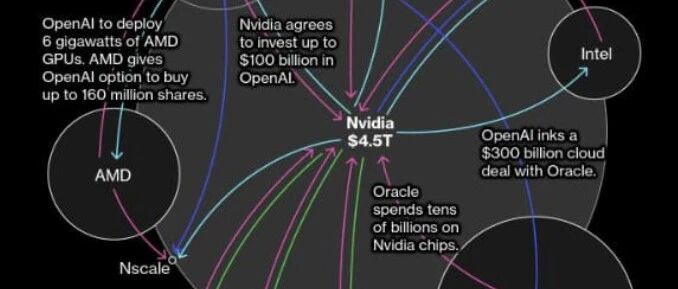
Core Insights - The article presents a bearish narrative on Nvidia, suggesting it exhibits signs of a Ponzi scheme due to alarming financial metrics and operational anomalies [3][4][5][10]. Receivables Anomaly - Nvidia's accounts receivable surged by 89% to $33.4 billion, with Days Sales Outstanding (DSO) increasing from 46 to 53 days, indicating potential collection issues [3][4]. Inventory Paradox - Inventory rose by 32% to $19.8 billion within three months, contradicting claims of high demand and sold-out capacity, which historically precedes financial collapses [4][5]. Cash Flow Signal - Nvidia's free cash flow conversion rate is only 75%, with a $4.8 billion gap between reported profits and actual cash flow, significantly lower than peers like TSMC and AMD [4][5]. Circular Financing Structure - The article details a complex flow of funds among Nvidia, Microsoft, OpenAI, and others, suggesting a closed-loop system that inflates revenue figures [5][10]. "Vibe Revenue" Admission - AI executives reportedly acknowledge that current AI revenues are largely based on hype rather than actual product sales, with OpenAI's projected 2025 revenue of $3.7 billion against expenses of $9.3 billion highlighting this discrepancy [7][10]. Historical Precedent - The article draws parallels between the current AI bubble and past financial frauds, emphasizing the rapid construction and scale of the current situation [8][10]. Margin Compression Evidence - Despite Nvidia's reported gross margin of over 70%, the article claims that true margins are declining due to various factors, including increased competition and product delays [8][10]. Smart Money Exit - Notable investors, including Peter Thiel and SoftBank's Masayoshi Son, have recently sold significant Nvidia shares, indicating a lack of confidence in the stock [8][10]. Contagion Mechanism - The potential for a broader market impact is discussed, with AI startups using approximately $26.8 billion in Bitcoin as collateral, which could trigger a market downturn if Nvidia's stock falls significantly [9][10]. Regulatory Response - The article anticipates regulatory scrutiny from the SEC and Federal Reserve regarding circular financing and related transactions, potentially leading to significant penalties [9][10]. Conclusion - The author concludes that this situation represents a significant financial risk, predicting a market correction in early 2026, urging investors to divest from AI-related assets [10].