CTA(商品交易顾问)

Search documents
“我们正在目睹一场AI创造性破坏席卷全球各行各业”!高盛合伙人:本质上,这是一次“护城河检查”
Hua Er Jie Jian Wen· 2026-02-14 03:24
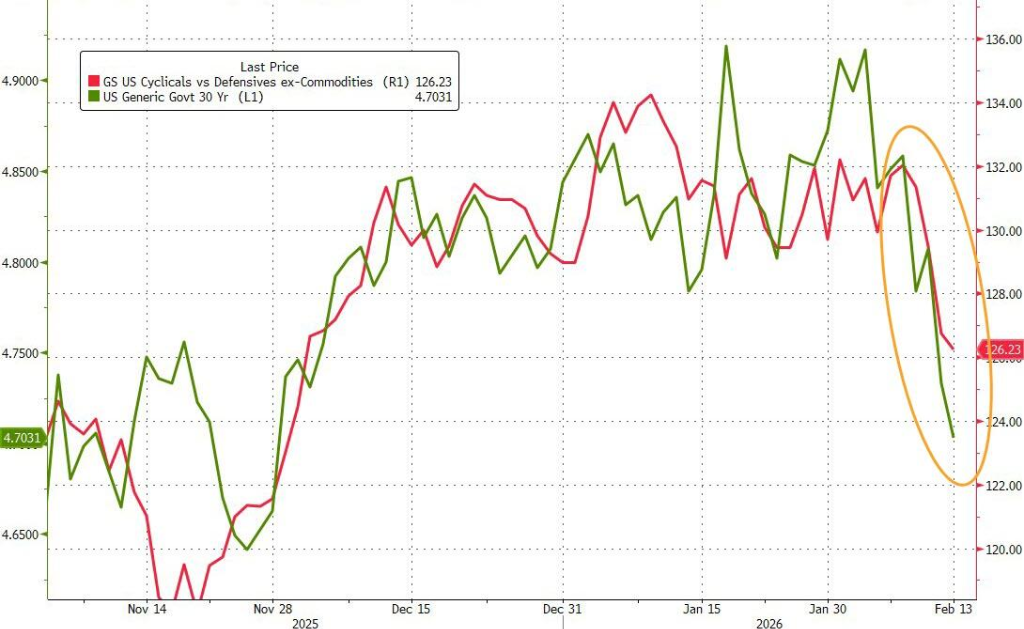
Core Insights - A wave of "creative destruction" driven by artificial intelligence (AI) is testing the competitive advantages of companies across various industries, with significant impacts observed in sectors such as software, insurance, wealth management, real estate services, and logistics [1][2][4][5] Group 1: Market Dynamics - The sentiment of "sell first, ask questions later" is spreading in the market, leading to accelerated sell-offs, primarily driven by AI concerns without clear catalysts [2] - Goldman Sachs estimates that Commodity Trading Advisors (CTAs) will sell between $1.5 billion to $2 billion worth of U.S. stocks in the coming week [2][14] - The software sector is experiencing valuation pressure, as AI is challenging traditional business models and undermining previously established competitive moats [3][5] Group 2: Valuation Concerns - Valuation multiples are difficult to anchor, and once they are questioned, it is hard to stop the downward trend; public company valuations have dropped from over 30 times earnings to just above 20 times [6] - The turmoil is spreading from public markets to private equity and private credit, particularly affecting the leveraged loan market [6] Group 3: Economic Signals - Recent market signals indicate a growth shock, with U.S. Treasury yields declining and cyclical stocks being sold off relative to defensive stocks [7][9] - The U.S. Consumer Price Index (CPI) for January showed a year-over-year increase of 2.4%, lower than expected, with core CPI at its lowest level in four years, reducing inflation concerns [9] Group 4: Investment Recommendations - Investors are advised to focus on companies with genuine competitive moats and tangible assets, as these are likely to perform better in the current environment [11][12] - The aerospace sector is seen as a favorable investment opportunity, particularly in companies like Airbus, while industrial stocks should be selected based on their benefit from the investment cycle [12] - Real estate investment trusts (REITs) in European residential properties are favored, while office REITs are advised against due to potential risks [12] Group 5: CTA Trigger Points - There is a need to monitor the CTA trigger points in major U.S. indices, with the Nasdaq 100 expected to experience the most severe sell-off [13][14] - The S&P 500 has fallen below its 50-day moving average and is approaching critical thresholds that could accelerate selling pressure [14]


高盛流动性专家:美股系统性需求已枯竭,预计9月将“充满挑战”
华尔街见闻· 2025-09-02 10:29
Core Viewpoint - Goldman Sachs warns that as September, historically the worst-performing month for U.S. stocks, approaches, a key support for the market—systematic demand—has nearly dried up, indicating that the market will face significant challenges this month [1][2]. Group 1: Seasonal Trends and CTA Impact - September has been recognized as a month of "seasonal panic," with the S&P 500 historically showing an average return of -1.17% since 1928, and the latter half of the month being particularly poor with an average return of -1.38% [2][3]. - The buying power of CTA funds, which have been significant drivers of market gains in recent months, has been exhausted, with their U.S. stock positions reaching a full 100% [3][4]. - CTA funds' purchasing power has dropped sharply from $27.66 billion in July to $12.56 billion in August, with expectations of only $2.96 billion in purchases for the entire month of September [3][5]. Group 2: Downside Risks and Institutional Positioning - If the market enters a downward trend, CTA funds may be forced to liquidate positions, potentially selling $22.25 billion in global stocks within a week, including $4.84 billion in U.S. stocks [4]. - In a more severe downturn, CTA models could lead to a massive sell-off of up to $217.92 billion in global stocks, with $73.69 billion attributed to U.S. stocks [5][6]. - Institutional investors have been net sellers of U.S. stocks for two consecutive months, reflecting a cautious stance as September approaches [7][10]. Group 3: Market Dynamics and Fund Flows - Despite recent market rebounds, Goldman Sachs' sentiment indicators remain negative, suggesting that overall positioning is still relatively balanced, with most investors having room to increase their positions [8][12]. - Hedge funds have shown a significant shift towards emerging markets, particularly Chinese assets, with net inflows into these markets exceeding historical averages [14][15]. - Retail investors remain active in individual stock trading but continue to funnel funds into passive investment vehicles like ETFs, leading to a divergence between active and passive fund flows [16][17]. Group 4: Market Stabilizers and Volatility - The internal structure of the market provides stabilizing forces, with dealers in a record long gamma position, which helps absorb market volatility by buying during downturns and selling during upswings [19]. - The low correlation among stocks indicates a highly differentiated market, moving away from a "Beta market" to an "Alpha market" where selective stock picking is essential for profitability [19]. - Implied volatility for the S&P 500 is at a near-year low, making options pricing extremely attractive for hedging against potential market movements [19].