企业护城河

Search documents
“我们正在目睹一场AI创造性破坏席卷全球各行各业”!高盛合伙人:本质上,这是一次“护城河检查”
硬AI· 2026-02-14 11:37
Core Viewpoint - The market is experiencing a "sell first, ask questions later" panic, fundamentally testing the economic moats of companies, with a focus on those with real competitive advantages, tangible assets, and industrial stocks. The aerospace sector is viewed positively, while caution is advised regarding bank stocks [2][3][15]. Group 1: Market Sentiment and AI Impact - A "creative destruction" driven by AI is sweeping across various industries, fundamentally testing the competitive advantages of companies [3][6]. - The initial perception of AI as a positive market factor has shifted to a rapid assessment of which companies can withstand technological disruptions [3][6]. - The sentiment of "sell first, ask questions later" is spreading, with accelerated selling but no clear catalysts beyond AI concerns [3][6]. Group 2: Valuation and Market Dynamics - Valuation multiples are difficult to anchor; once questioned, they tend to decline, with public company valuations dropping from over 30 times earnings to just above 20 times [8]. - The turmoil is spreading from public markets to private equity and private credit, particularly affecting the leveraged loan market [8]. Group 3: Investment Recommendations - Companies with genuine economic moats and tangible assets should be prioritized for investment, with a particular focus on the aerospace sector and industrial stocks benefiting from the investment cycle [15]. - Real estate investment trusts (REITs) in Europe, particularly German residential properties, are seen as favorable, while office REITs are to be avoided [15]. - Bank stocks are viewed as vulnerable due to multiple risks, including crowded positions in Europe, unaccounted AI disruption, and regulatory risks from potential political shifts in the U.S. [16]. Group 4: CTA Selling Signals - There is a need to be cautious of CTA (Commodity Trading Advisor) selling signals in major U.S. indices, with an estimated $1.5 to $2 billion in U.S. stock sales expected in the coming week [4][18]. - The S&P 500 has fallen below key moving averages, and a breach of the mid-term threshold of 6723 points could accelerate selling [18]. Group 5: Future Market Outlook - The current environment favors companies with real economic moats and tangible value, as AI continues to lower barriers to entry, leading to a market of clear winners and losers [21]. - Emerging markets are perceived as relatively clearer safe havens, with global trading dynamics expected to drive superior performance [21].



“我们正在目睹一场AI创造性破坏席卷全球各行各业”!高盛合伙人:本质上,这是一次“护城河检查”
Hua Er Jie Jian Wen· 2026-02-14 03:24
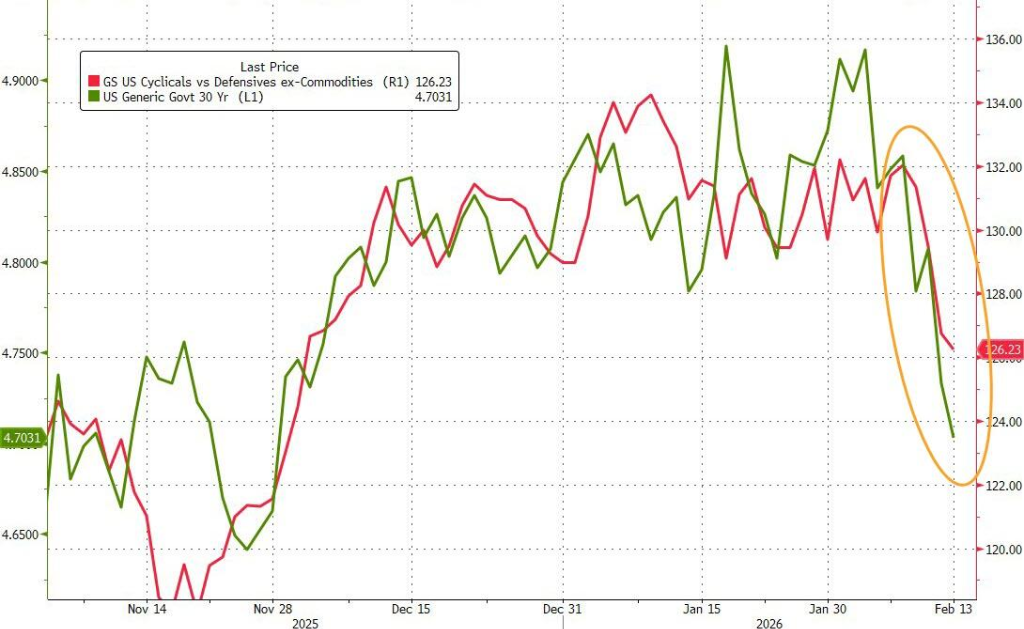
Core Insights - A wave of "creative destruction" driven by artificial intelligence (AI) is testing the competitive advantages of companies across various industries, with significant impacts observed in sectors such as software, insurance, wealth management, real estate services, and logistics [1][2][4][5] Group 1: Market Dynamics - The sentiment of "sell first, ask questions later" is spreading in the market, leading to accelerated sell-offs, primarily driven by AI concerns without clear catalysts [2] - Goldman Sachs estimates that Commodity Trading Advisors (CTAs) will sell between $1.5 billion to $2 billion worth of U.S. stocks in the coming week [2][14] - The software sector is experiencing valuation pressure, as AI is challenging traditional business models and undermining previously established competitive moats [3][5] Group 2: Valuation Concerns - Valuation multiples are difficult to anchor, and once they are questioned, it is hard to stop the downward trend; public company valuations have dropped from over 30 times earnings to just above 20 times [6] - The turmoil is spreading from public markets to private equity and private credit, particularly affecting the leveraged loan market [6] Group 3: Economic Signals - Recent market signals indicate a growth shock, with U.S. Treasury yields declining and cyclical stocks being sold off relative to defensive stocks [7][9] - The U.S. Consumer Price Index (CPI) for January showed a year-over-year increase of 2.4%, lower than expected, with core CPI at its lowest level in four years, reducing inflation concerns [9] Group 4: Investment Recommendations - Investors are advised to focus on companies with genuine competitive moats and tangible assets, as these are likely to perform better in the current environment [11][12] - The aerospace sector is seen as a favorable investment opportunity, particularly in companies like Airbus, while industrial stocks should be selected based on their benefit from the investment cycle [12] - Real estate investment trusts (REITs) in European residential properties are favored, while office REITs are advised against due to potential risks [12] Group 5: CTA Trigger Points - There is a need to monitor the CTA trigger points in major U.S. indices, with the Nasdaq 100 expected to experience the most severe sell-off [13][14] - The S&P 500 has fallen below its 50-day moving average and is approaching critical thresholds that could accelerate selling pressure [14]
什么是企业护城河,常见的企业护城河有哪些呢?|投资小知识
银行螺丝钉· 2026-01-25 13:42
Core Insights - The article discusses various types of competitive advantages, referred to as "moats," that companies can possess to maintain their market position and profitability [3][9][13]. Group 1: Types of Competitive Advantages - **Scale Advantage**: Companies like BlackRock, Vanguard, and State Street dominate the index fund market, collectively holding over 80% of the global market share. Larger funds can lower management fees, attracting more investors and creating a positive feedback loop [3]. - **Network Effect**: Industries such as stock exchanges and e-commerce benefit from network effects, where the value of the network increases with the number of users. For instance, the Hong Kong Stock Exchange has a significant market share, making it difficult for new entrants to compete [6][7]. - **Brand Advantage**: In sectors like consumer goods and pharmaceuticals, brand recognition plays a crucial role. Consumers often remember only a few brands, such as Moutai in liquor or Yili in dairy products, which illustrates the power of brand loyalty [9]. - **Switching Costs**: Companies that create ecosystems, like Apple with its product matrix, increase switching costs for users. Once consumers are accustomed to a particular ecosystem, it becomes challenging to switch to competitors [10][12]. - **Resource Advantage**: Industries such as mining and energy benefit from unique resources that are difficult to replicate. Companies with low extraction costs can maintain profitability and market dominance [13]. Group 2: Financial Characteristics of Companies with Moats - Companies with established moats typically exhibit strong financial metrics, indicating their ability to sustain profits over time [13].

Benchmark 新合伙人 Everett Randle: 忘掉 SaaS 逻辑与毛利率,AI 时代估值看单客价值
海外独角兽· 2025-12-31 12:05
Core Insights - The article discusses the confusion in evaluating AI companies using traditional SaaS metrics, highlighting that while AI companies show high value density, they often appear unattractive when assessed through familiar SaaS models due to lower gross margins and complex cost structures [1][2] - It emphasizes the need to abandon the obsession with SaaS gross margins and suggests that high usage of real products in the AI era will outperform "unreleased" luxury financing projects [2] - The article argues that the true moat for companies remains in technology rather than distribution or capital, and that rational analyses often mask a lack of intuition among decision-makers [2] Group 1 - AI companies demonstrate significant value density, with users willing to pay more than for traditional software, yet they often show lower gross margins and complex cost structures when analyzed through SaaS models [1] - The venture capital industry has relied on a set of validated standards over the past decade, such as gross margins and predictable growth curves, which may not adequately explain value creation in the AI context [1][2] - A new perspective is emerging that challenges the traditional metrics used to evaluate companies, particularly in the AI sector, where the focus should shift to absolute gross profit per customer rather than gross margins [22][23] Group 2 - The article highlights the importance of understanding the absolute gross profit dollars per customer in AI applications, which can be significantly higher than traditional SaaS companies despite lower gross margins [23][24] - It provides an example comparing a traditional SaaS company with a 75% gross margin contributing $200,000 in gross profit per customer to an AI company with a 50% gross margin contributing $500,000, illustrating the potential for greater economic value [23] - The discussion includes the notion that the AI coding market is rapidly expanding, with projections of significant net new ARR growth, indicating that AI applications are creating new opportunities that traditional SaaS metrics may not capture [21][22] Group 3 - The article asserts that the moat for AI companies remains in technology, as building excellent AI products is complex and requires deep integration into workflows, which is different from traditional SaaS products [27][28] - It warns that rapid growth can be unsustainable if companies do not establish sufficient value to retain customers, citing Jasper as an example of a company that struggled to maintain its growth trajectory [27] - The article emphasizes that the ability to create differentiated AI products is crucial, as the competitive landscape is evolving rapidly with new benchmarks set by labs like OpenAI [27][28] Group 4 - The article discusses the evolving landscape of venture capital, noting that firms like Benchmark focus on deep engagement with founders rather than merely chasing large funding rounds, which allows them to maintain relevance in the AI space [30][32] - It highlights the importance of being a meaningful partner to founders throughout their journey, rather than solely focusing on ownership percentages [32][33] - The article concludes that while the VC industry is shifting towards faster capital deployment, firms like Benchmark continue to prioritize high-touch, craft-oriented investment strategies [45][46]

解码4万亿市值密码:企业“护城河”才是资本疯抢的硬通货
Sou Hu Cai Jing· 2025-12-07 10:42
Core Insights - The article emphasizes the importance of a strong competitive moat for companies, highlighting that high profits can be fleeting without a sustainable advantage [1][6] - It discusses the differentiation between companies with deep moats, such as Moutai and Fuyao Glass, and those lacking such advantages, particularly in the consumer sector [1][3] Group 1: Competitive Moats - Apple has established a user retention barrier through its ecosystem, with iPhone 17 sales increasing by 14% year-on-year in the first ten days of launch [2] - Moutai maintains a gross margin above 90%, leveraging its social value and brand trust, which is difficult for new brands to replicate [1] - Fuyao Glass has a global market share exceeding 30% for five consecutive years, showcasing its strong competitive position in the automotive glass market [1][3] Group 2: Innovation and R&D - Continuous innovation is crucial for maintaining a competitive edge, as demonstrated by Andisu's 22-fold increase in net profit due to a robust patent portfolio [2] - WuXi AppTec's annual R&D investment exceeding 10 billion yuan supports its competitive moat through a cycle of research, patents, and profits [2] - Companies like Apple and Fuyao are investing heavily in R&D to enhance their competitive positions, with Apple allocating hundreds of billions annually for AI and hardware innovation [5] Group 3: Scale and Cost Advantages - Fuyao Glass exemplifies scale advantages, with logistics costs 12% lower than smaller competitors and a production line automation rate exceeding 90% [3] - The company's purchasing power allows it to negotiate lower prices for raw materials, significantly enhancing its cost structure compared to smaller firms [3] - The article highlights that for manufacturing firms, scale should be defined by the ability to eliminate competition rather than just capacity [3] Group 4: Switching Costs and Network Effects - High switching costs in B2B sectors, such as design software and ERP systems, create significant barriers for customers to change providers [4] - The network effect is illustrated by WeChat's 1.3 billion users, making it difficult for new social platforms to attract users away from established networks [4] - Companies that create ecosystems with integrated services, like Tencent, are building strong competitive moats through user engagement and functionality [4] Group 5: Market Trends and Investment Focus - The article notes a shift in capital market focus from seeking bargains to identifying companies with deep competitive moats, with over 80% of favored stocks having clear advantages [6] - Companies that invest in brand development, technological innovation, and scale optimization are positioned to thrive through industry cycles [6] - The current market environment favors firms that can demonstrate resilience and adaptability, reinforcing the importance of a strong competitive moat [6]



帮主郑重:潮汕生意口诀里,藏着中长线投资的底层逻辑
Sou Hu Cai Jing· 2025-11-16 09:45
Group 1 - The core business wisdom from Chaoshan emphasizes the importance of patience and understanding industry logic, which aligns with long-term investment strategies [1][3] - A successful business model in smaller towns involves less competition and building a loyal customer base, contrasting with the crowded markets of larger cities [3] - The investment philosophy of focusing on undervalued sectors and avoiding trends mirrors the local business approach of not chasing popular opportunities [3] Group 2 - The essence of both Chaoshan business practices and long-term investment is to remain patient, identify the right logic, and proceed steadily [3] - Observations from a 20-year career in finance highlight the difference between those who chase short-term gains and those who maintain patience for long-term success [3]

3 Top Stocks to Buy and Hold Forever
The Motley Fool· 2025-09-17 07:58
Core Insights - The article emphasizes three companies—Waste Management, Intuitive Surgical, and Marriott International—as strong candidates for long-term investment due to their competitive advantages and stable cash flows [2][3]. Waste Management - Waste Management (WM) reported second-quarter revenue of approximately $6.4 billion, reflecting a 19% year-over-year increase, driven by solid performance in core operations and contributions from a healthcare disposal acquisition [5]. - The legacy disposal business saw a revenue increase of 7.1% year over year, indicating robust growth even without acquisitions [5]. - WM's management projects full-year free cash flow between $2.8 billion and $2.9 billion, significantly up from an initial guidance of $125 million, supporting dividends and buybacks while allowing for growth investments [6]. - The company's scale, route density, and long-term contracts create a competitive moat that is difficult for new entrants to penetrate [6]. Intuitive Surgical - Intuitive Surgical reported second-quarter revenue of about $2.44 billion, a 21% year-over-year increase, driven by higher placements of da Vinci systems and increased procedure volumes [9]. - The installed base of da Vinci systems grew at a double-digit rate, and management expects procedure growth of approximately 15.5% to 17% in 2025 [9][10]. - The company has a strong balance sheet with significant cash reserves and no debt, enhancing its resilience [12]. - Intuitive Surgical's price-to-earnings ratio is around 61, indicating that much of the potential upside is already reflected in the stock price [11]. Marriott International - Marriott International's second-quarter revenue per available room (RevPAR) increased by 1.5% year over year, with international markets growing by 5.3% [13]. - Non-GAAP earnings per share rose to $2.65, up from $2.50 in the previous year, and adjusted EBITDA reached approximately $1.4 billion, a 7% increase year over year [13]. - The company repurchased about $0.7 billion of stock during the quarter and has returned approximately $2.1 billion year to date through dividends and buybacks [13]. - Marriott's asset-light model, focusing on franchising and management rather than ownership, allows for low capital needs and strong cash conversion [14].


刘润:企业想活得久、赚得多,必须懂得挖护城河
创业家· 2025-07-18 09:56
Group 1 - The core viewpoint emphasizes that product strength equals value potential, and marketing's role is to reduce cognitive friction while channels aim to lower distribution friction. Short-term supply-demand imbalances create temporary dividends, which companies cannot rely on for long-term success. Only those companies that understand how to build a competitive moat can achieve sustainable profits [1] Group 2 - The article promotes a course titled "Consumer Reconstruction Selected Course," featuring top practical mentors from the Chinese and Japanese consumer sectors, aimed at providing insights into the methodologies of consumer giants [2] - The course is priced at 12,800 yuan per person, with an early bird price of 9,800 yuan per person [3] - The event will take place in Shanghai from August 7 to August 9 [4]

识别企业护城河,避开陷阱,抓住本质!
雪球· 2025-06-15 05:24
Core Viewpoint - The article emphasizes the importance of identifying companies with deep economic moats for long-term investment success, highlighting that many investors confuse short-term advantages with long-term barriers [2][3]. Group 1: Economic Moats - The article categorizes economic moats into six types: brand premium, network effects, scale cost advantages, high user switching costs, core technology barriers, and resource exclusivity [3]. - Brand value is not just about recognition but also about consumers' willingness to pay a premium [3]. - Network effects create a positive feedback loop where the value of a platform increases with more users [3]. Group 2: Misconceptions about Moats - Common misconceptions that can lead to investment risks include: technology leadership that is easily iterated, reliance on a single blockbuster product, short-term traffic benefits, channel advantages under pressure, and over-dependence on management capabilities [3]. - These factors may provide temporary growth but lack structural barriers, making them less reliable for long-term investment [3]. Group 3: Investment Analysis - In dynamic competitive markets, the strength of an economic moat determines investment certainty [3]. - Instead of chasing superficial high-growth data, it is crucial to analyze whether a company possesses pricing power or user lock-in capabilities [3].




揭秘“股神”巴菲特的3大财富密码,普通人也能抄作业!
天天基金网· 2025-05-31 04:20
Core Viewpoint - Warren Buffett announced his decision to step down as CEO by the end of the year, marking the end of an era in the investment world [1] Group 1: Investment Philosophy - The concept of a "moat" in investing includes several categories, such as cost advantages in production and services, and demand-side advantages that are difficult for competitors to replicate [3] - The essence of a moat is an advantage that cannot be easily imitated or surpassed by competitors in the short to medium term [3] Group 2: Circle of Competence and Focus - The main challenge in executing a seemingly simple investment framework is the discrepancy between ideals and reality, particularly due to market volatility and unpredictability [4] - Understanding value investing, including concepts like margin of safety and circle of competence, is crucial for investors [4] Group 3: Time and Patience - Time and patience are fundamental yet challenging aspects of investing; even a modest annual return can lead to significant wealth accumulation over time through compounding [5] - Buffett's investment philosophy emphasizes the importance of waiting for the right opportunities, suggesting that only a limited number of investments (e.g., 20) may define an investor's success [6]