
CoWoS先进封装技术

Search documents
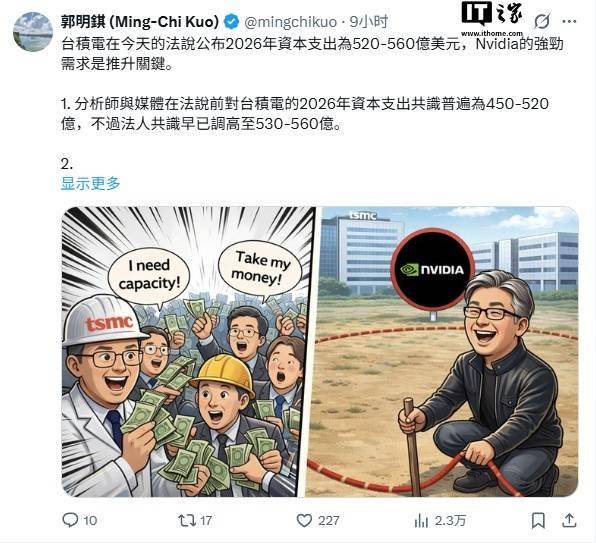
台积电产能争夺战升级:英伟达CEO黄仁勋率先开启“包地”战略
Sou Hu Cai Jing· 2026-01-15 23:28
Group 1 - TSMC's capital expenditure budget for 2026 is projected to be between $52 billion and $56 billion, which translates to approximately 363.25 billion to 391.20 billion RMB [1] - Market analysis suggests that TSMC typically adopts a conservative approach when announcing capital expenditure guidance, indicating a higher likelihood that the actual expenditure will exceed pre-meeting expectations [1] - NVIDIA's strong demand is identified as a key driver for TSMC's increased capital expenditure, with NVIDIA adopting a more aggressive strategy to secure advanced process capacity [3] Group 2 - NVIDIA's CEO Jensen Huang proposed a "land package" strategy, offering to invest in securing land adjacent to TSMC's Fab 18, which significantly influenced TSMC's capital expenditure outlook [3] - Prior to Huang's proposal, institutional investors had consensus expectations for TSMC's 2026 capital expenditure at around $45 billion to $50 billion, approximately 314.36 billion to 349.28 billion RMB [3] - TSMC is facing tight capacity in advanced processes (such as 3nm and 2nm nodes) and advanced packaging technologies, maintaining a strict review mechanism for capacity allocation [4] Group 3 - To secure sufficient capacity close to their most optimistic demand, customers are encouraged to adopt strategies similar to NVIDIA's, which involves investing more funds to lock in land and bear capacity construction costs [5] - The global semiconductor manufacturing resources are becoming increasingly tight, making it more challenging for other customers to achieve similar capacity supply as NVIDIA [5]


2026年格隆汇“全球视野”十大核心资产之台积电
Ge Long Hui A P P· 2026-01-03 08:25
Core Viewpoint - TSMC is positioned as the "invisible king" of the AI era, holding a dominant monopoly in AI chip production, capturing over 90% of the global market share in AI chip manufacturing, and is expected to experience significant growth driven by advanced process iterations and increased capacity [1][7]. Group 1: Industry Dynamics - The semiconductor industry has shifted from a vertically integrated IDM model to a collaborative model involving Fabless design, Foundry manufacturing, and OSAT testing, with TSMC emerging as a key player in this new structure [8]. - The outsourcing ratio of wafer production has increased from 9% in 2000 to over 33% in 2020, with Fabless companies accounting for 34.8% of global IC sales [12]. Group 2: Competitive Advantages - TSMC has established a dual barrier of technology and capital, creating an "unmatched" moat in the semiconductor manufacturing industry [15]. - TSMC leads in advanced process technology, with stable mass production at 3nm and the initiation of 2nm production, outpacing competitors like Samsung and Intel by at least three years [16]. - The capital-intensive nature of semiconductor manufacturing allows TSMC to invest heavily in capacity expansion, with plans to invest $49 billion in 2026 alone [18]. Group 3: AI Demand and Growth - The explosive growth of the global AI industry has made AI chips a necessity, with TSMC monopolizing over 95% of AI accelerator chip foundry services and over 80% of device-side AI chip foundry services [21]. - TSMC's advanced packaging technology, CoWoS, is crucial for AI chip performance, with expected monthly production capacity reaching 104,000 units by the end of 2026, nearly doubling from the end of 2025 [30]. Group 4: Financial Performance and Valuation - TSMC's revenue compound annual growth rate (CAGR) from 2010 to 2025 is projected at 14.8%, with a forecasted revenue growth of 30% in 2026, significantly above market consensus [24]. - The expected revenue for TSMC in 2026 is $158.08 billion, with a net profit margin of 42.5%, leading to a target market capitalization of $16.8 to $20.2 trillion [26]. Group 5: Business Structure and Strategy - TSMC's growth is supported by a multi-faceted approach, including leading advanced processes, capacity expansion, and collaboration across the entire industry chain [27]. - The customer base includes major tech giants like NVIDIA and AMD, fostering a stable and deeply integrated partnership that enhances order demand and collaborative R&D [32].

美股异动|台积电股价飙升创历史新高 投资者信心倍增
Xin Lang Cai Jing· 2025-10-01 22:48
Group 1 - TSMC (Taiwan Semiconductor Manufacturing Company) has seen a stock increase of 5.58% over two days starting October 1, reaching a historical high, indicating strong investor confidence in the company's future [1] - TSMC's 2nm process technology is gaining attention, crucial for the PC industry, with AMD planning to use it in its next-generation EPYC Venice data center CPU and Intel in its Nova Lake series, due to Intel's own 18A process not achieving ideal yield rates [1] - TSMC maintains a leading market share of 71% in the foundry industry, driven by rapid advancements in 3nm technology, high utilization rates of 4/5nm processes in AI GPU production, and the expansion of CoWoS advanced packaging technology [1] Group 2 - The potential implementation of new semiconductor tariff policies by the U.S. government may pressure semiconductor brands, but could benefit companies like TSMC that have manufacturing facilities in the U.S., providing them with negotiation leverage and potential tax benefits [2] - OpenAI's CEO Sam Altman's visit to TSMC highlights the importance of collaboration, focusing on details regarding the contract manufacturing of OpenAI's self-developed chips, indicating TSMC's significant role in future AI chip production [2] - TSMC's advantages in technological innovation, market share growth, and international collaboration suggest a promising outlook in the semiconductor industry, with investors encouraged to monitor TSMC's advancements in advanced processes and international projects for potential stock price support [2]
AI驱动台积电(TSM.US)30%增长预期,资本支出按兵不动!地缘政治风险成首要考量
智通财经网· 2025-07-18 07:02
Group 1: Core Insights - TSMC demonstrates strong performance in Q2 2025 with revenue growth of 44.4% to $30.07 billion and earnings per share of $2.47, driven by robust demand for AI chips [3] - Despite the strong performance, TSMC maintains a cautious capital expenditure plan for 2025, projected between $38 billion and $42 billion, reflecting concerns over macroeconomic uncertainties and geopolitical risks [1][2] - The company is actively addressing potential geopolitical risks by emphasizing its long-term investment plans in the U.S., including a $165 billion investment for six advanced wafer fabs and two advanced packaging plants over the next decade [2] Group 2: Market Dynamics - The demand for AI chips is expected to remain strong, with TSMC raising its revenue growth forecast for 2025 from a mid-range of 20% to approximately 30%, indicating optimism in the AI chip market [3] - TSMC's advanced process technologies, particularly in 7nm and below, are crucial for meeting the growing needs of AI applications across various sectors, including data centers and edge computing [3][4] - The company faces competition from rivals like Samsung and Intel but is well-positioned to maintain its leadership in the AI chip market due to its technological strengths and customer base [4] Group 3: Strategic Positioning - TSMC's cautious approach to capital expenditure is a rational response to current geopolitical and economic uncertainties, allowing the company to reserve space for long-term stable development [4] - The ongoing development of advanced packaging technologies, such as CoWoS, positions TSMC to meet the high-density, high-bandwidth, and low-latency requirements of AI and high-performance computing [4] - TSMC's strong performance and strategic investments are expected to support the continued growth of the semiconductor industry, particularly in the AI segment, contributing to overall market optimism [3][4]
关税和全球经济放缓影响,摩根大通下调台积电CoWoS需求
硬AI· 2025-04-17 15:09
点击 上方 硬AI 关注我们 摩根大通将其对台积电CoWoS先进封装技术在未来两年的消费预期分别下调了7%和3%,理由是来自亚马逊自研AI芯片 的需求减少,以及基于宏观经济的不确定性。摩根大通预测,受关税和全球经济放缓的影响,台积电管理层可能将2025 财年的收入增长指引从约25%下调至20%左右。 硬·AI 作者 | 董 静 此外,亚马逊Trainium芯片被外部客户采用的前景有限。摩根大通现在预期,未来两年,下一代Trainium 项目的生命周期单位仅增长5-10%,市场可能会对亚马逊的定制芯片(ASIC)项目持更为谨慎的态度。 尽管如此,摩根大通预测, 2025年台积电CoWoS的整体需求仍预计增长107%,2026年继续保持37%的 增长,这主要得益于英伟达的强劲需求、ASIC项目增加(尤其是博通和联发科)以及苹果WMCM芯片封 装业务的启动。 01 英伟达仍是CoWos最大客户 但增长预期趋于理性 报告预计,台积电的CoWoS产能将在2025年继续保持紧张,但到2026年可能会达到供需平衡。 英伟达继续是CoWoS-L需求的主要驱动力,大摩预计,该公司将获得足够的CoWoS分配,以在2025年生 产 ...