
3nm工艺

Search documents
英特尔最大晶圆厂,复活?
半导体行业观察· 2026-01-20 02:02
Group 1 - Intel's Ohio One project, initially touted as the largest wafer factory in the U.S., has faced delays and scale reductions but remains active, with recent contractor job postings indicating acceleration in progress [1] - The Ohio One facility is designed to host up to eight wafer fabs, with the first two expected to begin production by 2030-2031, significantly delayed from the original 2025 target [1] - The first wafer fab will be the 1st fab, followed by the 2nd fab expected to start production a year later, coinciding with Intel's development of its next-generation 14A process [1] Group 2 - Intel's latest Panther Lake mobile CPUs are produced in Arizona and Oregon using the new 18A process, marking a significant advancement for domestic chip manufacturing, although there are no large external customers for this process [2] - CEO Pat Gelsinger has shifted from a pessimistic view of the 18A process to a more optimistic stance recently, despite the 14A process now expected to reach mass production in 2027 [2] - The Ohio One site was initially predicted to be the birthplace of the 14A process, but this timeline has shifted, with derivative products already occupying a significant portion of Intel's lineup before the site's official opening [2] Group 3 - The U.S. government allocated $8.9 billion from the CHIPS Act to Intel in exchange for a 10% equity stake, alongside a $5 billion collaboration with NVIDIA, signaling a resurgence in Intel's competitiveness, particularly in the foundry business [3] - Intel is accelerating the construction of the Ohio One facility after years of stagnation, but the timeline for its completion remains uncertain [3] Group 4 - TSMC is facing a "happy dilemma" with its 3nm process capacity fully booked until 2027, prompting significant increases in capital expenditure plans [5] - This capacity constraint is reshaping the market dynamics, leading TSMC's top clients to consider alternatives like Samsung and Intel [5] - TSMC's capital expenditure for 2026 is projected to be between $52 billion and $56 billion, exceeding previous expectations due to the overwhelming demand for advanced nodes [5] Group 5 - The supply-demand imbalance is causing market oversupply, with major clients like Apple, NVIDIA, AMD, Broadcom, Qualcomm, and MediaTek seeking alternative capacities as TSMC's advanced process node market share is expected to drop from 95% to 90% [6] - TSMC's 3nm monthly production capacity is planned to expand to 190,000 wafers by the end of 2026, but this will still fall short of client demand [6] - TSMC is adopting a more aggressive strategy by delaying new 3nm process development and encouraging clients to shift products originally slated for 2027/2028 to the 2nm GAA process [6] Group 6 - Samsung's Taylor wafer fab is seen as a more likely alternative for clients seeking supply options compared to Intel, with Qualcomm and AMD being the most likely to consider Samsung [7] - Discussions have indicated that Apple and Broadcom are evaluating Intel, but significant work remains for Intel's 14A process to be competitive [7]


台积电三季度利润新高:多终端高成长,先进工艺涨价进行时
2 1 Shi Ji Jing Ji Bao Dao· 2025-10-17 15:23
Core Insights - TSMC's Q3 revenue reached $33.1 billion, a year-on-year increase of 40.8% and a quarter-on-quarter increase of 10.1%, driven by cost optimization and improved capacity utilization [1][2] - The company's gross margin was 59.5%, significantly exceeding the previous quarter's guidance of 55.5% to 57.5% [1] - TSMC's operating profit margin was 50.6%, surpassing the previous quarter's guidance of 45.5% to 47.5%, with a net profit margin of 45.7% [2] Market Performance - High-Performance Computing (HPC) has become a crucial revenue driver for TSMC, increasing its revenue contribution from 51% in the same period last year to 57% to 60% in recent quarters [2] - The smartphone market saw a significant revenue increase due to the seasonal demand, while the automotive chip market, which had been sluggish, has begun to recover [2][5] - TSMC's advanced process technologies, particularly 3nm and 5nm, accounted for 60% of revenue, up from 52% last year [3] Industry Trends - The semiconductor foundry industry is facing a structural price increase environment as major end markets return to normal inventory levels [3] - TSMC's CEO indicated that AI demand remains strong, with a projected CAGR exceeding 45% over the next five years [3] - The company is planning to increase prices for its 2nm advanced process technology [3] Future Outlook - TSMC's overseas factory capacity is expected to dilute gross margins by approximately 1% to 2% in the coming years, with initial estimates of 2% to 3% dilution expanding to 3% to 4% later [3] - The automotive chip market is anticipated to gradually recover by the first half of 2025, with power chips completing inventory adjustments [5][6] - The global semiconductor supply chain is temporarily moving away from the inventory correction cycle, with a potential price increase atmosphere developing in the foundry market [6][7]
台积电三季度利润新高:多终端高成长 先进工艺涨价进行时
2 1 Shi Ji Jing Ji Bao Dao· 2025-10-17 15:20
Core Viewpoint - TSMC's Q3 financial results reflect strong demand in the AI industry, with significant revenue growth driven by advanced technology processes and a recovery in the smartphone and automotive chip markets [2][4][10]. Financial Performance - TSMC reported Q3 revenue of $33.1 billion, a year-on-year increase of 40.8% and a quarter-on-quarter increase of 10.1% [3]. - The gross margin for the quarter was 59.5%, exceeding the previous guidance of 55.5% to 57.5% [3]. - Operating margin reached 50.6%, surpassing the guidance of 45.5% to 47.5% [3]. - Net income attributable to shareholders was NT$452.3 billion, reflecting a 39.1% year-on-year increase [3]. Market Segments - High-Performance Computing (HPC) has become a significant revenue driver, contributing 57% to 60% of TSMC's revenue in recent quarters, up from 51% year-on-year [3][6]. - The smartphone market saw a 19% quarter-on-quarter revenue increase due to seasonal demand, while the automotive chip market experienced an 18% increase, indicating a recovery [4][10]. - IoT business revenue also rose by 20% quarter-on-quarter [10]. Technology and Production - TSMC's advanced process technologies are in high demand, with 3nm and 5nm processes accounting for 60% of revenue, up from 52% last year [6][7]. - The CEO indicated that AI demand is expected to grow at a CAGR of over 45% in the next five years [6]. Pricing and Capacity - The wafer foundry industry is facing a structural price increase environment as major end markets return to normal inventory levels [5]. - TSMC is considering price increases for its 2nm advanced process technology, with expectations of a 20% higher price compared to 3nm by 2026 [8]. Industry Outlook - The semiconductor supply chain is moving away from the inventory correction cycle, with a potential for price increases in various process platforms due to strong AI demand [9][15]. - Despite the positive outlook, uncertainties in the global trade environment and potential market challenges in 2026 remain [14][15].
美股异动|台积电股价飙升创历史新高 投资者信心倍增
Xin Lang Cai Jing· 2025-10-01 22:48
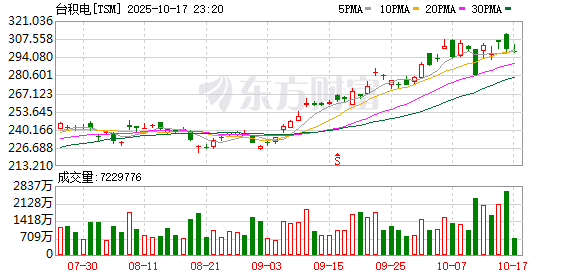
Group 1 - TSMC (Taiwan Semiconductor Manufacturing Company) has seen a stock increase of 5.58% over two days starting October 1, reaching a historical high, indicating strong investor confidence in the company's future [1] - TSMC's 2nm process technology is gaining attention, crucial for the PC industry, with AMD planning to use it in its next-generation EPYC Venice data center CPU and Intel in its Nova Lake series, due to Intel's own 18A process not achieving ideal yield rates [1] - TSMC maintains a leading market share of 71% in the foundry industry, driven by rapid advancements in 3nm technology, high utilization rates of 4/5nm processes in AI GPU production, and the expansion of CoWoS advanced packaging technology [1] Group 2 - The potential implementation of new semiconductor tariff policies by the U.S. government may pressure semiconductor brands, but could benefit companies like TSMC that have manufacturing facilities in the U.S., providing them with negotiation leverage and potential tax benefits [2] - OpenAI's CEO Sam Altman's visit to TSMC highlights the importance of collaboration, focusing on details regarding the contract manufacturing of OpenAI's self-developed chips, indicating TSMC's significant role in future AI chip production [2] - TSMC's advantages in technological innovation, market share growth, and international collaboration suggest a promising outlook in the semiconductor industry, with investors encouraged to monitor TSMC's advancements in advanced processes and international projects for potential stock price support [2]
关税前夕订单激增,台积电Q1净利润同比增60%超预期,市场聚焦法说会
硬AI· 2025-04-17 15:09
点击 上方 硬AI 关注我们 台积电第一季度营收8392.5亿元台币,同比增长42%,增长部分由于关税政策之前的囤货行为。公司预计,第二季度销售额284亿美元至292亿美元,第二季度营业利润率 达47%至49%,毛利率将达到57%至59%。 硬·AI 作者 | 张雅琦 编辑 | 硬 AI 17日,台积电公布2025Q1业绩: 台积电2025第一季度业绩表现强劲,销售额、净利润双双超预期。 但增长部分可能由于在美国的关税政策之前,客户对智能手机、笔记本电脑和其他 电子产品的囤货行为。 投资者更加关注台积电2025年的收入和支出前景。公司高管于周四14:00举行的法说会上表示, 维持2025年资本支出在380亿-420亿美元不变,维持 53%的长期毛利率预期不变。 营收: 台积电第一季度营收8392.5亿元台币,同比增长42%,预估8343亿元台币。 净利润: 净利润3616亿元台币,同比增长60.3%,预估3467.6亿元台币。 营业利润: 营业利润4070.8亿元台币,同比增长63%,预估3985.9亿元台币。 毛利率: 毛利率58.8%,前季59%,预估58.1%。 营业利润率: 营业利益率48.5%,前季 ...