Consumer Price Index (CPI)

Search documents
With a cautious eye on oil prices, Fed likely to hold rates next week following February's inflation reading
Yahoo Finance· 2026-03-11 17:57
Core Inflation and Federal Reserve Outlook - The Iran war is anticipated to increase headline inflation primarily due to rising oil prices, while the core Consumer Price Index (CPI) is moving towards the Federal Reserve's 2% target, as indicated by February's data [1][2] - Analysts expect the Federal Reserve to maintain steady interest rates in the near term, monitoring oil prices and their impact on inflation and the economy [3] Inflation Metrics - The core CPI rose by 0.2% month-over-month in February and 2.5% year-over-year, remaining consistent with January's figures [2] - The Personal Consumption Expenditures (PCE) index, the Fed's preferred inflation measure, is projected to be around 3% on a core basis, which is approximately half a percentage point higher than the CPI [5] Economic Projections - Core PCE inflation is expected to rise to 3.1%, compared to 2.5% for CPI, with some analysts forecasting it at 2.9% [6] - The Fed is not in a rush to make policy changes and will wait for more data on core PCE services inflation before making significant adjustments [6]
Consumer prices rose 2.4% annually in February, as expected
CNBC· 2026-03-11 12:31
Core Insights - The February Consumer Price Index (CPI) report indicates inflation remains stable, with prices for shelter and services rising modestly while certain goods categories, such as used vehicles and auto insurance, experienced declines [1][4] - The core CPI, excluding food and energy, recorded a monthly increase of 0.2% and an annual rate of 2.5%, aligning with forecasts [2] - The CPI's overall increase of 0.3% for the month resulted in a 12-month inflation rate of 2.4%, consistent with Dow Jones consensus estimates [2] Inflation Components - Shelter, the largest component of the CPI, saw a 0.2% increase, leading to an annual rate of 3%, with rent rising only 0.1%, the smallest monthly increase since January 2021 [3] - Apparel prices increased by 1.3% monthly, while new vehicle prices remained steady with a 0.5% annual increase; energy prices rose by 0.6% and food prices increased by 0.4% monthly, with an annual rise of 3.1% [4] - Egg prices notably fell by 3.8%, resulting in a significant annual drop of 42.1% [4] Geopolitical Impact - The recent U.S.-Israel attack on Iran has altered the inflation outlook, with crude oil prices rising sharply due to concerns over supply disruptions in the Middle East [6] - Higher oil prices are expected to complicate the inflation outlook in the coming months, as increases in energy costs typically affect transportation and consumer goods [7] - Economists anticipate that the inflationary effects from the current geopolitical tensions may be temporary and could subside once the situation stabilizes [8] Federal Reserve Considerations - The February CPI report suggests the Federal Reserve may maintain its current interest rate stance while assessing the impact of previous rate cuts and ongoing geopolitical tensions on the economic outlook [9] - Market expectations indicate a 43% chance of a second interest rate reduction before the end of the year, with traders nearly certain the Fed will not change rates in March [10]


What To Expect From Wednesday's Report On Inflation
Investopedia· 2026-03-10 00:00
Core Insights - The upcoming Consumer Price Index (CPI) report is expected to show a 2.4% year-over-year increase for February, consistent with January's rate, but may be less relevant due to the recent surge in energy prices caused by the Iran war [1][1][1] - Core prices, excluding food and energy, are anticipated to rise by 2.5%, also matching January's figures, indicating persistent inflation above the Federal Reserve's 2% target [1][1][1] - The Iran conflict has altered the inflation outlook by increasing energy prices, which could pose additional inflation risks despite the CPI report suggesting a stable inflation environment prior to the war [1][1][1] Economic Implications - A flat inflation rate, while still above the Fed's target, suggests that inflation was not a significant threat before the Iran war, but the conflict has introduced new risks [1][1][1] - The Federal Reserve is closely monitoring inflation data to determine potential interest rate cuts, which could lower borrowing costs and support the job market, although many policymakers prefer to maintain current rates to avoid exacerbating inflation [1][1][1] - Two opposing forces are influencing consumer prices: tariffs are increasing prices for physical goods, while decelerating rent increases are exerting downward pressure on overall inflation [1][1][1]

Goldman Sachs resets PCE inflation target after CPI bombshell
Yahoo Finance· 2026-02-14 02:03
Core Insights - Goldman Sachs has revised its forecast for the Federal Reserve's preferred inflation measure, predicting a 3.05% year-over-year increase in core PCE [1][11] - This revision indicates a challenging outlook for investors anticipating interest rate cuts, as the timeline for such cuts is likely to be extended [2][12] Inflation Data Analysis - The latest CPI report indicated an inflation rate of 2.4% in January, the lowest since May, but Goldman Sachs suggests that PCE inflation will be significantly higher due to peculiarities in the data [2][8] - Goldman Sachs estimates a month-over-month increase of 0.40% in core PCE for January, up from a prior expectation of 0.30% [5][9] PCE vs. CPI - The Federal Reserve prioritizes the PCE inflation rate over the CPI, making the upcoming PCE reports critical for interest rate decisions [3][5] - The differences in how CPI and PCE are calculated contribute to the expectation that PCE will show higher inflation rates, particularly influenced by consumer electronics and IT commodity prices [9][11] Future Reports and Implications - The Bureau of Economic Analysis is set to release the December PCE report on February 20 and the January report on March 13, which will be pivotal for the Fed's interest rate strategy [5][11] - Goldman Sachs anticipates a headline PCE increase of 2.81% in January, slightly up from 2.8% in November, with core PCE expected to rise to 3.05% [11][12]

Inflation surprise sends stocks into rally mode as January prices cool more than expected
Fox Business· 2026-02-13 18:41
Group 1 - The January inflation report showed a Consumer Price Index (CPI) increase of 0.2% month-over-month, which was below the expected 0.3% rise, and an annual inflation rate of 2.4%, also under forecasts, leading to a market rebound and optimism regarding Federal Reserve interest rate flexibility [2][8] - Energy prices, particularly a decline in gasoline prices, contributed significantly to the lower-than-expected inflation figures, offsetting increases in shelter and food costs, which is crucial for preventing a re-acceleration of overall inflation [5][8] - The combination of moderating inflation and strong employment figures may allow the Federal Reserve to consider cutting interest rates sooner than previously anticipated, as indicated by market reactions to the inflation data [6][8] Group 2 - The market's swift reaction to the inflation data reversed earlier losses, suggesting that investors view the report as a sign that inflation is approaching the Federal Reserve's target without harming economic growth [8] - Upcoming inflation indicators, including producer prices, will be closely monitored to confirm that the disinflation trend remains intact, following the January CPI release [8]

1月美国消费者价格同比上涨2.4%,低于预期
Xin Lang Cai Jing· 2026-02-13 14:04
Group 1 - The core point of the article is that the January Consumer Price Index (CPI) in the U.S. has shown a year-on-year increase of 2.4%, which is lower than expected and indicates a potential easing of the persistent inflation issue in the country [1][10][11] - The core CPI, excluding food and energy, rose by 2.5%, aligning with economists' expectations [2][11] - Month-on-month, the seasonally adjusted overall CPI increased by 0.2%, while the core CPI rose by 0.3%, both of which were below market expectations of 0.3% [5][14] Group 2 - Housing costs were the main driver of the CPI increase, but they only rose by 0.2% in January, contributing to a year-on-year increase of 3% [5][14] - Food prices increased by 0.2%, with five out of six major food categories experiencing price hikes, while energy prices decreased by 1.5% [5][14] - Following the data release, U.S. stock futures showed little volatility, and U.S. Treasury yields fell, indicating a shift in market expectations towards a potential interest rate cut by the Federal Reserve [8][17] Group 3 - The report has added complexity to the economic outlook, with the Atlanta Fed's GDPNow model projecting a 3.7% growth rate for the U.S. economy in the fourth quarter [8][17] - Despite controlled energy prices, the inflation rate remains above the Federal Reserve's 2% annual target, and concerns persist regarding the labor market, with an average of only 15,000 new jobs added monthly last year [8][17] - The U.S. Treasury Secretary expressed optimism that an "investment boom" will support economic growth, and inflation is expected to return to the Federal Reserve's target level by mid-year [8][18]
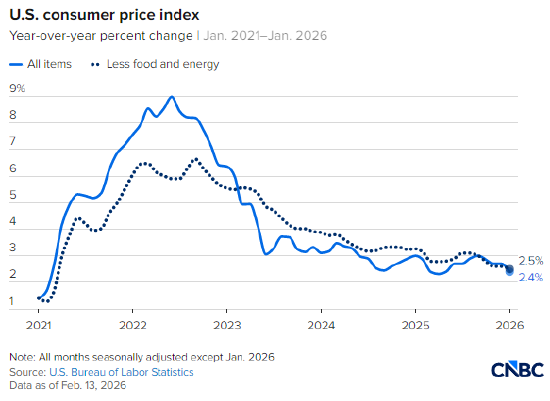
The January CPI inflation report is due out Friday morning. Here's what it's expected to show
CNBC· 2026-02-12 19:55
Group 1 - The consumer price index (CPI) is expected to show a 2.5% gain year-over-year, returning to levels seen in May 2025 [2][4] - The headline CPI was at 2.7% in December and has been on a downward trend since peaking above 3% in September 2025, with core CPI at 2.6% in December [3][4] - A lower inflation reading could give the Federal Reserve more confidence to lower benchmark borrowing rates without risking inflation resurgence [4][5] Group 2 - Goldman Sachs anticipates a contribution of 0.07 percentage points to core inflation from tariffs, with potential upward pressure on various sectors [7] - The strong jobs report showed nonfarm payroll gains of 130,000 for January and a drop in the unemployment rate to 4.3%, which initially caused market concerns about the Fed's rate cuts [8] - A consensus or below reading on inflation could alleviate concerns about the labor market's impact on Fed policy [8]

Two Measures of Inflation: November 2025
Etftrends· 2026-01-22 20:18
Core Inflation and Federal Reserve Actions - Inflation remains a significant concern, with core PCE at 2.8% and core CPI at 2.6%, both above the Federal Reserve's 2% target [1][2] - The Federal Reserve uses PCE data as its primary inflation gauge and emphasizes core inflation, which excludes volatile food and energy prices [2][3] - In its latest meeting, the Fed cut the federal funds rate by 25 basis points to a range of 3.50%-3.75%, marking the third consecutive cut and the lowest level since November 2022 [3] Future Expectations and Market Sentiment - The Fed is expected to hold rates steady in the upcoming meeting, with a 95% likelihood of maintaining current rates according to the CME FedWatch Tool [4] Comparison of PCE and CPI - Core PCE is preferred over core CPI due to its lower volatility, making it a more reliable indicator for the Fed's dual mandate of price stability and maximum employment [6] - Historically, core CPI has shown more volatility compared to core PCE, which has implications for inflation management [7][10] - As of November 2025, core CPI has grown 983% since 1960, while core PCE has grown 705%, indicating a significant difference in inflationary growth rates [11]

Weekly Economic Snapshot: Consumer Prices Ease as Margin Debt Hits Historic Highs
Etftrends· 2026-01-20 16:46
Economic Overview - The U.S. economy shows signs of cooling inflation and resilient consumer activity, with consumer price growth at a six-month low in December and retail sales rebounding [1] - Investor sentiment is high, indicated by record-high margin debt levels, suggesting increased market risk-taking [1] Inflation Dynamics - Consumer inflation decreased for the second consecutive month in December, with the Consumer Price Index (CPI) at 2.68%, down from 2.74% in November, and a monthly increase of 0.3% [2] - Core inflation slightly increased from 2.63% in November to 2.64% in December, with a monthly rise of 0.2% [2] - Conversely, the Producer Price Index (PPI) rose unexpectedly to 2.95% in November, up from 2.80% in October, indicating potential future consumer inflation [3] Consumer Spending - Retail sales increased by 0.6% in November, surpassing the 0.5% forecast, marking a recovery from a revised decline of -0.1% in October [4] - Core sales, excluding autos, rose by 0.5%, exceeding the projected 0.4% growth, although control purchases rose only 0.3%, below the 0.4% forecast [5] Margin Debt Insights - Margin debt reached a record high of $1.23 trillion in December, marking an eighth consecutive monthly increase and a more than 30% surge over the past year [6][7] - High margin debt levels indicate strong investor confidence but also suggest increased market volatility and risk-taking behavior [7] Market Reactions - The S&P 500 reached a record high before ending the week with a 0.4% loss, while the SPDR S&P 500 ETF Trust (SPY) fell by 0.3% [8] - The S&P Equal Weight Index increased by 0.7% from the previous week [8] Treasury Yields and Fed Outlook - The 10-year Treasury yield finished at 4.24%, and the 2-year note at 3.59%, with a 95% chance that the Fed will hold rates steady at the upcoming meeting [9]

WisdomTree Experts Talk Fed's Independence, CPI, & More
Etftrends· 2026-01-14 22:41
Core Insights - The article discusses the macroeconomic factors influencing advisors and investors in 2026, particularly focusing on the Federal Reserve's independence and inflation concerns [2][3]. Federal Reserve Developments - The Department of Justice has subpoenaed the Federal Reserve, raising concerns about its independence, which could impact market dynamics [3][4]. - Market reactions have shown initial pullbacks following the news, with expectations that advisors and traders will adopt a wait-and-see approach until more clarity emerges [5]. - There is speculation about whether Jerome Powell will remain as a governor until 2028, highlighting the uncertainty surrounding leadership at the Fed [6]. Inflation Concerns - There are doubts regarding the accuracy of the Consumer Price Index (CPI) due to outdated methods used by the Bureau of Labor Statistics, which may misrepresent the true inflation landscape [7][8]. - Advisors and investors are currently underexposed to commodities, particularly gold, which presents opportunities for hedging against inflation and achieving long-term gains [9]. Investment Opportunities - The WisdomTree Japan Opportunities Fund (OPPJ) is highlighted as a compelling investment choice for 2026, as Japan's economy shows signs of improvement due to favorable fiscal policies and moderate inflation [10][11]. - OPPJ targets Japanese companies with strong growth potential, including those held by Berkshire Hathaway and those with high shareholder yields, providing a diversified investment approach [12]. - The fund is positioned as a strategic option for navigating the uncertainties of the U.S. markets in 2026, encouraging advisors to remain adaptable [13].