Cuda软件

Search documents
趁Gemini 3“东风”,“谷歌链”挑战“英伟达链”,颠覆AI交易格局
华尔街见闻· 2025-11-25 14:46
Core Viewpoint - Google is challenging Nvidia's dominance in the AI chip market by promoting its TPU chips for local deployment in data centers, aiming to capture a significant market share and generate substantial revenue growth [2][5][10]. Group 1: Google's TPU Strategy - Google has begun marketing its TPU chips for deployment in clients' own data centers, moving beyond its traditional cloud rental model [8][9]. - Meta is negotiating with Google to use TPU chips worth billions in its data centers by 2027, while also renting Google Cloud chips next year [4][10]. - This potential deal could allow Google to capture 10% of Nvidia's annual revenue, translating to billions in new income [5]. Group 2: AI Model Breakthrough - Google's Gemini 3 language model, trained primarily on TPU chips, has received positive market reactions, suggesting it may outperform competitors like OpenAI's ChatGPT [5][18]. - The Gemini 3 model is reported to be faster and more capable than its competitors, which could enhance Google's position in the AI market [20][22]. - The success of Gemini 3 is expected to bolster the adoption of TPU chips, as it demonstrates their effectiveness in training advanced AI models [19][20]. Group 3: Competitive Landscape - Nvidia's CEO Jensen Huang is responding to Google's TPU advancements by investing in companies like Anthropic and OpenAI, ensuring they continue to use Nvidia's GPUs [6][7][24]. - Analysts suggest that Google's advancements could disrupt the AI investment ecosystem, leading to increased capital expenditures and uncertainty in investment returns for other companies [26][27]. - The competitive dynamics are shifting, with Google potentially narrowing the gap with Nvidia in the training chip market, which was previously considered Nvidia's stronghold [22][28].




趁Gemini 3“东风”,“谷歌链”挑战“英伟达链”,颠覆AI交易格局
美股IPO· 2025-11-25 03:40
Core Insights - Google is challenging Nvidia's dominance in the AI chip market by promoting its TPU chips for deployment in clients' data centers, aiming to expand beyond its cloud rental business [1][3][6] - Meta is negotiating with Google for a multi-billion dollar deal to use TPU chips in its data centers by 2027, which could capture 10% of Nvidia's annual revenue, translating to billions in new income for Google [3][6] - Google's recent launch of the Gemini 3 language model, trained primarily on TPU chips, has garnered positive market reactions, leading to a significant rise in Google's stock price and narrowing the market cap gap with Nvidia [3][9][10] Group 1: TPU Strategy and Market Position - Google has shifted its TPU strategy from cloud rental to local deployment, emphasizing security and compliance for sensitive data processing [6][7] - The introduction of the "TPU@Premises" initiative includes a software tool called "TPU command center" to facilitate client use of TPU chips, positioning it as a competitor to Nvidia's Cuda software [7] - Google has been actively engaging smaller cloud service providers to host TPU chips, offering financial backing to ensure their participation [8] Group 2: Competitive Responses and Market Dynamics - Nvidia's CEO has responded to Google's TPU strategy by investing billions in companies like Anthropic and OpenAI to secure commitments for using Nvidia GPUs [5][11] - Analysts suggest that Google's advancements in AI, particularly with the Gemini 3 model, could disrupt the AI investment landscape, leading to increased capital expenditures and uncertain returns for other companies [13][14] - The potential for lower-cost TPU chips to perform comparably to Nvidia's offerings raises concerns for companies heavily invested in Nvidia's technology, indicating a possible shift in market dynamics [14]

趁Gemini 3“东风”,“谷歌链”挑战“英伟达链”,颠覆AI交易格局
Hua Er Jie Jian Wen· 2025-11-25 00:26
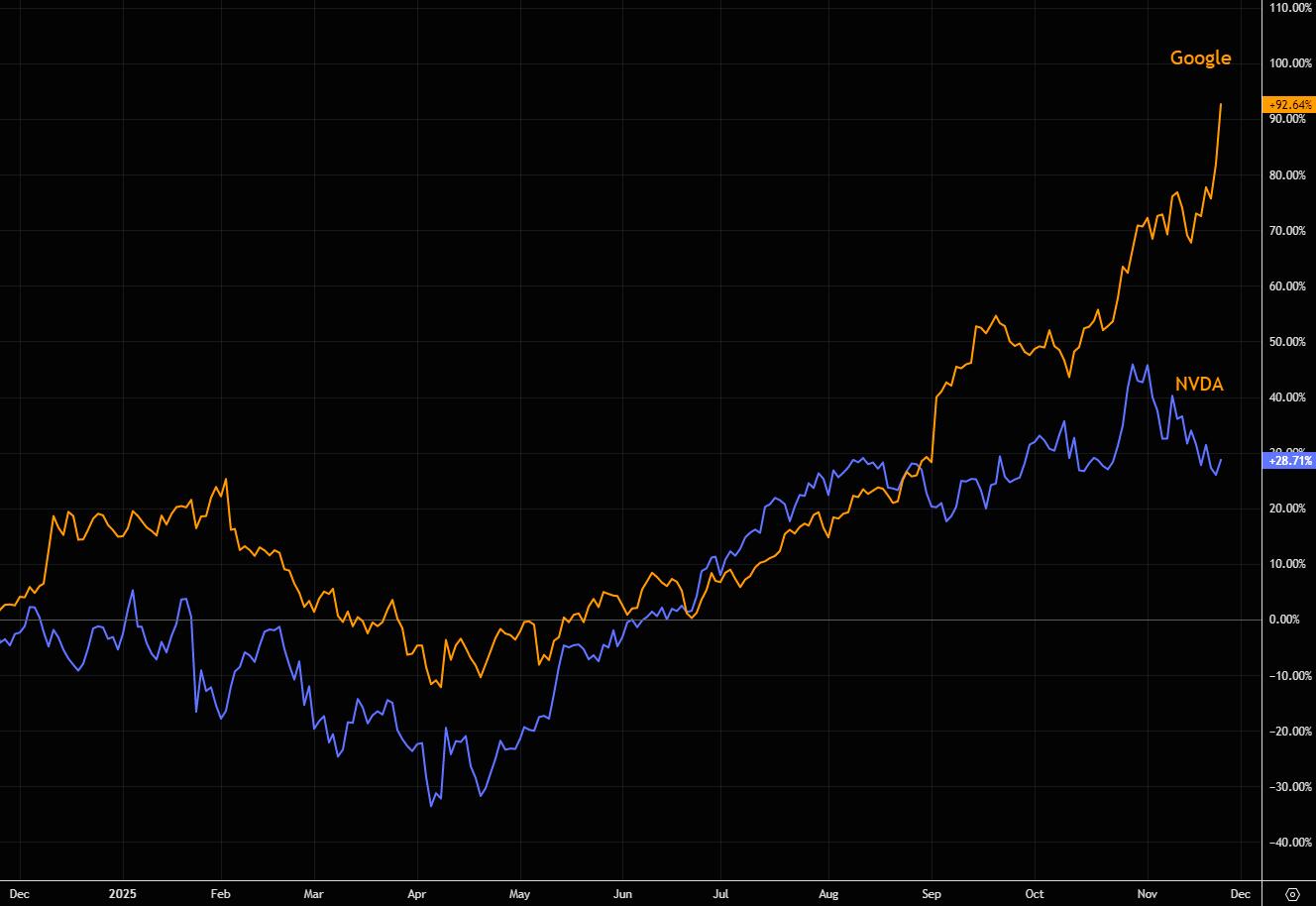
Core Insights - Google is challenging Nvidia's dominance in the AI chip market by promoting its TPU chips for deployment in clients' data centers, targeting major customers like Meta [1][4] - A potential deal with Meta could allow Google to capture 10% of Nvidia's annual revenue, translating to billions in new income for Google Cloud [1][4] - The recent launch of Google's Gemini 3 language model, trained primarily on TPU chips, has sparked significant market interest and led to a notable increase in Google's stock price [1][6] Group 1: Google's TPU Strategy - Google has shifted its TPU strategy from cloud rental to local deployment, emphasizing security and compliance for sensitive data processing [4][5] - The introduction of the "TPU@Premises" initiative aims to facilitate easier use of TPU chips through the "TPU command center" software, which is designed to compete with Nvidia's Cuda software [5] - Google has been actively engaging with smaller cloud service providers to host TPU chips, offering financial backing to ensure their adoption [5] Group 2: Market Dynamics and Competitive Response - Nvidia's CEO has responded to Google's TPU advancements by investing billions in companies like Anthropic and OpenAI to secure their continued use of Nvidia GPUs [3][8] - Analysts suggest that Google's advancements in AI technology, particularly with Gemini 3, could reshape the AI investment landscape and challenge Nvidia's market position [10][11] - Despite Nvidia's strong financial performance, there are concerns that Google's cost-effective TPU chips could disrupt the current market dynamics and lead to buyer remorse among companies heavily invested in Nvidia's technology [11] Group 3: Financial Implications - Analysts estimate that if Google's DeepMind AI research lab and TPU sales were treated as a separate entity, their value could approach $1 trillion, highlighting their significance to Alphabet [7] - Google's stock has surged 68% this year, outperforming major indices, while Nvidia's stock has seen a decline of nearly 10% this month, narrowing the market capitalization gap between the two companies [1][7]

英伟达的阉割版GPU,要来了
半导体芯闻· 2025-07-10 10:33
Core Viewpoint - Nvidia plans to launch a simplified AI chip designed specifically for the Chinese market in September, adapting to U.S. export controls while still relying on its software ecosystem [1][2] Group 1: Nvidia's Market Strategy - The new chip, Blackwell RTX Pro 6000, lacks high bandwidth memory and NVLink, making it a limited-functionality product for Chinese consumers [1] - Nvidia's CEO Jensen Huang aims to gain support from Chinese business leaders during his visit to Beijing, emphasizing the company's commitment to the Chinese market [1] - Despite U.S. pressures, Nvidia's market capitalization recently surpassed $4 trillion, buoyed by the growth of artificial intelligence and improving U.S.-China relations [1] Group 2: Challenges and Competition - Nvidia's market share in China has decreased from 95% to 50% due to U.S. export controls, but the Chinese AI market is projected to reach $50 billion soon [2] - The company has delayed the chip's shipping until September, awaiting full approval from Washington to avoid repeating the $5.5 billion asset write-down from the H20 chip incident [2] - Chinese tech giants like Alibaba, ByteDance, and Tencent are exploring in-house chip development while still collaborating with Nvidia [2] Group 3: Financial Performance - In fiscal year 2025, Nvidia generated $17.1 billion in revenue from China, accounting for 13% of total sales [3] - Nvidia's spokesperson highlighted the importance of the Chinese developer community in creating widely used open-source models and applications [3]