
Find N5

Search documents
OPPO 折叠屏技术被苹果研究,全球销量逆势增长
Xin Lang Cai Jing· 2026-01-30 06:15
Group 1 - Apple is accelerating the development of its first foldable iPhone by purchasing OPPO's flagship foldable model, Find N5, for disassembly and research, highlighting OPPO's technological leadership in the foldable screen sector [1] - OPPO's global smartphone sales have shown strong growth, with a 7.6% year-on-year increase in Q4 2025, and a notable 10.2% growth in the Chinese market, making it the top performer in the Android segment [4] - OPPO's total sales, including OnePlus and Realme, are projected to exceed 190 million units in 2025, ranking third globally, driven by precise positioning and innovation investments in high and mid-high-end markets [4] Group 2 - The upcoming foldable iPhone is expected to feature a Samsung panel with an external screen of approximately 5.5 inches and an internal screen of about 7.8 inches, with a phased release starting in September 2026 and a price range of $2000 to $2500, facing some mass production challenges [3] - IDC indicates that the high-end market is currently the core battleground for industry innovation, and OPPO's combination of technological leadership and market recognition positions it well for future competition in the foldable screen arena [4]


OPPO西北首家旗舰店落户西安 科技国潮吸引驻华外交官打卡体验
Guan Cha Zhe Wang· 2026-01-19 04:00
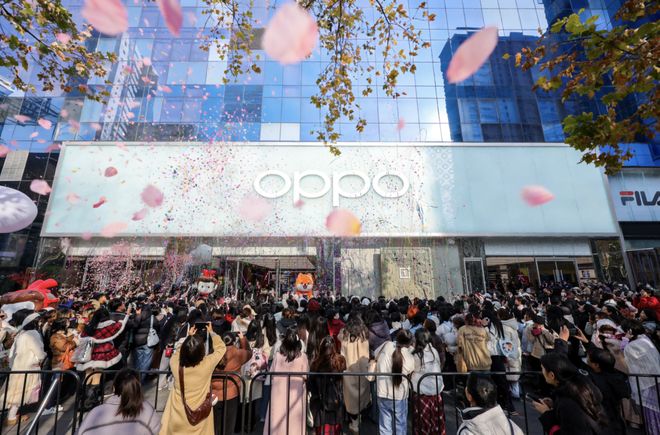
Core Viewpoint - OPPO has opened its first flagship store in Xi'an, positioning it as a cultural landmark that merges traditional Qin and Tang heritage with modern design, aimed at attracting young consumers and fostering cultural exchange [1][2][12] Group 1: Store Concept and Design - The Xi'an flagship store is designed as a "city park for young people," integrating historical elements from the ancient capital of Chang'an into its modern aesthetic [1][2] - The store features a blend of traditional craftsmanship and contemporary design, utilizing materials inspired by ancient bricks and incorporating modern lighting techniques [2][5] - Water imagery is introduced in the interior design to evoke the historical landscape of Chang'an, creating a dialogue between the past and present [5] Group 2: Cultural and Social Engagement - The store aims to be a cultural hub, offering a space for social interaction and cultural experiences, including the integration of popular two-dimensional culture [5][8] - OPPO collaborates with popular IPs from gaming and anime, such as "Light and Night" and "Haikyuu!!", to create engaging experiences that resonate with young consumers [8][12] - The flagship store will host various events and activities, including image creation workshops and creator sharing sessions, to encourage young creators to use the space for artistic expression [8][10] Group 3: Technological Innovation - OPPO leverages cutting-edge technology to enhance user experience, featuring products like the Find X9 series and AI-driven functionalities that allow for interactive cultural experiences [10][12] - The store serves as a platform for showcasing how technology can enrich traditional culture, with diplomats expressing interest in the innovative applications of OPPO's products [10][12] - OPPO's flagship store represents a new retail model that combines cultural experience, social interaction, and technological engagement, appealing to a younger demographic [12]
华创证券:3C、消费、高端制造等多轮驱动 3D打印发展空间广阔
智通财经网· 2025-12-16 02:03
Core Insights - 3D printing additive technology addresses pain points in traditional manufacturing processes, with significant growth potential driven by 3C, consumer, and industrial sectors [1] - The domestic supply chain for 3D printing equipment and components is rapidly catching up, with consumer-grade products leading in the domestic market [1] Group 1: Industry Overview - 3D printing offers advantages such as reduced product development cycles, efficient formation of complex structures, and higher material utilization compared to traditional manufacturing [1] - According to data from Zhongshan Industrial Research Institute, the distribution of downstream applications in China's 3D printing market shows aerospace accounting for the largest share at 16.7%, followed by medical (15.5%), automotive (14.5%), consumer electronics (11.9%), and academic research (11.2%) [1] - The global 3D printing market is projected to reach $21.9 billion by 2024 and $115 billion by 2034 according to Wohler Associates [1] Group 2: Consumer Electronics - Apple's entry into the 3D printing space is expected to lead the development in the 3C sector, with the introduction of 3D printing processes in products like the iPhone Air and Apple Watch Ultra [2] - The use of titanium in 3D printing is gaining traction due to its lightweight and high-strength properties, with significant advancements in foldable screen technology [2] Group 3: Consumer Market - The application of 3D printing is expanding from industrial to consumer markets, including entertainment and education, with open-source models and community sharing lowering the learning curve [3] - The global consumer-grade 3D printing market is expected to grow from $4.1 billion in 2024 to $16.9 billion by 2029 according to Zhaosheng Consulting [3] Group 4: High-end Manufacturing - 3D printing is enabling breakthroughs in commercial aerospace and nuclear fusion industries by overcoming traditional manufacturing limitations [4] - Major organizations like NASA and SpaceX are utilizing additive manufacturing for critical components in rocket technology [4] Group 5: Supply Chain - Domestic manufacturers of 3D printing equipment and components are rapidly improving their performance, with companies like Plater and Huazhu High-Tech closing the gap with international leaders [5] - In the consumer market, Chinese suppliers dominate the global consumer-grade 3D printer shipment market, accounting for nearly 95% of the total shipments [5]

迟到七年的折叠屏iPhone,是「最不苹果」的苹果产品
36氪· 2025-07-23 00:06
Core Viewpoint - The article discusses the anticipated release of Apple's first foldable iPhone, highlighting its potential features and market positioning, while questioning the necessity and functionality of foldable smartphones in general [4][5][24]. Group 1: Product Development and Features - Apple is expected to launch its foldable iPhone by the end of 2024, with a price starting at $2000, aligning with previous leaks from analysts [4][24]. - The foldable iPhone will feature a book-style design, expanding from a 5.5-inch screen to a 7.8-inch screen when opened, which is close to the size of an iPad mini [6][15]. - The device's thickness will range from 9mm to 9.5mm when folded and 4.5mm to 4.8mm when opened, which is comparable to other recent foldable models [7]. - The foldable iPhone will utilize components from competitors, including a foldable OLED screen from Samsung, indicating a reliance on existing technology rather than pioneering new innovations [9]. - Apple is reportedly working on a "no crease" display technology, with two internal prototypes under development [9][10]. Group 2: Market Context and Challenges - The foldable smartphone market is currently small, with only 700 million units shipped in China in 2023, representing just 2% of the total smartphone market [24]. - There is skepticism about the practical applications of foldable smartphones, as the market has yet to see a product that significantly alters consumer perceptions [25][26]. - The article raises concerns about whether the foldable iPhone can justify its high price point and meet consumer expectations, especially given the existing competition and market dynamics [29][30]. Group 3: AI Integration and Future Prospects - The foldable iPhone is being positioned as a "true AI phone," capable of multi-modal and cross-app functionalities, which could redefine user interaction through AI agents [20][21]. - The potential for AI integration suggests that the foldable iPhone could serve as a versatile device, merging the capabilities of a smartphone, tablet, and PC [25]. - The timeline for the foldable iPhone's release indicates that while initial specifications may be finalized in 2024, mass production may not occur until late 2026, highlighting the challenges in bringing this product to market [24][22].

透露IPO进展,荣耀新资本故事跳出“手机”:AI生态成突围关键
Hua Xia Shi Bao· 2025-07-03 13:55
Group 1: IPO Preparation - Honor has entered the counseling phase for its IPO, which is expected to last at least three months [2][3] - The company received approval for its IPO counseling from the Shenzhen Securities Regulatory Bureau on June 26 [3] - Honor's shareholder structure is becoming increasingly diversified, with 23 shareholders including major players like China Mobile and BOE [3] Group 2: Market Position and Strategy - Honor is likely to choose the Hong Kong stock market for its IPO, which would provide greater flexibility post-restructuring [4] - The company aims to transform from a smartphone manufacturer to a leading AI terminal ecosystem company, as outlined in its Alpha strategy [4] - Honor has launched various products in 2023, including budget smartphones, gaming laptops, and a foldable flagship phone, Magic V5, priced from 8,999 yuan [5] Group 3: Competitive Landscape - The foldable smartphone market is gaining attention, with competitors like OPPO, Huawei, and Xiaomi also releasing new models [6] - Honor's market performance in Q1 2025 was not strong, as it fell out of the top five smartphone manufacturers in China [6][7] - Despite recent challenges, industry experts believe Honor's adjustments in leadership and strategy will lead to improved market performance [7]
重回主航道,OPPO做对了什么?
远川研究所· 2025-05-29 12:27
Core Viewpoint - The article discusses OPPO's journey in the semiconductor industry, particularly its chip development initiative, Zheku, which was launched in 2020 but was ultimately terminated due to market challenges and the need for better cash flow management. The narrative emphasizes the importance of user experience and long-term competitiveness in the smartphone market, highlighting OPPO's strategic pivot back to core business after the setback [1][2][4]. Group 1: Zheku's Development and Termination - Zheku was established in 2020 as part of OPPO's self-developed chip initiative, named after the Mariana Trench, indicating the challenges ahead [1]. - Over two years, Zheku released several products, including the NPU "Mariana X" and Bluetooth audio SoC "Mariana Y," but the initiative was halted in mid-2023 due to declining smartphone sales and unsustainable R&D costs [1][2]. - The decision to terminate the chip development was seen as a necessary move for OPPO to maintain healthier cash flow and enhance its risk resilience [1]. Group 2: Market Recovery and Strategic Focus - Following the dissolution of Zheku, OPPO launched the Find X7 series, featuring a SoC co-developed with MediaTek, which led to a rapid recovery in market share, reclaiming the third position in the domestic market by Q1 2023 [2]. - OPPO's ability to quickly regroup and return to its main business path serves as a reference for other industry players struggling between innovation and survival [2]. Group 3: Long-term Strategy and User Experience - The smartphone market has seen a decline in shipment volumes since 2017, with longer replacement cycles leading to increased market concentration among major brands [4]. - OPPO's approach to chip development was driven by the need for long-term competitiveness rather than short-term gains, emphasizing that chip production is a means to enhance user experience rather than an end goal [4][6]. - The company focuses on system integration, where multiple technologies work together to meet user needs, rather than merely producing components [4][6]. Group 4: Innovation and Market Positioning - OPPO has adopted a systematic approach to innovation, continuously iterating on hardware to improve user experience, as seen in the Find X8 Ultra's camera system [6][9]. - The Find N5 foldable phone achieved a record low thickness of 8.93mm, showcasing OPPO's commitment to pushing technological boundaries and enhancing user experience [7][9]. - OPPO's market share in the premium segment (over $600) ranks among the top three globally, with significant presence in the $400-$500 range in Mexico, indicating strong brand positioning [9].

独家丨OPPO中国区总裁刘波卸任,段要辉直接负责中国区全部业务
雷峰网· 2025-04-25 10:40
雷峰网消息,OPPO原中国区总裁刘波将卸任并学习深造,高级副总裁段要辉将直接负责全部中国区业 务。 OPPO内部消息表示,原中国区总裁刘波因脱产参加高管学习计划卸任该职位。高级副总裁段要辉直接负 责中国市场,对中国区整体业务负责。另外,此次调整还涉及线下销售板块,由原Reno与A系列GTM部长 汤杰负责中国区线下销售工作 ,向段要辉汇报。 2024年1月,段要辉升任公司高级副总裁后分管中国区,刘波向其汇报。二位共同操盘 Find X8和Find N5等产品。IDC最新数据显示,OPPO在2025 第一季度出货量同比增幅达3.3%,上升到国内市场第三 位。 值得一提的是,原中国区总裁刘波所参加的OPPO高管学习计划,是OPPO已运行多年的领导力培养计 划。 据公开资料显示,原OPPO研究院院长刘畅曾参与高管学习计划,并于2024年返回公司后担任硬件工程总 裁。 本文作者长期关注智能硬件及终端,对终端渠道、业内动态感兴趣的行业人士,欢迎添加作者微信( ByArsT )交流。 " OPPO市场局面稳定后,刘波进修深造。 " 作者丨马广宇 编辑丨相辉 // 近期热门文章 独家丨vivo巴西子品牌JOVI首款产品将于二 ...
X @𝘁𝗮𝗿𝗲𝘀𝗸𝘆
𝘁𝗮𝗿𝗲𝘀𝗸𝘆· 2025-03-18 05:18
Product Features - OPPO Find N5 boasts a thin design [1] - The black color variant of OPPO Find N5 is prone to attracting dust [1]