GPT 5.2

Search documents
从Gemini到豆包:全球两大AI巨头为何走上同一条路?
第一财经· 2026-02-14 15:19
Core Viewpoint - ByteDance has officially launched the Doubao Model 2.0 series, which includes significant upgrades in multi-modal understanding, enterprise-level agent capabilities, and cost efficiency, positioning it among the global leaders in AI models [1][2]. Version Iteration Updates - The Doubao 2.0 series features three different sizes: Pro, Lite, and Mini, with enhanced multi-modal understanding and improved capabilities for real-world long-chain tasks, achieving top-tier performance in high-value economic and research tasks [4][7]. Technical Advancements - Doubao 2.0 Pro is designed for deep reasoning and long-chain task execution, directly competing with models like GPT 5.2 and Gemini 3 Pro, indicating a strategic alignment among leading AI laboratories towards achieving general artificial intelligence (AGI) [2][4]. Performance Metrics - The Doubao 2.0 Pro flagship model has achieved gold medal results in IMO, CMO mathematics competitions, and ICPC programming contests, showcasing its top-tier mathematical and reasoning capabilities [4][5]. Multi-Modal Understanding - The model has significantly upgraded its multi-modal understanding capabilities, excelling in visual reasoning, spatial perception, and long-context understanding, achieving the best performance in authoritative tests [5][8]. Cost Efficiency - Doubao 2.0 Pro pricing is based on input length, with costs of 3.2 RMB per million tokens for input and 16 RMB per million tokens for output, offering a substantial cost advantage over competitors like Gemini 3 Pro and GPT 5.2 [6][7]. Real-World Task Execution - The core focus of Doubao 2.0's upgrade is its ability to execute complex real-world tasks, supported by breakthroughs in multi-modal understanding, allowing the model to evolve from a "test-taker" to an "executor" [7][9]. Competitive Landscape - The competition between Doubao 2.0 and Gemini centers on multi-modal capabilities, with both aiming to create AI that comprehends and interacts with the complexities of the physical world, moving beyond mere language processing [9].


Seedance 2.0之后 字节跳动发布豆包大模型2.0
Zhong Guo Jing Ying Bao· 2026-02-14 10:22
Core Insights - ByteDance officially launched the Doubao-Seed-2.0 series on February 14, focusing on optimizing large-scale production environments and enhancing the execution capabilities for complex real-world tasks [1] Group 1: Model Performance - The flagship Doubao-2.0 Pro model demonstrated top-tier foundational capabilities, winning gold medals in IMO, CMO mathematics competitions, and the ICPC programming competition, while outperforming Gemini 3 Pro in the Putnam benchmark test [1] - In terms of knowledge coverage, Doubao-2.0 has strengthened its long-tail domain knowledge, achieving comparable scores in scientific knowledge tests with Gemini 3 Pro and GPT 5.2, and ranking among the industry leaders in interdisciplinary knowledge application [1] Group 2: Multimodal Capabilities - Doubao-2.0 has undergone a comprehensive upgrade in multimodal capabilities, achieving the best industry scores in visual reasoning, spatial perception, and long-context understanding tests, enabling efficient comprehension of charts, complex documents, and videos [1] - The model has enhanced its understanding of time series and motion perception, allowing for real-time video stream analysis, environmental awareness, and proactive interaction, applicable in diverse life scenarios such as fitness guidance and companionship [1] Group 3: Agent Capabilities and Pricing - The Agent capabilities of Doubao-2.0 Pro excelled in instruction adherence and tool invocation assessments, achieving the highest score of 54.2 in the HLE-Text evaluation, surpassing other models [2] - Doubao-2.0 Pro is now available on the Doubao App, desktop client, and web version, with a pricing structure of 3.2 yuan per million tokens for input (up to 32k) and 16 yuan per million tokens for output, offering better cost-effectiveness compared to Gemini 3 Pro and GPT 5.2 [2] - The Lite version is priced at only 0.6 yuan per million tokens, with overall performance exceeding that of the previously released Doubao-1.8 [2]
AI大战持续升级!Seedance 2.0之后,字节跳动又发布豆包大模型2.0
Guang Zhou Ri Bao· 2026-02-14 09:06
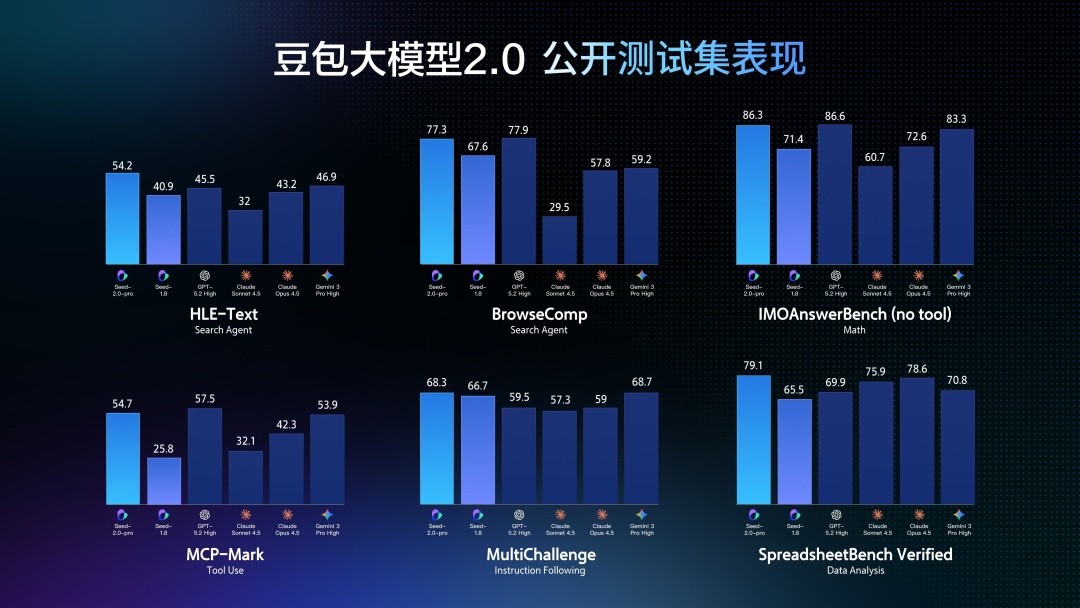
Core Insights - ByteDance has launched the Doubao-Seed-2.0 series, optimizing for large-scale production environments to handle complex real-world tasks [1] - The Doubao-2.0 Pro flagship model has achieved top-tier performance in various competitions, surpassing Gemini 3 Pro in mathematical and reasoning capabilities [1] - The model has enhanced knowledge coverage in niche areas and performed well in scientific knowledge tests, ranking alongside Gemini 3 Pro and GPT 5.2 [1] Model Capabilities - Doubao-2.0 has upgraded its multimodal understanding capabilities, achieving industry-leading performance in visual reasoning, spatial perception, and long-context understanding [3] - The model can analyze real-time video streams and understand dynamic scenes, making it applicable in fitness guidance, fashion advice, and companionship [3] - Doubao-2.0 Pro has excelled in instruction following, tool invocation, and search agent evaluations, achieving a score of 54.2 in the HLE-Text test, significantly outperforming other models [3] Pricing Strategy - Doubao-2.0 Pro is priced based on input length, with costs of 3.2 yuan per million tokens for inputs under 32k and 16 yuan per million tokens for outputs, offering a cost advantage over Gemini 3 Pro and GPT 5.2 [4] - Doubao-2.0 Lite is positioned as a cost-effective option, with input pricing at only 0.6 yuan per million tokens, surpassing the previous generation model Doubao 1.8 in overall performance [4] Competitive Landscape - The 2026 Spring Festival has become a competitive arena for major AI companies, with ByteDance, Alibaba, Tencent, and Baidu investing over 4.5 billion to compete [5] - The competition has shifted from technical specifications to practical applications in real-world scenarios, with ByteDance leveraging the capabilities of Doubao-2.0 to enhance AI's role in everyday life [5] - The focus is on capturing user attention and establishing AI ecosystem entry points, with the goal of translating advanced technology into tangible user value [5]
Seedance2.0之后 字节发布豆包大模型2.0
Nan Fang Du Shi Bao· 2026-02-14 07:07
Core Insights - ByteDance has launched the Doubao-Seed-2.0 series, optimizing for large-scale production environments to handle complex real-world tasks [1] - The Doubao-2.0 Pro flagship version has achieved top-tier performance in various competitions, surpassing Gemini 3 Pro in mathematical reasoning and problem-solving capabilities [1] - Doubao-2.0 enhances knowledge coverage in niche areas and performs well in scientific knowledge tests, ranking alongside Gemini 3 Pro and GPT 5.2 [1] Group 1 - Doubao-2.0 has upgraded its multimodal understanding capabilities, achieving industry-best performance in visual reasoning, spatial perception, and long-context understanding [1] - The model has improved its understanding of time series and motion perception, enabling real-time video analysis and environmental interaction for applications in fitness guidance and companionship [2] - The Doubao-2.0 Pro has been launched on various platforms, including the Doubao App and web client, allowing users to experience its capabilities in "expert" mode [2] Group 2 - The pricing for Doubao-2.0 Pro is set based on input length, with costs of 3.2 yuan per million tokens for inputs under 32k and 16 yuan per million tokens for outputs, offering a significant cost advantage over competitors [2] - Doubao-2.0 Lite provides excellent cost-performance, with input pricing at only 0.6 yuan per million tokens, surpassing the previous generation model Doubao-1.8 [2]

豆包大模型2.0正式发布
新华网财经· 2026-02-14 07:04
Core Insights - Doubao 2.0 has officially entered its second phase, focusing on systematic optimizations for large-scale production environments, enhancing capabilities in efficient inference, multimodal understanding, and complex instruction execution to better tackle real-world complex tasks [1] Group 1: Product Features - The Doubao 2.0 series includes three general-purpose agent models (Pro, Lite, Mini) and a Code model, designed to flexibly adapt to various business scenarios [2] - Doubao 2.0 Pro targets deep reasoning and long-chain task execution, directly competing with GPT 5.2 and Gemini 3 Pro [2] - Doubao 2.0 Lite balances performance and cost, with comprehensive capabilities surpassing the previous generation model Doubao 1.8 [2] - Doubao 2.0 Mini is aimed at low-latency, high-concurrency, and cost-sensitive scenarios [2] - The Code version (Doubao-Seed-2.0-Code) is specifically designed for programming scenarios and performs better when used in conjunction with TRAE [2]

豆包大模型2.0发布 包含三款通用Agent模型和Code模型
Feng Huang Wang· 2026-02-14 06:51
Core Insights - ByteDance announced the release of Doubao Model 2.0, which includes Pro, Lite, Mini, and Code models, optimized for large-scale production environments to enhance multimodal understanding, complex instruction execution, and long-range task processing capabilities [1] Group 1: Model Features - Doubao 2.0 Pro targets deep reasoning and long-chain tasks, competing with GPT 5.2 and Gemini 3 Pro [1] - Doubao 2.0 Lite surpasses the previous main model Doubao 1.8 in overall capabilities [1] - Doubao 2.0 Mini is designed for low latency, high concurrency, and cost-sensitive scenarios [1] - The Code model is specifically developed for programming scenarios and can integrate with AI programming product TRAE [1] Group 2: Performance Metrics - Doubao 2.0 has achieved state-of-the-art (SOTA) levels in multimodal understanding, excelling in visual reasoning, perception, spatial reasoning, and long-context understanding tasks [1] - In dynamic scene evaluations like TVBench and EgoTempo, Doubao 2.0 outperformed human benchmarks [1] - The model demonstrated excellent performance in long video understanding across multiple streaming real-time question-answering benchmarks [1] Group 3: Competitive Edge - Doubao 2.0 Pro scored higher than GPT 5.2 in scientific evaluations such as SuperGPQA and HealthBench [1] - The model achieved gold medal results in IMO, CMO mathematics competitions, and ICPC programming contests [1] - The reasoning cost of Doubao 2.0 Pro is approximately an order of magnitude lower than that of leading industry models [1] Group 4: Availability - Doubao 2.0 Pro is now available on Doubao App, desktop, and web versions, with users able to experience it in "Expert" mode [2] - The Code model has been integrated into the Chinese version of TRAE [2] - Volcano Engine has launched API services for the Doubao 2.0 series models for enterprise and developer use [2]
字节跳动发布豆包大模型2.0,主打真实世界复杂任务执行力
Huan Qiu Wang· 2026-02-14 06:36
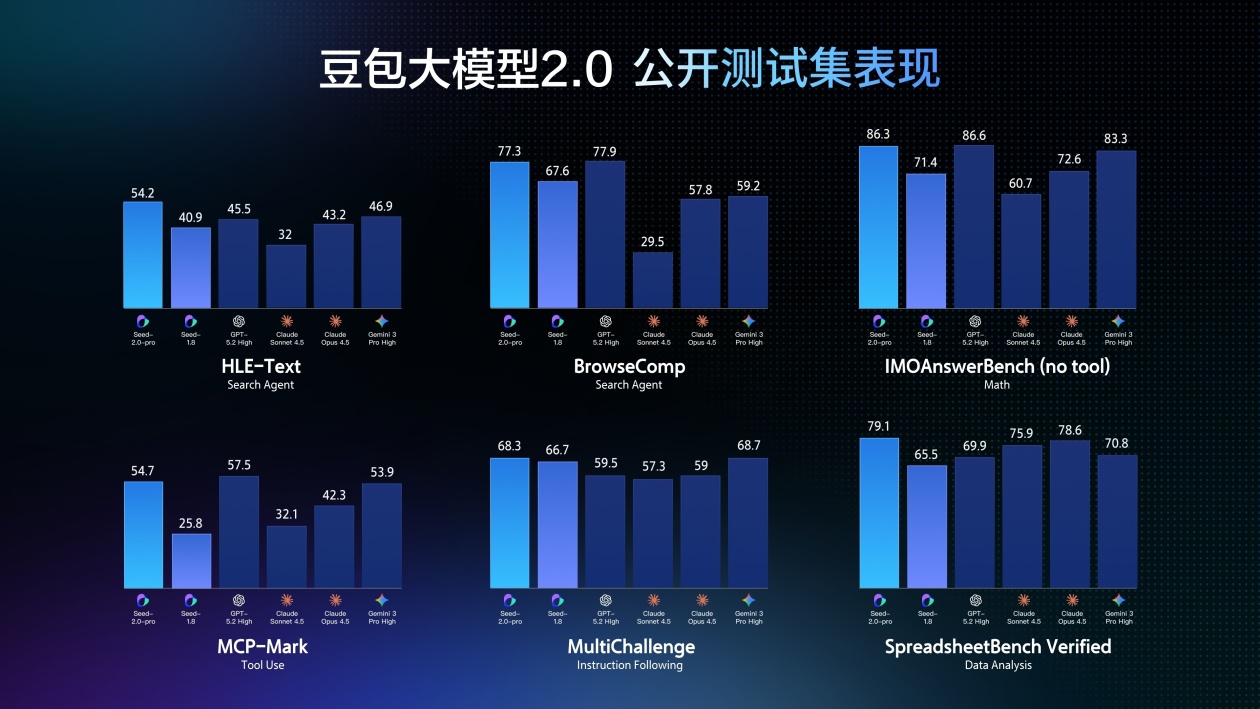
Core Insights - ByteDance has launched the Doubao-Seed-2.0 series, optimizing for large-scale production environments to handle complex real-world tasks [1] - The Doubao-2.0 Pro flagship version has achieved top-tier performance in various competitions, surpassing Gemini 3 Pro in mathematical reasoning and problem-solving capabilities [1] - The model has enhanced knowledge coverage in niche areas and performed well in scientific knowledge tests, ranking alongside Gemini 3 Pro and GPT 5.2 [1] - Doubao-2.0 has upgraded its multimodal understanding capabilities, achieving industry-leading results in visual reasoning and complex document comprehension [1] Performance Enhancements - The model has improved its understanding of time series and motion perception, enabling real-time video analysis and environmental interaction for applications in fitness guidance and companionship [2] - Doubao-2.0 Pro has demonstrated top-level performance in instruction following and tool usage, achieving a score of 54.2 in the HLE-Text evaluation, significantly outperforming other models [4] Market Positioning - Doubao-2.0 Pro is available on the Doubao App, desktop client, and web version, with a pricing model based on input length, offering a cost advantage over Gemini 3 Pro and GPT 5.2 [4] - The Doubao-2.0 Lite version provides high cost-performance, with input pricing at 0.6 yuan per million tokens, outperforming the previous generation model Doubao-1.8 [4]
豆包大模型2.0正式发布
财联社· 2026-02-14 06:28
Core Insights - Doubao 2.0 has officially entered its second phase, focusing on systematic optimizations for large-scale production environments, enhancing capabilities in efficient inference, multimodal understanding, and complex instruction execution to better tackle real-world complex tasks [1] Product Overview - The Doubao 2.0 series includes three general-purpose agent models (Pro, Lite, Mini) and a Code model, designed to flexibly adapt to various business scenarios: - Doubao 2.0 Pro targets deep reasoning and long-chain task execution, fully competing with GPT 5.2 and Gemini 3 Pro [2] - Doubao 2.0 Lite balances performance and cost, with comprehensive capabilities surpassing the previous generation model Doubao 1.8 [2] - Doubao 2.0 Mini is aimed at low latency, high concurrency, and cost-sensitive scenarios [2] - The Code version (Doubao-Seed-2.0-Code) is specifically designed for programming scenarios, showing enhanced performance when used in conjunction with TRAE [2]

Rosenblatt Raises Price Target For Arista Networks (ANET)
Yahoo Finance· 2026-02-12 08:54
Group 1 - Arista Networks (NYSE:ANET) is recognized as one of the top 11 communication equipment stocks favored by hedge funds [1] - Analyst Michael Genovese from Rosenblatt raised the price target for Arista Networks from $140 to $165, indicating a 20% upside potential at current levels while maintaining a Neutral rating [1][2] - The company is expected to announce its fourth-quarter results soon, with positive developments noted in recent wins and opportunities [2] Group 2 - Arista Networks specializes in high-performance, software- and data-driven client-to-cloud networking solutions, focusing on AI, data center, and routing architectures [4] - The company emphasizes low latency, automation, high-speed, and scalability, serving diverse market segments including cloud service providers, financial services, government, healthcare, education, and energy [4] - Recent developments in Microsoft's AI chip rollout are seen as beneficial for Arista, as it reduces dependency on Nvidia and supports Ethernet-driven scale-up for AI workloads [3]

微信,给元宝“纠偏”
Sou Hu Cai Jing· 2026-02-05 22:46
Core Viewpoint - WeChat's decision to restrict the "Yuanbao" red envelope feature has sparked significant discussion on social media, highlighting the platform's commitment to user experience and its evolving business strategy [1][3][9] Group 1: WeChat's Strategy - WeChat is undergoing a transformation from a "technology-driven" model to a "user-driven" model, emphasizing user experience as a core principle [7][8] - The platform's evolution includes the integration of various features such as public accounts, mini-programs, and video accounts, which have created a complex ecosystem [7] - The restriction on Yuanbao links may serve as a strategic move to maintain user engagement and prevent the dilution of user experience [9][10] Group 2: Market Dynamics - The competitive landscape suggests that simply investing heavily in marketing, as seen with various tech companies, does not guarantee user retention or loyalty [11][12] - Historical context indicates that WeChat's success with the red envelope feature was rooted in its already strong user engagement, rather than just financial incentives [13][14] - The platform's ability to connect with 1.4 billion global users positions it as a fertile ground for AI development, requiring patience and strategic focus [15][17] Group 3: Future Outlook - The potential for AI within WeChat's ecosystem is significant, but it necessitates a strong commitment to enhancing user experience and product quality [14][18] - The narrative suggests that once the Yuanbao feature is adequately prepared, the value of WeChat as an AI platform will be fully realized [18]