GPUaaS业务

Search documents
利空突袭!科技巨头突然暴跌,发生了什么?
天天基金网· 2025-12-12 01:03
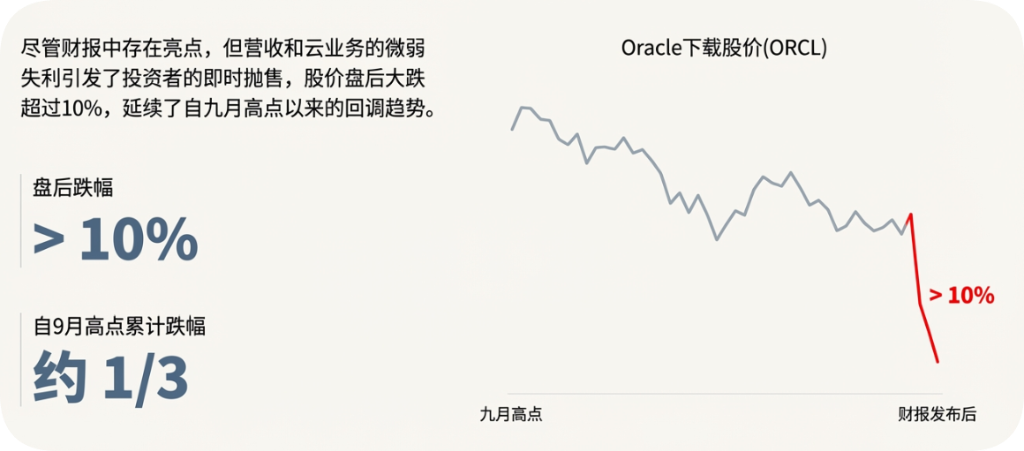
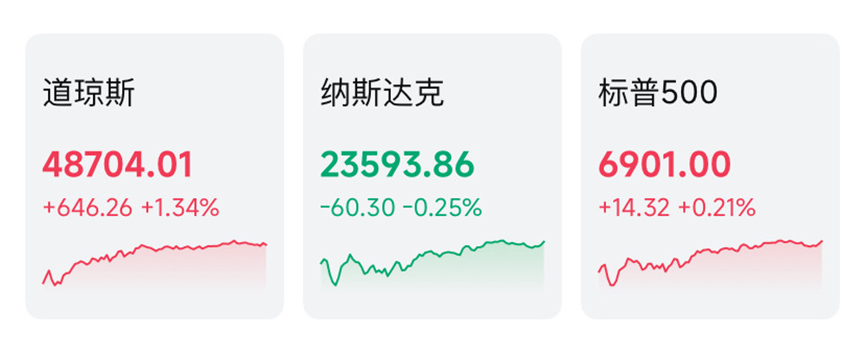
Market Overview - The U.S. stock market experienced significant style rotation, with technology stocks declining while small-cap and cyclical stocks rose [2][4] - The Dow Jones Industrial Average increased by 1.34% to 48,704.01 points, and the S&P 500 rose by 0.21% to 6,901 points, both reaching record closing highs, while the Nasdaq Composite fell by 0.25% to 23,593.86 points [4][6] Technology Sector Performance - Major technology stocks mostly declined, with the Nasdaq-100 index dropping by 0.71%. Notable declines included Google down over 2%, Nvidia down over 1%, and Tesla down over 1% [6] - Oracle's stock plummeted nearly 11% following disappointing earnings, reigniting concerns over high valuations in the tech sector [8][9] Oracle's Financial Results - Oracle reported Q2 FY2026 revenue of $16.058 billion, a 14% increase from $14.059 billion year-over-year, but below analyst expectations of $16.192 billion [9] - The company's remaining performance obligations surged by 438% to $523 billion, but it faced a negative free cash flow of $13.2 billion, raising concerns about its debt levels, projected to reach approximately $300 billion by 2028 [9][11] Semiconductor Sector Insights - The Philadelphia Semiconductor Index fell by 0.75%, with ARM and Intel both declining over 3% [7] - Broadcom reported Q4 FY2025 revenue of $18.01 billion, a 28% year-over-year increase, driven by a 74% rise in AI semiconductor revenue [11][12] Precious Metals Market - Following the Federal Reserve's interest rate cut, precious metals prices surged, with gold reaching a one-month high of $4,285.75 per ounce and silver hitting a historical high of $64.308 per ounce [13][15] - UBS forecasts that if industrial and investment demand exceeds expectations, silver prices could potentially reach $65 per ounce by the first nine months of 2026 [15]



美股奇观:大盘在涨,巨头大跌
Shang Hai Zheng Quan Bao· 2025-12-12 00:55
Market Performance - The US stock market experienced significant style rotation, with technology stocks declining while small-cap and cyclical stocks rose [1] - The Dow Jones Industrial Average increased by 1.34% to close at 48,704.01 points, and the S&P 500 rose by 0.21% to 6,901 points, both reaching record closing highs, while the Nasdaq fell by 0.25% to 23,593.86 points [1][3] Company Earnings - Oracle's Q2 FY2026 earnings report showed total revenue of $16.058 billion, a 14% increase from $14.059 billion year-over-year, but fell short of analyst expectations of $16.192 billion [7] - Oracle's remaining performance obligations (RPO) surged by 438% to $523 billion, driven by orders from major players like OpenAI and Nvidia, but the company reported a free cash flow of -$13.2 billion [7] - Concerns over AI investment returns and debt financing risks were raised following Oracle's earnings report, leading to a nearly 11% drop in its stock price [6][9] Semiconductor Sector - Broadcom reported Q4 FY2025 revenue of $18.01 billion, up from $14.05 billion year-over-year, with a forecast of $19.1 billion for Q1 FY2026, exceeding market expectations [9] - The growth in Broadcom's revenue was primarily attributed to a 74% increase in AI semiconductor revenue, which is expected to double in the first quarter of 2026 [9] Precious Metals - Following the Federal Reserve's interest rate cut, precious metals prices surged, with spot gold reaching a one-month high of $4,285.75 per ounce and silver hitting a historical high of $64.308 per ounce [12][11] - Mining stocks also saw gains, with notable increases in companies like Coeur Mining and Kinross Gold [14]
华尔街点评甲骨文财报:看似超预期,实则利润“虚胖”,投资逻辑已从“看订单”转向“看兑现”
美股IPO· 2025-12-11 13:00
Core Viewpoint - Oracle's recent financial report has sparked significant discussion on Wall Street, highlighting a substantial reliance on non-recurring income to inflate profits, despite a record backlog of $523 billion in orders and a notable increase in non-GAAP EPS [1][3][8] Financial Performance - Oracle reported a non-GAAP EPS of $2.26, significantly exceeding market expectations of $1.65, primarily due to $2.7 billion in non-recurring income from the sale of its stake in Ampere [8] - The company's total revenue grew by 13% year-over-year, slightly below market expectations, with cloud infrastructure revenue at $4.079 billion, a 66% increase, but still below UBS's forecast of 68% growth [7][8] Order Backlog and Conversion Concerns - The order backlog reached a record high of $523 billion, with a $67.7 billion increase in the quarter, reflecting a year-over-year surge of 583% in implied order value, driven by AI-related purchases from major clients like Meta and Nvidia [6][8] - Despite the impressive order growth, concerns are rising regarding the conversion of these orders into sustainable revenue, with analysts noting a lack of confidence in the company's ability to translate order volume into profits [7][10] Capital Expenditure and Cash Flow - Oracle's capital expenditures soared to $12 billion, more than doubling year-over-year, leading to a negative free cash flow of -$10 billion [8][9] - The management has raised the capital expenditure target for FY2026 to $50 billion, which is 75% of the expected annual revenue, indicating a significant investment in AI infrastructure [8][9] Market Reactions and Analyst Ratings - Following the earnings report, Oracle's stock price fell over 10%, prompting several investment banks, including UBS and Morgan Stanley, to lower their target prices or reassess their ratings [5][10] - UBS maintained a "Buy" rating but reduced the target price from $380 to $325, while Bank of America also retained a "Buy" rating, lowering its target from $368 to $300 [10][11] Valuation and Future Outlook - The valuation logic for Oracle has shifted from a premium based on order potential to a discount reflecting conversion risks, with analysts emphasizing the need for clearer signals of revenue growth and improved profit margins [10][12] - Discrepancies in valuation perspectives stem from differing views on Oracle's potential for AI transformation, with some analysts optimistic about the long-term potential of the $523 billion backlog, while others call for more concrete evidence of profitability improvements [12][14]

华尔街点评甲骨文财报:看似超预期,实则利润“虚胖”,投资逻辑已从“看订单”转向“看兑现”
Hua Er Jie Jian Wen· 2025-12-11 08:58
Core Insights - Oracle's stock plummeted over 10% after the earnings report, prompting several investment banks to lower target prices or reassess their ratings [1] - Concerns have shifted from order growth to conversion efficiency, with a significant increase in RPO but doubts about sustainable profit generation [2][6] - The discrepancy between strong EPS and weak core profitability raises questions about the underlying business health [3][4] Financial Performance - Oracle reported a record RPO of $523 billion, with new orders increasing by $67.7 billion, driven by AI-related purchases from major companies like Meta and Nvidia [2] - Total revenue grew by 13% year-over-year, but cloud infrastructure revenue of $4.079 billion fell short of market expectations [2][3] - Non-GAAP EPS reached $2.26, significantly exceeding the expected $1.65, primarily due to $2.7 billion in non-recurring gains from the sale of Ampere shares [3] Capital Expenditure and Cash Flow - Capital expenditures surged to $12 billion, a 200% increase year-over-year, leading to negative free cash flow of -$10 billion [3][4] - Management raised the capital expenditure target for FY2026 to $50 billion, which is 75% of the expected annual revenue, indicating a mismatch between high investment and slow revenue conversion [3][4] Market Reactions and Valuation Adjustments - Investment banks have collectively downgraded target prices, reflecting a shift in valuation logic from premium based on order potential to discount due to realization risks [6][7] - UBS maintained a "Buy" rating but lowered the target price from $380 to $325, while Bank of America also retained its "Buy" rating with a target price cut from $368 to $300 [6][7] - Morgan Stanley has placed its rating and target price under review, expressing concerns over order conversion and margin trends [6][7] Future Outlook - UBS and Bank of America remain optimistic about the long-term potential of Oracle's $523 billion RPO, anticipating recovery as OCI growth accelerates [6][7] - Morgan Stanley emphasizes the need for clearer signals of revenue growth, stable margins, and positive cash flow to rebuild confidence in Oracle's AI business profitability [7]